Transcription
CATALOG NUMBER HF 3030 H
OBJECT NAME Letter
DATE April 8th 1837
AUTHOR Anicartha Miller
RECIPIENT Ann(e) Hoffman Nicholas
MEDIUM Paper, ink
DESCRIPTION An update on the lives of the community/church after an extended
period of time in which Ann Hoffman did not answer her letters.
PEOPLE Miss Ellis, Morris Ketchum, Mrs Akerly, Margaret, George, Mr
Ludlow’s, Mr Benedicts, Elizabeths, Mrs Robinson, Katy, Spencer,
Mr Williams, Dr Vanderpool, Mr V, Miss Gilbert, Miss Barnes,
Franklin, Dr. Macdonald, Eliza, Emma, Mr Payne, Miss Hathaway,
Margaret,
PLACES
EVENTS Fundraising
KEY WORDS Female Bible Association, Board of Foreign Missions, Lunatic
Asylum
*Original spelling retained throughout work, content appears exactly as written.
[PAGE 1]
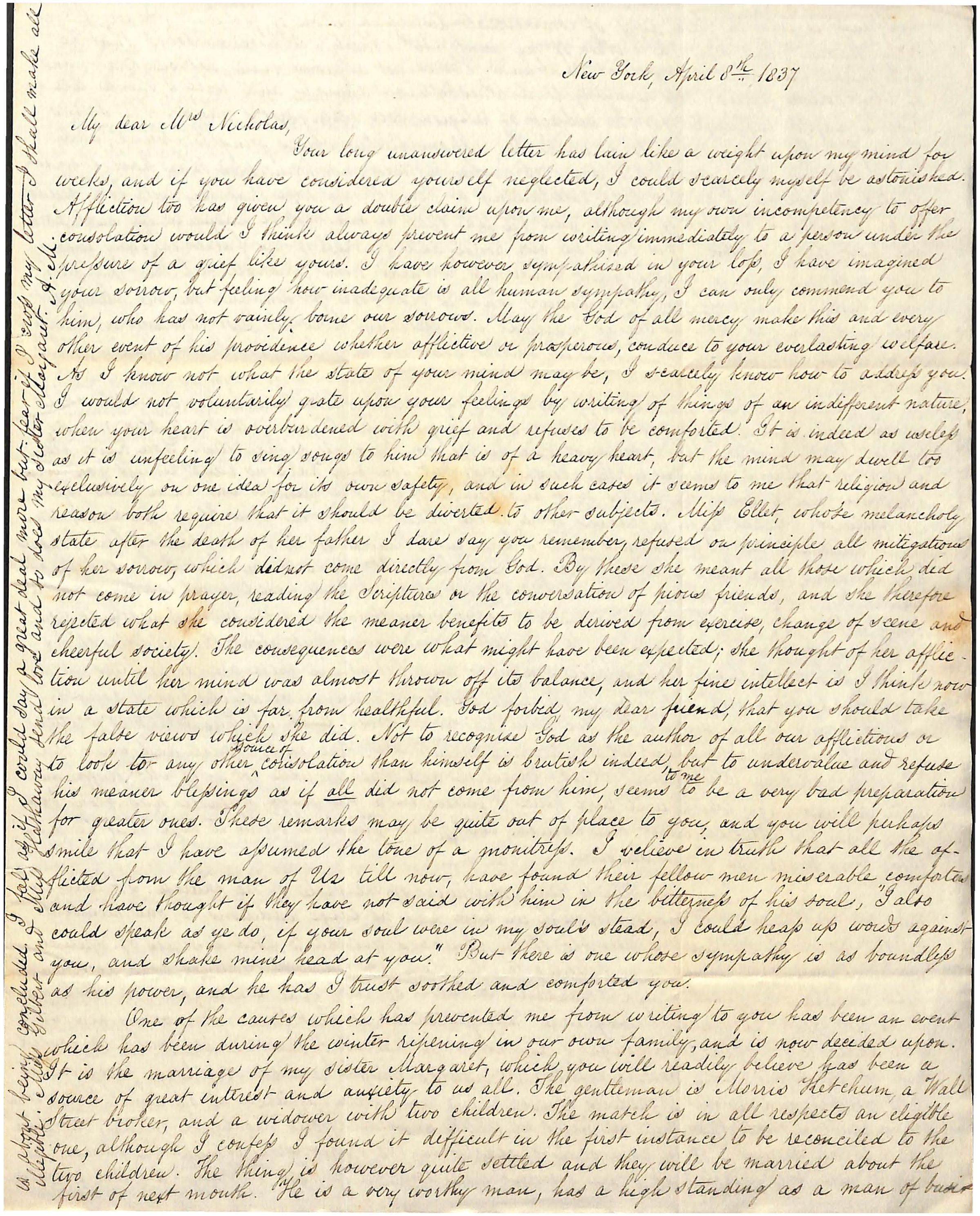
New York, April 8th 1837
My dear Mrs Nicholas,/
Your long unanswered letter has lain like a weight upon my mind for/ weeks, and if you have considered yourself neglected, I could scarcely myself be astonished./ Affliction too has given you a double claim upon me, although my own incompetence to offer/ consolidation would I think always prevent me from writing immediately to a person under the/ pressure of a grief like yours. I have however sympathized in you loss, I can only imagine/ your sorrow, but feeling how inadequate is all human sympathy, I can only commend you to/ him, who has not vainly borne our sorrows. May the God of all mercy make this and every/ other event of his providence whether afflictive or prosperous, conduce to your everlasting welfare./ As I know not what the state of your mind may be, I scarcely know how to address you./ I would not voluntarily grate upon your feelings by writing of things of an indifferent nature,/ when your heart is overburdened with grief and refused to be comforted. It is indeed as useless/ as it is unfeeling to sing songs to him that is of a heavy heart, but the mind may dwell too/ exclusively on one idea for its own safety, and in such cases it seems to me that religion and/ reason require that it should be diverted to other subjects. Miss [Ellis], whose melancholy/ state after the death of her father I dare say you remember, refused on principle all mitigation/ of her sorrow, which did not come directly from God. By these she meant all those which did/ not come in prayer, reading the Scriptures or the conversations of pious friends, and she therefore/ rejected what she considered the meaner benefits to be derived from exercise, change of scene and/ cheerful society. The consequences were what might have been expected; she thought of her afflict-/tion until her mind was almost thrown off its balance, and her fine intellect is I think now/ in state which is far from healthful. God forbid my dear friend, that you should take/ the false views she did. Not to recognize God as the author of all our afflictions or/ to look to any other [inserted: source of] consolation than himself is brutish in deed but to undervalue and refuse/ his meaner blessings as if all did not come from him, seems [inserted: to me] to be a very bad preparation/ for greater ones. These remarks may be quite out of place to you, and you will perhaps/ smile that I have assumed the tone of a monitress, I believe in truth that all the af-/flicted from the man of Us til now, have found their fellow men miserable comforters/ and have thought if they have not said with him in the bitterness of his soul, “I also/ could speak as ye do, if your soul were in my soul’s stead, I could heap up words against/ you, and shake mine head at you.” But there is one whose sympathy is as boundless/ as his power, and he has trust soothed and comforted you./
One of the causes which have prevented me from writing to you has been an event/ which has been during this winter ripening in our own family, and is now decided upon./ It is the marriage of my sister Margaret, which you will readily believe has been a/ source of great interest and anxiety to us all. The gentleman is Morris Ketchum, a Wall/ Street broker, and a widower with two children. The match is in all respects an eligible/ one, although I confess I found it difficult in the first instance to be reconciled to the/ two children. The thing is however quite settled and they will be married about the/ first of next month. He is a very worthy man, has a high standing as a man of busi-/
[END OF PAGE 1]
[PAGE 2]
ness, and is even in these days of commercial distress a man of fortune. As we have/ long known him, being a brother of my aunt Mrs [Akerly]. I have no doubt that he/ will make Margaret an excellent husband. He is not a pious man, although a man/ of very serious views goes regularly to a Presbyterian church, and will I think exer-/cise a happy influence on the subject of religion over Margarets mind. She seems/ herself to be deeply impressed with the responsibilities she is going to assume, and/ says that she feels deeply the want of higher motives and principles than have ever acc-/tuated her before. I cannot help entertaining a very stong hope that they will both decide to be Christians. The loss of Georgre and the fear that he may not be happy is the most pain-/ful part of the matter. His birth in our house, and the death of his father in his early infancy/ have given me feelings of great tenderness towards him. I shall feel the separation/ from him very severely, but God knows what is best both for him and for me. Margaret/ will leave home as soon as she is married. Mr Ketchum lives in East Broadway where/ he is has a fine house, but I hope in another year we may be nearer to her than we shall be at first./
The winter has passed away with us very agreeably. We have had very little cold/ weather and scarcely any snow. We have had no great fire to excite the public mind,/ but we have now an all-absorbing topic in the commercial difficulties. You have seen/ a great deal of it I dare say in the newspapers, but you can have no idea unless you were/ here how much everyone talks of it and thinks of it. The number and character of/ the failures, which have included some of the oldest houses in New York Produced con-/stant excitement and I sometimes wish I were in Illinois or in some place where I should/ hear no news, and have little time for reflection. It sees to me that I have been all/ winter busy about nothing. Elizabeth’s affairs which I had hoped would have been en-/tierly settled by this time are no nearer a conclusion that they ere when I wrote to you./ I have no received any answer to my letter, which was sent about the middle of De-/cember. I began to think their silence singular and feel afraid there are difficulties in the/ way. I addressed Mrs Robinson in the most courteous manner of which I was capable,/ and it seems to me uncivil [inserted: in her] to have returned no answer to it as Elizabeth has written/ to you, I suppose you know what her arrangements are. She and Spencer and your old/ Katy are still in Seventeenth Street. Elizabeth and Spencer will not go to Mr Hoffman’s/ until his marriage which will take place I believe in a few days. Spencer has been very/ regular in his attendance at our church lately, and Elizabeth seems to hope that he may before long make the great decision./
You will like to hear something of the state of the church. It certainly/ may be considered prosperous, although we have no large additions to our numbers./ In the month of February a number of the churches resolved to hold a series of special/ meetings, and our church was solicited to join them. A course of meetings was accordingly/ held similar in number and character to those of last year when you were with us./ I do not think [inserted: quit] as much feeling was manifested as at the time. Five or six persons/ were added to the church, although I am not sure that all of that number could be consid-/ered as the fruits of the special effort. Mr Ludlow’s church received very large accessions to/ their number, and in Mr Benedict’s church thirty nine were baptized at one time. There can/ be no doubt I think that there are times in which unusual efforts should be made, but there/ seems to me so much of an equivocal character in the spirit with which the church at-/tempts these enterprises, that I am growing more doubtful of their propriety. On this occasion/
[END OF PAGE 2]
[PAGE 3]
I do not think the church was quite unanimous in their approbation of the measure./ The grace of liberty has I think increased among us. You may remember that last year/ our Female Bible Association have collected $113 and at the same time $30 were collected for / the Tract Society. This year $113 have been collected for the Tract Society and the Bible / Association have collected $286 which are paid to the Board of Foreign Missions/ I do not know the amounts collected in the church for for other objects, but they are all much/ larger than ever before. A new plan for benevolent operations has lately been adopted, and/ is about to be carried into execution. It is to appropriate each month in the year to some special object, and to receive the contributions in a box placed in a convenient place situation. The design is to encourage a systemic and equitable plan of giving to the great in-/strumentalities of the day, and the plan has been found in some churches which have/ adopted it to be eminently successful and conducive to their spiritual good. The church/ debt of upwards of $300 was paid before the plan was suffered to go into effect. Mr Wil-/liams has not been of late very well. He has for three or four months past preached three/ times a day, making every afternoon at the prayer meeting an exposition of some portion of/ scripture equal in length and interest to any of his sermons. If he preservers in this of course/ I think he will before long dis-qulaify himself for preaching at all altogether. I understand that he/ will discontinue his afternoon lectures after he finished the 11th Hebrew of which he/ has been making a very interesting exposition, but I think if he were wise he would stop/ at once. His habits I believe are very much as they have always been, studious and reserved, al-/though I have heard it remarked that he was growing less shy than formerly. There/ are to be some changes in the church this Spring. Mrs Hewitt and her daughter are going to remove to Poughkeepsie. Dr Vanderpool is going to be married, not as/ I had always to Miss Gilbert, but to Miss Barnes a Methodist. The Doctor/ was the only young man in the church in whom I had felt much interest, although/ to say the truth, he was almost the only one I knew. I have lately become acquainted/ with Mr [Verbyck], a young artist, whom you may remember to have seen. He is quite/ an interesting young man, rather “melancholy and gentlemanlike”, plays with taste on the/ guitar and sings agreeably and is altogether quite a genius. He seems to be a young man/ of piety, although he has never interested himself much in the affairs of the church./ I delivered your message to Mr Williams and indeed read him a part of your letter./ He seemed pleased to hear from you and begged that when I wrote, I would commend/ him to you, and to the church which is in your house./
My brother Franklin has formed a partnership for the practice of the law in Vicksburg and would seem to have determined from this to remain/ there for the winters at least. We have only lately heard of it, and although I do not feel/ quite reconciled to it I am willing to think it is for the best. He says he feels it a great/ sacrifice to settle himself among a people of rude manners and equivocal morals/ as they are there, but seems to think it as present his best course. I should be very sorry to think/ his residence there would be very long. His health at present requires a warm/ climate and it is necessary for him to have occupation. My three brothers who are/ there will all leave Mississippi to come home about the first of June.
Dr. Macdonald has made up his mind to come to New York to live and is/ about resigning his situation at the Lunatic Asylum. It will be I have no donut a very/
[END OF PAGE 3]
[PAGE 4]
advantageous change for him, although a very great loss to the institution. He has acquired/ so high a reputation there, that he is sure of commanding a very large practice in the city./ His brother will of course be with him. His health is very much as it was when you/ left, and his helplessness equally great. I shall see more of him and I hope be more/ ready to influence him than in his present situation. They will probably not remove [to torow] however under three four months. /
Mr Payne has been frequent visitor at our house until within about six weeks past, during which time we have only seen him in church. I understand/ he has had all his front teeth taken out and is waiting to have them replaced before/ he will shew himself. He has confided to Eliza a manuscript which he has been writing/ As I have not seen it, I cannot pronounce an opinion, but Eliza did not think it/ very remarkable. It is a fictitious narrative, without much incident and embodying I suspect/ his own thoughts and feelings. He says the original of many of the thoughts was bor-/rowed from Mr Williams’ sermons. I do not know whether he ever intends to publish it./
Eliza bids me say that she has long been in expectation of Emma’s letter, and intends/ before long to write herself. I can very readily imagine that it has been no easy matter/ for either of you to write this winter. Although not laboring under disadvantages/ of the same kind I have found it difficult myself this winter to find leisure for such/ purposes. I have been very constantly employed, although as I have already told you/ I fear not to great purpose. One undertaking in which I have embarked seems now/ likely to become useful. It is a projected Asylum for coloured orphan children. Funds/ have been raised which will justify the purchase of a house and a contract for one/
[END OF PAGE 4]
[MARGIN OF PAGE 1]
is about being concluded. I feel as if I could day a great deal more but fear if I cross my letter I shall make all illegible. Miss Gilbert and Miss Hathaway send love and so does my sister Margaret.
M.
[MARGIN OF PAGE 2]
Mr George Doughlass is to be married to a poor [Seaton] girl not quite fifteen. The family are in a rage.
[END OF LETTER]Transcriber
Tara R. IacobellisLanguage
English