Fishhook / Hameçon
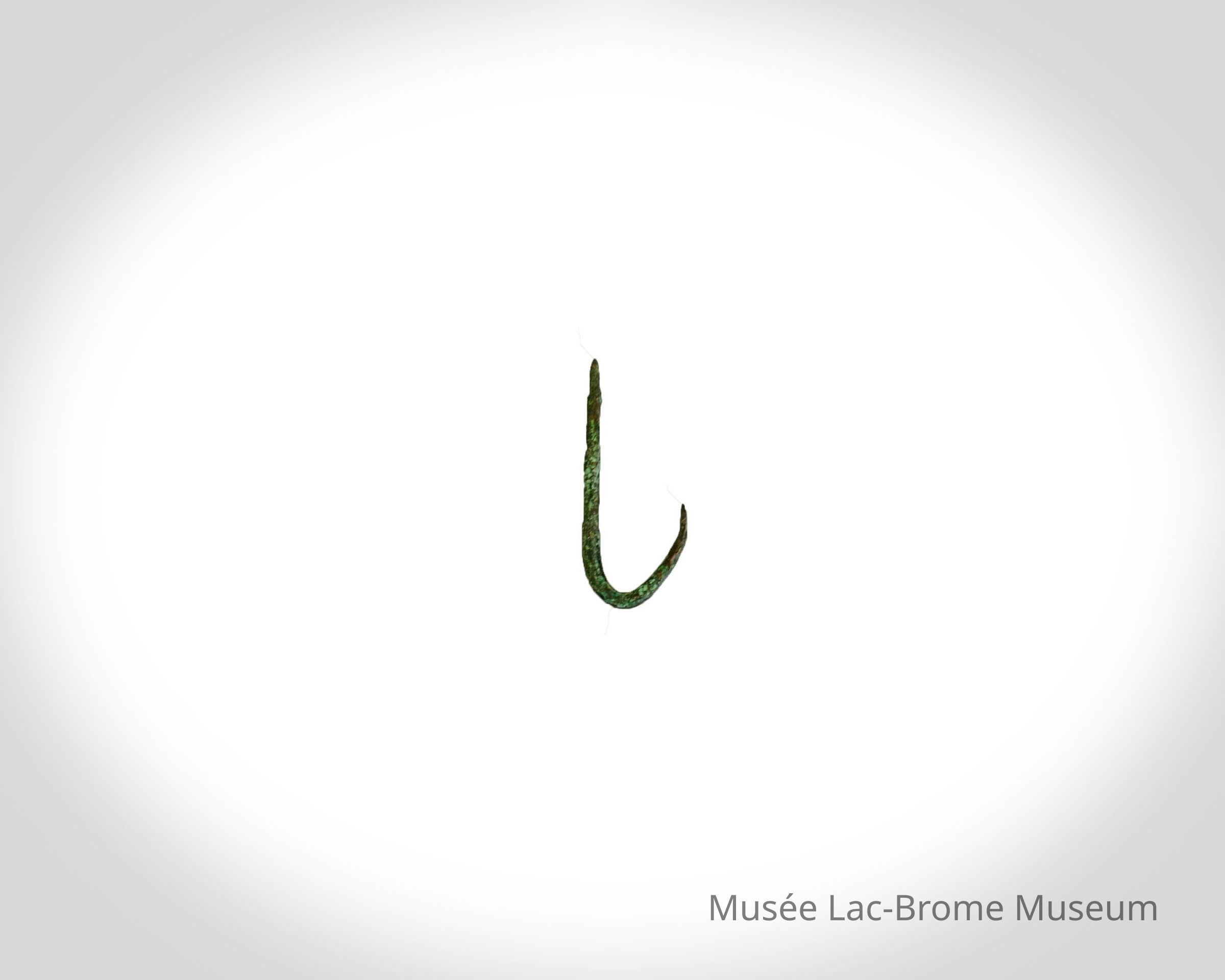
The image shows a greenish metal hook centred on a plain, white background. / L'image montre un hameçon métallique verdâtre centré sur un fond blanc uni.
Name/Title
Fishhook / HameçonEntry/Object ID
328.1Description
A short black copper fishhook with a slight bend on the lower tip. The fishhook has blue-green patches across the surface. / Un hameçon court en cuivre noir avec une légère courbure sur la pointe inférieure. L'hameçon présente des taches bleu-vert à la surface.Context
Found on Round Island in Lake Memphremagog along with a copper-edged weapon, this fishing hook was most likely used by Abenaki individuals to fish in the lake. The Abenaki do not have a history of copper production; it is therefore believed that this hook was traded from another area in North America. Similar fishhooks have been found in New Brunswick, Maine, the Outaouais River, and the Great Lakes region. It is therefore theorized that the fishhook came from one of those regions. Research shows that North American Indigenous peoples began mining copper around 9,500 years ago. However, the process was labour-intensive and did not significantly improve upon the tools made from more widely available materials. The practice was therefore mostly stopped around 3000 years ago. - - - - Retrouvé sur l'île Ronde, dans le lac Memphrémagog, en même temps qu'une arme en cuivre, cet hameçon était probablement utilisé par les Abénaquis pour pêcher dans le lac. Les Abénaquis n'ont pas d'histoire de production de cuivre ; nous pensons donc que cet hameçon a été échangé à partir d'une autre région d'Amérique du Nord. Des hameçons similaires ont été trouvés au Nouveau-Brunswick, au Maine, dans la rivière Outaouais et dans la région des Grands Lacs. On suppose donc que l'hameçon provient de l'une de ces régions. Les recherches montrent que les peuples autochtones d'Amérique du Nord ont commencé à extraire du cuivre il y a environ 9 500 ans. Toutefois, ce procédé nécessitait beaucoup de main-d'œuvre et n'apportait pas d'améliorations significatives par rapport aux outils fabriqués à partir de matériaux plus répandus. Cette pratique a donc été abandonnée il y a environ 3 000 ans.Collection
IndigenousCategory
Fishing Equipment
Acquisition
Accession
328Made/Created
Time Period
Pre-Contact / Pré-contactEthnography
Culture/Tribe
Abenaki / Abénaquis
Algonquin, First Nation / Première Nation