Name/Title
Suturing the CityDescription
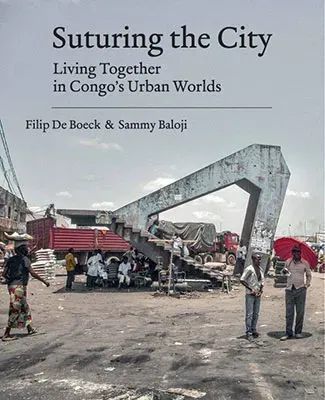
Suturing the City is a hybrid object whose production is worth reflecting upon. On the one hand, it is an art book, published by the Arts Council-supported Autograph ABP in London, which had earlier exhibited some of Baloji's photographs. The Imane Farès Gallery in Paris, which represents Baloji, also contributed financially to what was no doubt an expensive volume to produce. Further support was received from the Wiels contemporary arts centre in Brussels, which exhibited De Boeck and Baloji's Urban Now: city life in Congo in 2016, which subsequently toured to Portugal and Canada. Yet it is also an academic monograph; the text by De Boeck is by turns theoretical, autobiographical, historical, reflective and poetic. The anthropologist needed to remove himself from departmental life for a two-month writing retreat in Lisbon to shape most of the book, a decision that also seems to have led to a neighbour offering to help edit the emerging manuscript. Research funding from the University of Leuven under the umbrella of a larger project on satellite cities in Africa appears to have enabled joint research visits by the authors to Kinshasa and Lubumbashi, ending in 2015. And then there is the contribution of Congolese people to the research, a Congolese professor, a long-term assistant and their family members. Ordinarily, disciplinary and commercial forces act to keep these distinct areas of activity separate; the art gallery will occasionally bring in academics to write forewords, give commentaries, and chair discussions at openings. And the academic journal or book will occasionally critique the work of practitioners such as Baloji, and the historical and visual contexts within which they perceive they are embedded. Collaborations between anthropologists and visual artists are, of course, not unheard of, and there are some good examples around, but I do not know of one as successful as this in book form. Partly this success is due to the multiple agency support outlined above, but when you dig down into the book you realize that it transpired only as a result of a shared research agenda, a joint investigation that emerged from the field and that was shaped there, in collaboration with the community and their urban environment. The interplay between Baloji's visual enquiry and De Boeck's ethnographic description is intensely satisfying and enriching, and also does something else very important – far from characterizing those struggling to live in Congo's cities as victims on the fringes of modernity, the photographs allow people's dignity and creativity to shine through in a way that anthropology is sometimes ill equipped to do.Book Details
Author
Filip De Boeck, Sammy Baloji