Name/Title
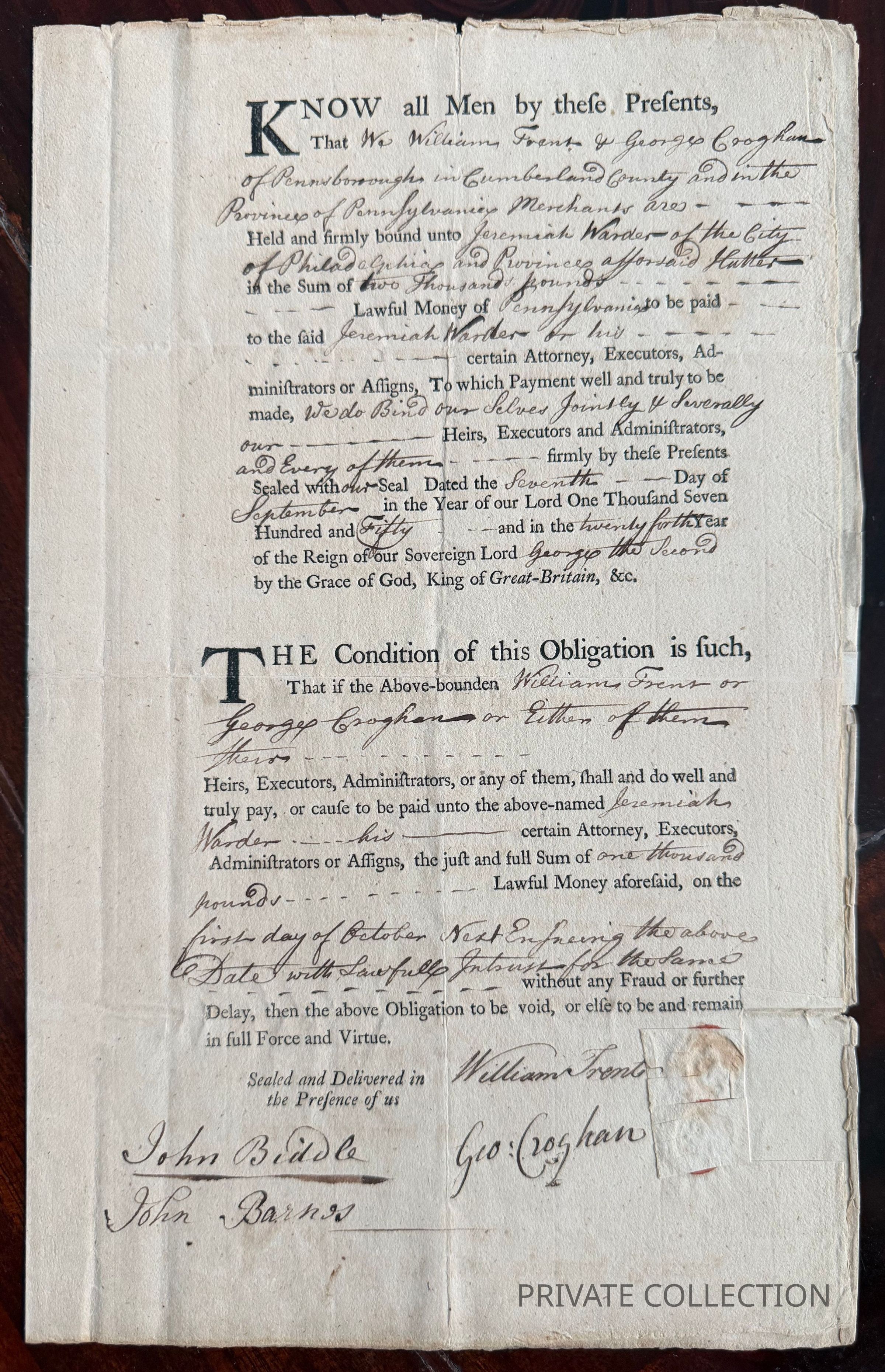
(FRANKLIN IMPRINT). Know all Men by these Presents That [William Trent & George CroghanDescription
(FRANKLIN IMPRINT). Know all Men by these Presents That
[William Trent & George Croghan of Pennsborough in Cumberland
County and in the Province of Pennsylvania Merchants are] Held and
firmly bound unto [Jeremiah Warder of the City of Philadelphia &
Province aforesaid Hatters] in the Sum of [Five Thousand & Seven
pound Six shillings] Lawful Money of [Pennsylvania] to be paid to
the said [Jeremiah Warder or his] certain Attorney, Executors,
Administrators or Assigns, To which Payment well and truly to be
made, [We do Bind ourselves Jointly & Severally our] Heirs,
Executors and Administrators, [and Every of them] firmly by these
Presents Sealed with [our] Sea. Dated the [Seventh] Day of
[September[ in the year of our Lord One Thousand Seven Hundred and
[Fifty] and in the [24th] Year of the Reign of our Sovereign Lord
George the Second by the Grace of God, King of Great-Britain, &c..
Similar to Miller 10 (Variant).
Though this lacks an imprint, it is clearly the work of Franklin's press.
This is a bond and judgment in which
William Trent and George Croghan promise to pay £2000
to Jeremiah Warder by 1 October 1751. It is signed and
sealed by Trent and Croghan and witnessed by John Biddle and John
Barnes, and docketed on the back.
William Trent (1715-1787) was a
Philadelphia fur trader and merchant. He was commissioned as a
captain of the Virginia Regiment in the early stages of the French
and Indian War, when he served on the western frontier with the
young Lt. Colonel George Washington. Trent led an advance group who
built forts and improved roads for troop access and defense of the
western territory. He was later promoted to the rank of major. In
1744, Trent purchased vast lands in the Ohio country west of the
Appalachians. From then through the 1780s, he was a key figure in
encouraging westward expansion by Anglo-American settlers past the
Appalachians, as he wanted to sell his land in parcels for
development. William Trent along with twenty-two other fur traders
formed a group in 1763 that was known as the Indian Company.
Because of the losses the Indian Company members experienced in the
French and Indian War, they were seeking land grants. During this
time, Trent's longtime friend and previous business partner, George
Croghan, decided to embark on a journey to London and present the
Indian Company's case. While Croghan was in England asking for
reparations on behalf of the Indian Company, Trent immediately
began concerning himself with new business endeavors in hopes to
regain the fortune he lost during the French and Indian War. In
December of 1763, Trent began a partnership with John Baynton and
Samuel Wharton. Samuel, Baynton, and Wharton were all equally
interested in land speculation of 1,700 acres of Cumberland County
land.
George Croghan, (1720-1782), was a Philadelphia trader who
won the confidence of Indian tribes and negotiated numerous
treaties of friendship with them in behalf of the British
government. He was deeply involved in the beginnings of the French and Indian war and was with Washington at Fort Necessity. He worked to keep the Indians neutral during the
Revolution.
Jeremiah Warder (1711-1783) was a wealthy Philadelphia
merchant. John Biddle (1707-1789) moved with his brother William to
Philadelphia from Mount Hope, New Jersey, in the 1720s, becoming
the first of the Philadelphia Biddle family.Condition
Overall Condition
Very GoodDate Examined
Apr 1, 2026Notes
Printed broadside, 12-1/2 x 7-3/4 inches. Accomplished in manuscript, docketed on rear, wax seals. Very minor chipping, else very good.