Name/Title
BOERHAAVE, Hermann (1668–1738). Aphorismi de Cognoscendis et Curandis MorbisDescription
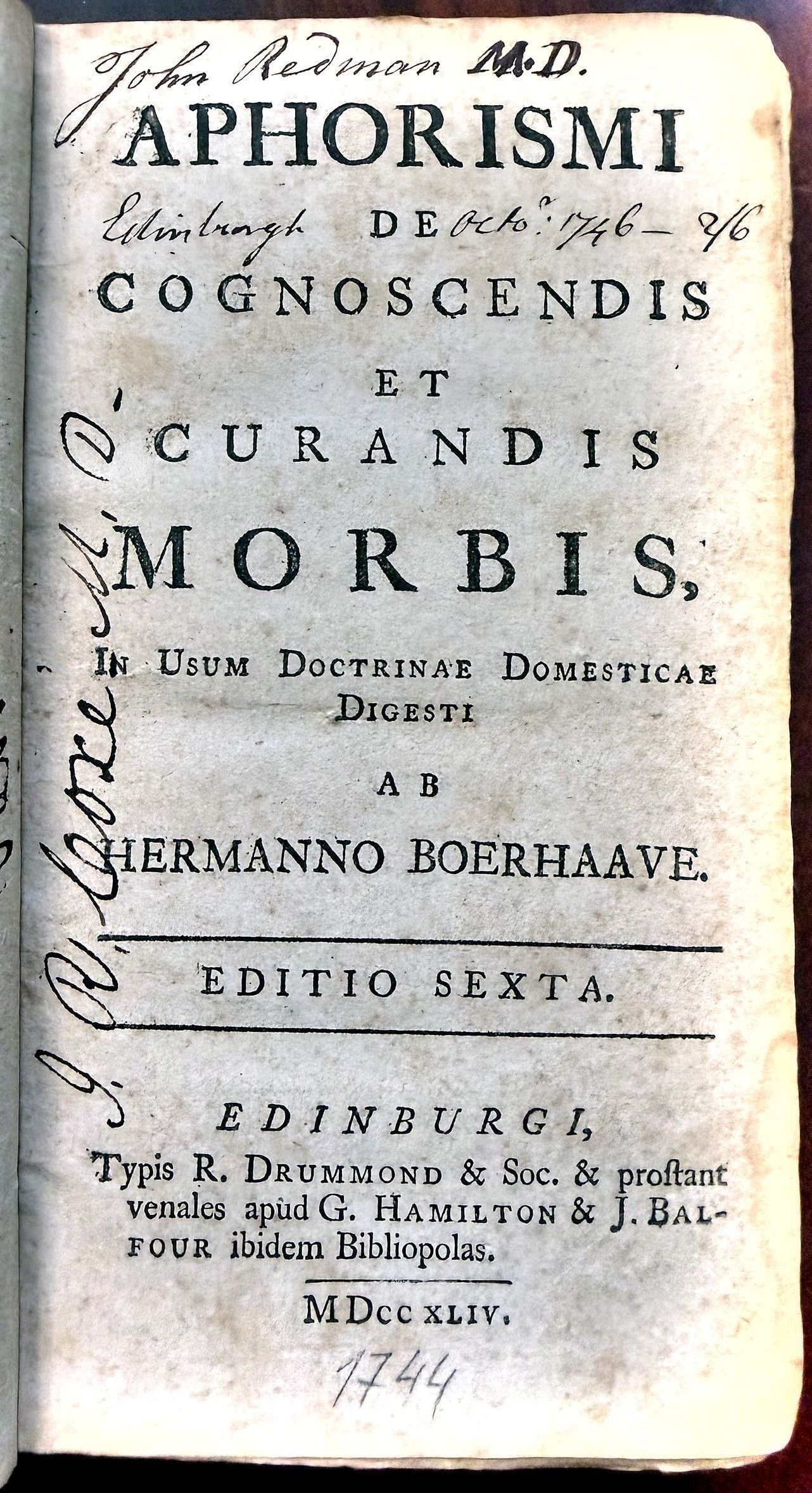
BOERHAAVE, Hermann (1668–1738). Aphorismi de Cognoscendis et Curandis Morbis, in Usum Doctrinae Domesticae Digesti. Editio sexta. Edinburgh: typis R. Drummond & Soc., and sold by G. Hamilton and J. Balfour, booksellers there, 1744.
John Redman's copy, signed and dated at Edinburgh in October 1746.
[Accession number to be assigned]
Inscribed at the head of the title in ink, "John Redman M.D.," and beneath the title, in the same hand, "Edinburgh Decr. Octor. 1746 — 2/6," recording the place, the month and the price he paid. A later pencil note repeats the date of the imprint.
Boerhaave's Aphorisms is the book on which the medicine of the eighteenth century was built. First published at Leiden in 1709, it compresses the whole of the diagnosis and treatment of disease into about fifteen hundred numbered propositions, arranged so that a student could carry the system in his head. Boerhaave taught it at Leiden to the men who founded the Edinburgh medical school, and Edinburgh taught it to the Americans. The line runs from Leiden to Edinburgh to Philadelphia, and this copy is a link in it that can be dated to the month.
John Redman (1722–1808) was apprenticed in Philadelphia to John Kearsley, practised for a time in Bermuda, and went abroad in the middle 1740s to complete his training. He was at Edinburgh when he bought this book and took his doctorate at Leiden in 1748, the town where Boerhaave had taught until his death ten years before. He returned to Philadelphia in 1751 and became the most influential preceptor of his generation. John Morgan, who founded the first American medical school, read with him. So did Caspar Wistar. So, from 1761 to 1766, did Benjamin Rush, who left Redman's shop for Edinburgh with a letter of introduction and came home to teach the system in a chair of his own.
The significance of this copy is that it is Redman's working Boerhaave, bought as a student and carried back to the Philadelphia consulting room where Rush served his five years. Whether Rush handled this particular volume cannot be proved. What can be said is that the book records, in Redman's hand and with a date, the exact point at which Boerhaave's system entered the library of the man who trained Rush in it.