Name/Title
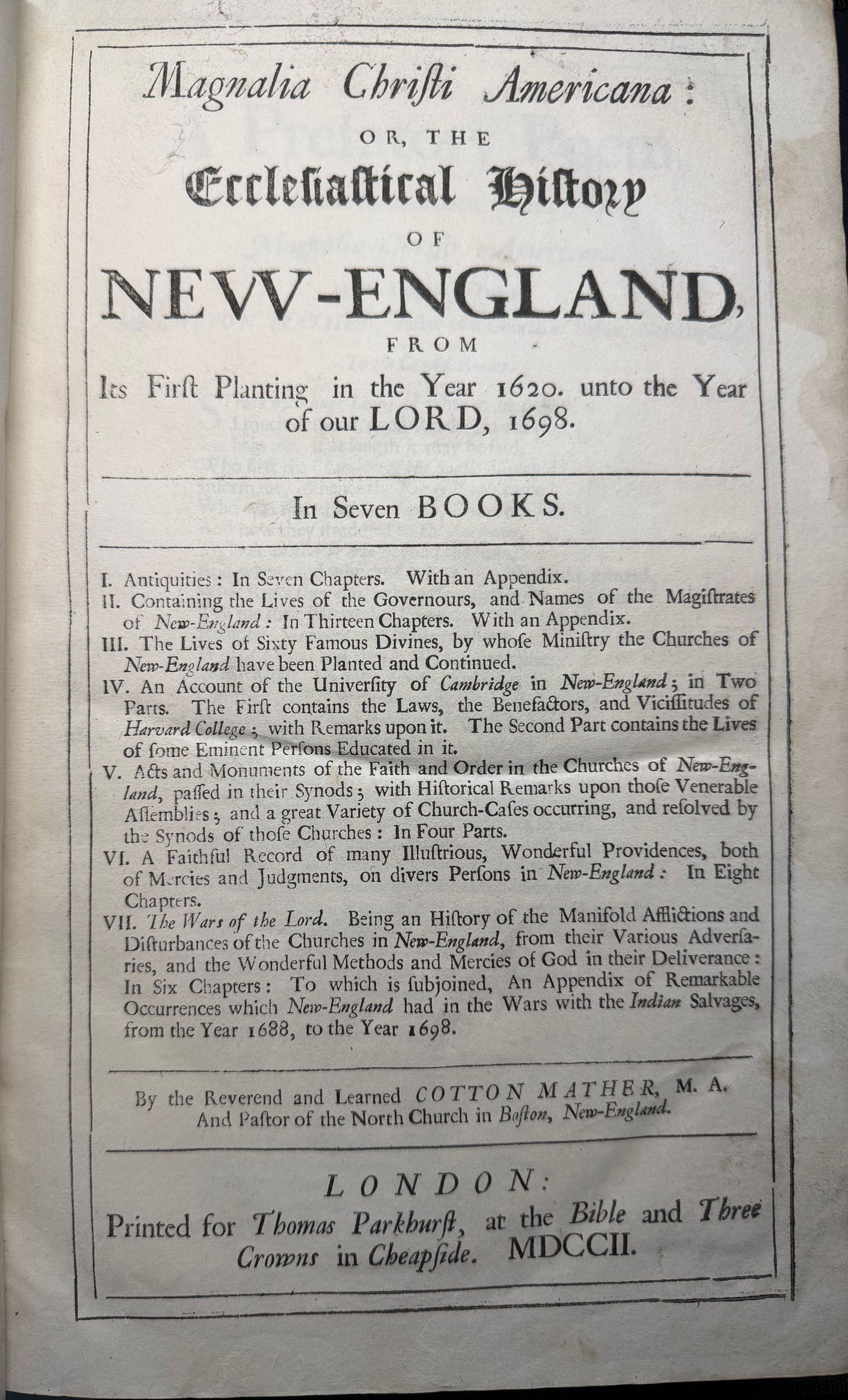
Mather, Cotton: MAGNALIA CHRISTI AMERICANADescription
London: Thomas Parkhurst, 1702.
Seven parts bound in one volume. [2],[30],38,[2],75,[2],238,[2],125-222,100,[2],88,118,[2]pp. including both variants of the two-page advertisement leaf, one bound among the preliminaries and one at the end of the text, plus double-page engraved map.
The first edition of what Streeter calls "the most famous American book of colonial times." Mather's opus is an indispensable source for the history of New England in the 17th century, both for its biographies and its history of civil, religious, and military affairs.
As Mather biographer Kenneth Silverman explains, the Magnalia, as published in the first London edition of 1702, “was unmistakably a grandly imagined and formidable work: about eight hundred folio pages of double columns, divided in seven substantial books - history of the settlement of New England; lives of the governors; lives of the leading ministers (the longest book); history of Harvard College, with the lives of eminent graduates; account of the New England manner of worship; ‘Remarkables of Divine Providence’; and a history of the invasion of the New England churches by heretics, Andros, devils, Indians, and others. Mather gathered this information industriously and from many sources: surviving diaries, letters, and other papers; his father’s correspondence; the manuscript histories of New England by William Hubbard and William Bradford; personal acquaintance with surviving members of the earlier generations, the sermon notebooks in which he had taken down their words firsthand, informants who had known them.”
Far from being a dull chronicle of events, the Magnalia is full of lively biographical pieces, vivid descriptions of the times, and many surprising sidelights. It has been mined by modern scholars for its unsurpassed view of New England at the end of the 17th century. As Silverman points out, the “enduring importance” of the book “lies in its sheer amassment of precious information about the early history of New England - about leaders in church and state, Puritan relations with the Indians, the development of Harvard, the 1689 revolt, the expeditions against Canada, the Salem trials.” The Magnalia is also significant as “a documentary history of early New England and a small anthology of early American poetry,” reproducing as it does a number of significant documents, including the various creeds and platforms of the New England churches, and preserving numerous examples of American elegies and verse, some of which until then had existed only in manuscript.
The map, which depicts New England, Long Island, and eastern New York, has been labeled by cartographic historian Barbara McCorkle as "[t]he first eighteenth-century general map of New England." It was probably adopted from "A New Map of New England. New York. New Iarsey. Pensilvania. Maryland. and Virginia," likely composed by Phillip Lea in 1680.
“...probably the best known book of colonial times” - GROLIER AMERICAN HUNDRED. “...the most ambitious (and the longest) book to be written by any New England colonist in the seventeenth century” - Fairbanks. “...one of the most influential books in American historiography” - Kraus.
A landmark in colonial New England history, and a book of increasing rarity, especially in nice condition.Other Names and Numbers
Other Numbers
Number Type
ReferencesOther Number
HOWES M391, "b." STREETER SALE 658. GROLIER AMERICAN 100, 6. EUROPEAN AMERICANA 702/127. HOLMES, COTTON MATHER 213. SABIN 46392. CHURCH 806. LARNED 3054. BRADFORD 3370. McCORKLE 702.3, 680.4 (ref). CUMMING, BRITISH MAPS OF COLONIAL AMERICA, pp.31-33. MapForum, PRINTED MAPS OF NEW ENGLAND TO 1780, 1702:01. SCHWARTZ & EHRENBERG, pp.133-34. Kenneth Silverman, The Life and Times of Cotton Mather (New York: Harper & Row, 1970), p.158. Jonathan L. Fairbanks and Robert F. Trent, eds., New England Begins: The Seventeenth Century, Vol. 2 (Boston: Museum of Fine Arts, 1982), p.152. Michael Kraus, The Writing of American History (Norman: Univ. of Oklahoma Press, 1953), p.36.Condition
Overall Condition
Very GoodDate Examined
Sep 24, 2026Notes
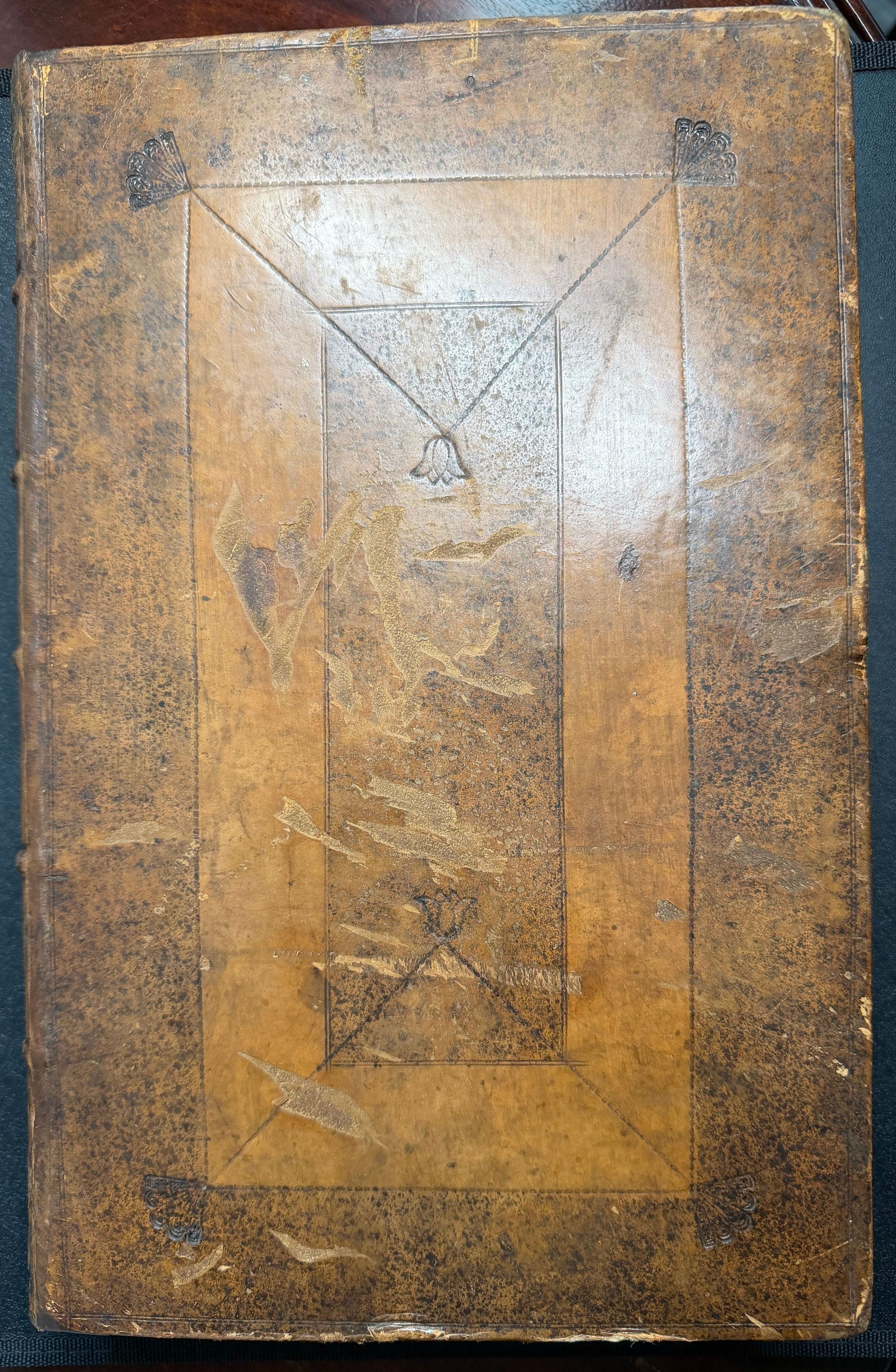
Text printed in double columns. Without errata leaves, as usual. Folio. Contemporary paneled calf, sprinkled, rebacked with original spine with raised bands and gilt leather label laid down, board edges ruled in gilt, edges sprinkled red. Binding rubbed and somewhat worn. Slightly later armorial bookplate and modern bookplate, both on front pastedown. Preliminary sections bound out of order, with six commendations in verse (leaves B1-B4, [6]pp.) and the attestation (A2-A4, 4pp.) inverted and ads (leaf A6, [2]pp.) and titlepage of first book (1 leaf, [2]pp.) bound between them. Minor soiling to text. Small hole in lower edge of leaf 4A1, affecting border of fourth book titlepage; small burn hole in outer edge of leaf 7K4, just touching text. Overall, a handsome copy, in a contemporary binding.