Name/Title
Pennsylvania Hospital. The Founders' Subscription Book of Promissory Notes, 1751-1754Description
1751-1754, with clerks' memoranda to April 1767
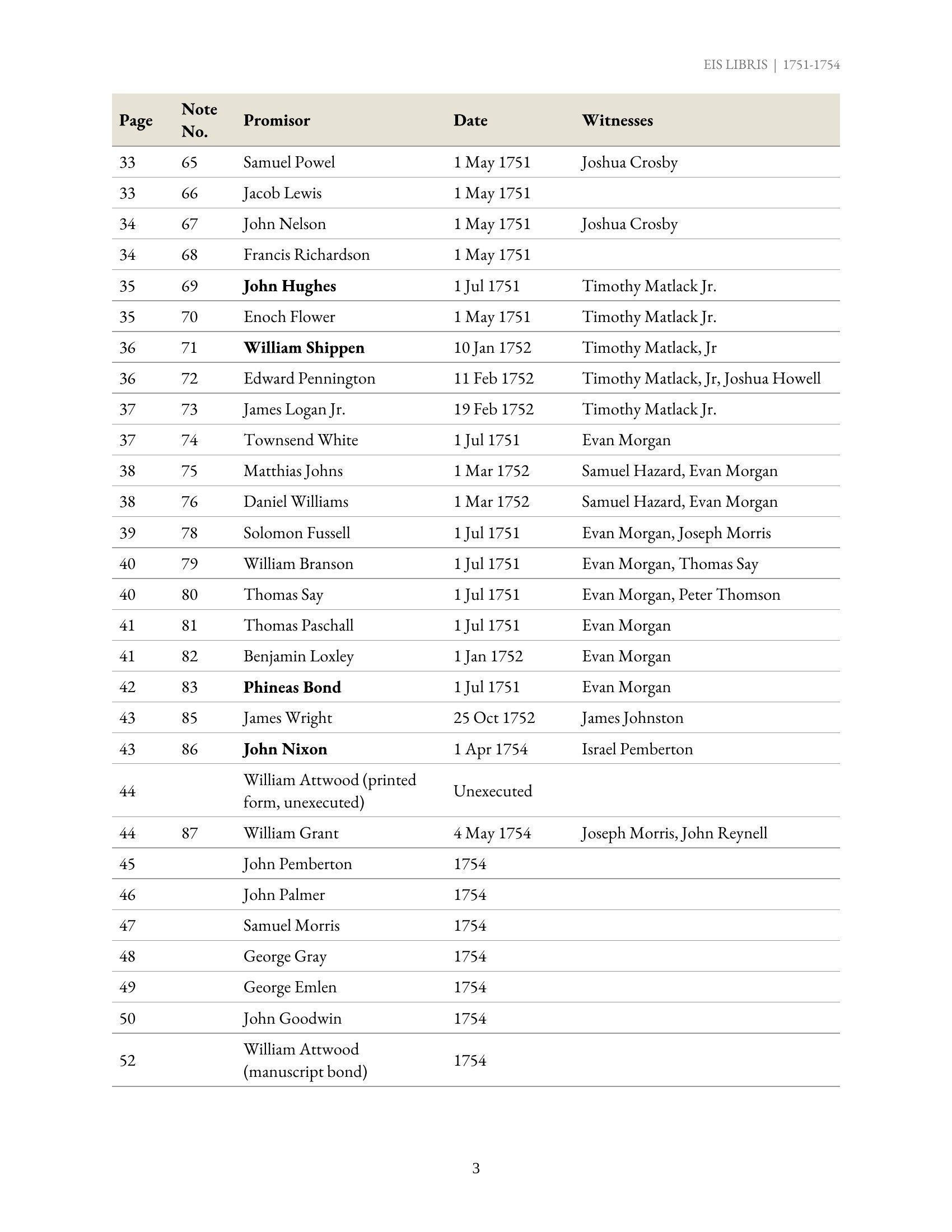
73 bonds on 42 numbered pages, two notes to a page: 65 printed notes numbered in the founding sequence of 87, one printed form made out to William Attwood but never signed, and seven manuscript bonds of 1754. Front matter of four manuscript leaves. Original front and back boards, both now detached. The front board is marked "#4" in pencil on the inside.
This is the first of the Treasurer's books of the Pennsylvania Hospital, the volume in which the founding subscription of 1751 was secured. Franklin's scheme for the Hospital turned on a conditional grant. The Assembly would give two thousand pounds if private citizens first pledged the same, and Franklin later called it the best of his political manoeuvres. Every pledge was taken as a debt. The subscriber signed a printed promissory note from Franklin and Hall's press, payable to the Treasurer with interest, before one or two witnesses, and the Treasurer bound the notes two to a page in the order they were signed.
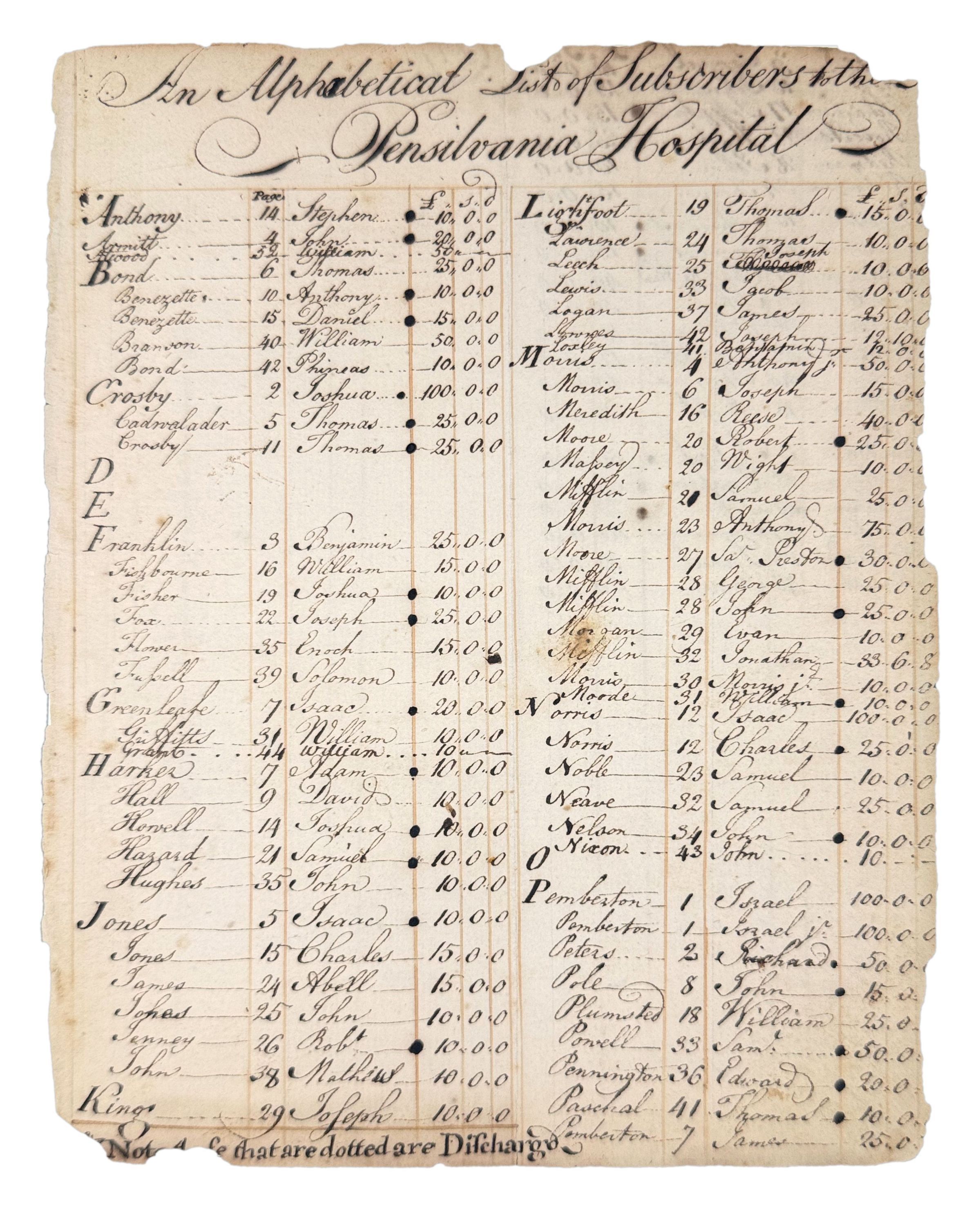
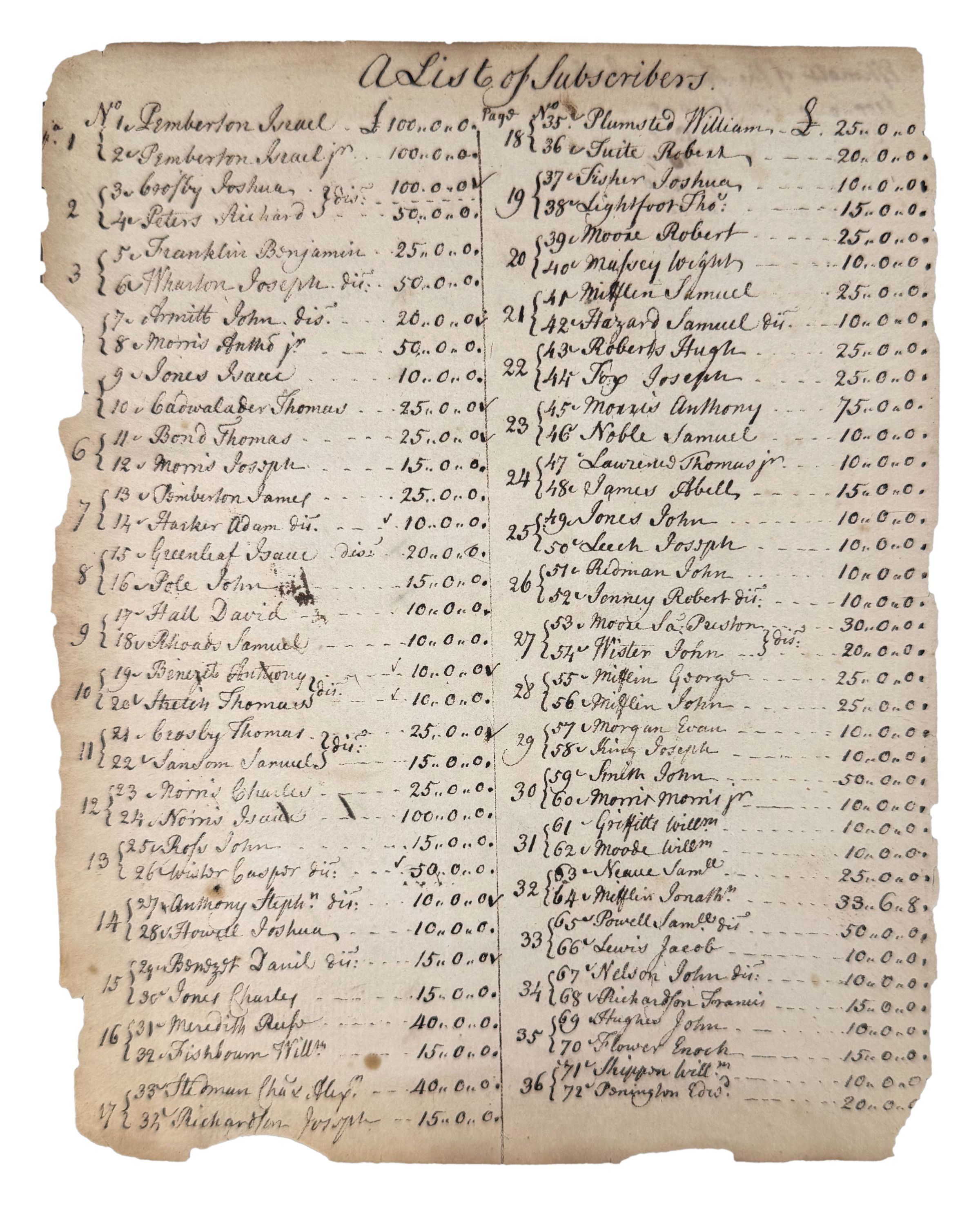
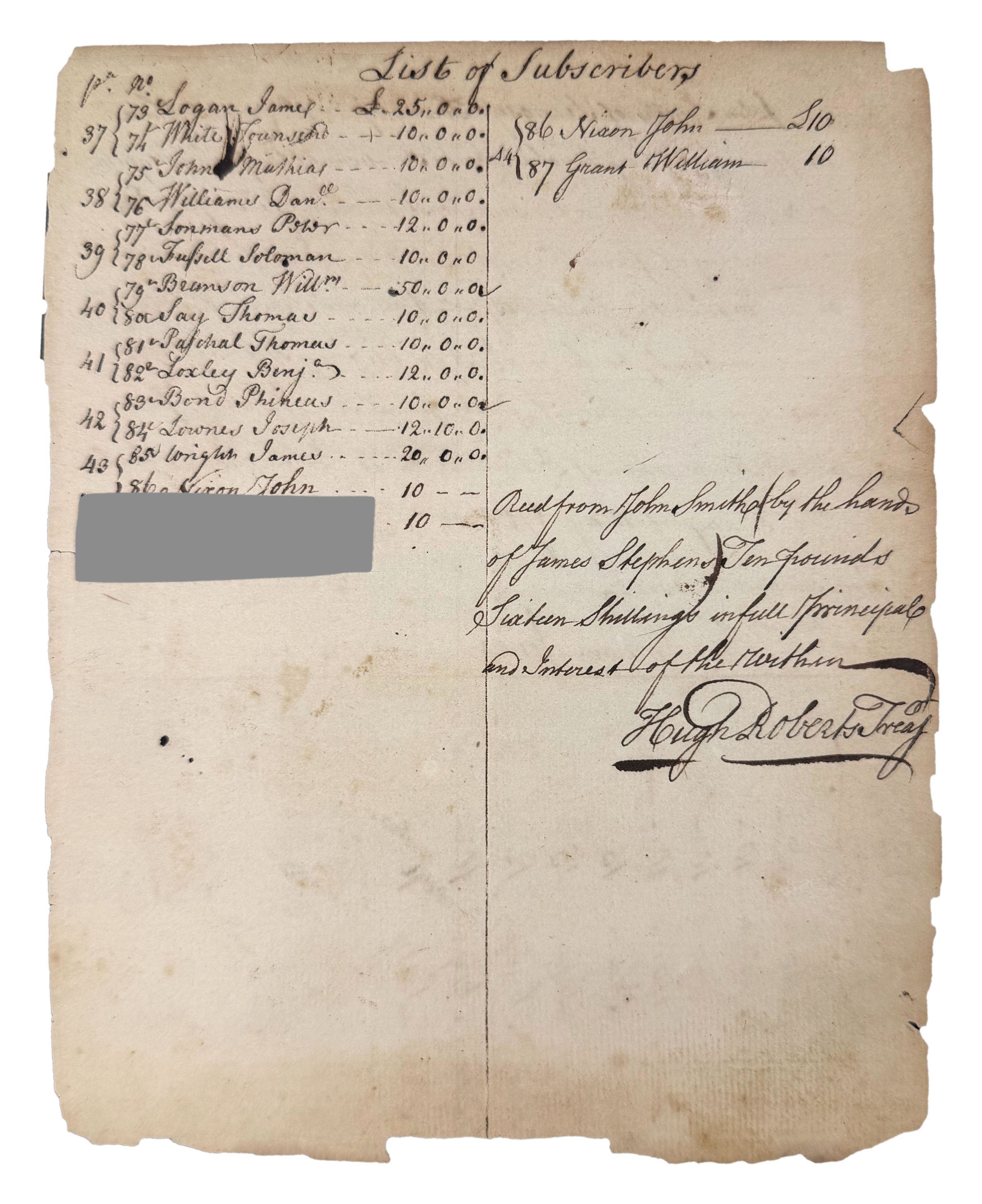
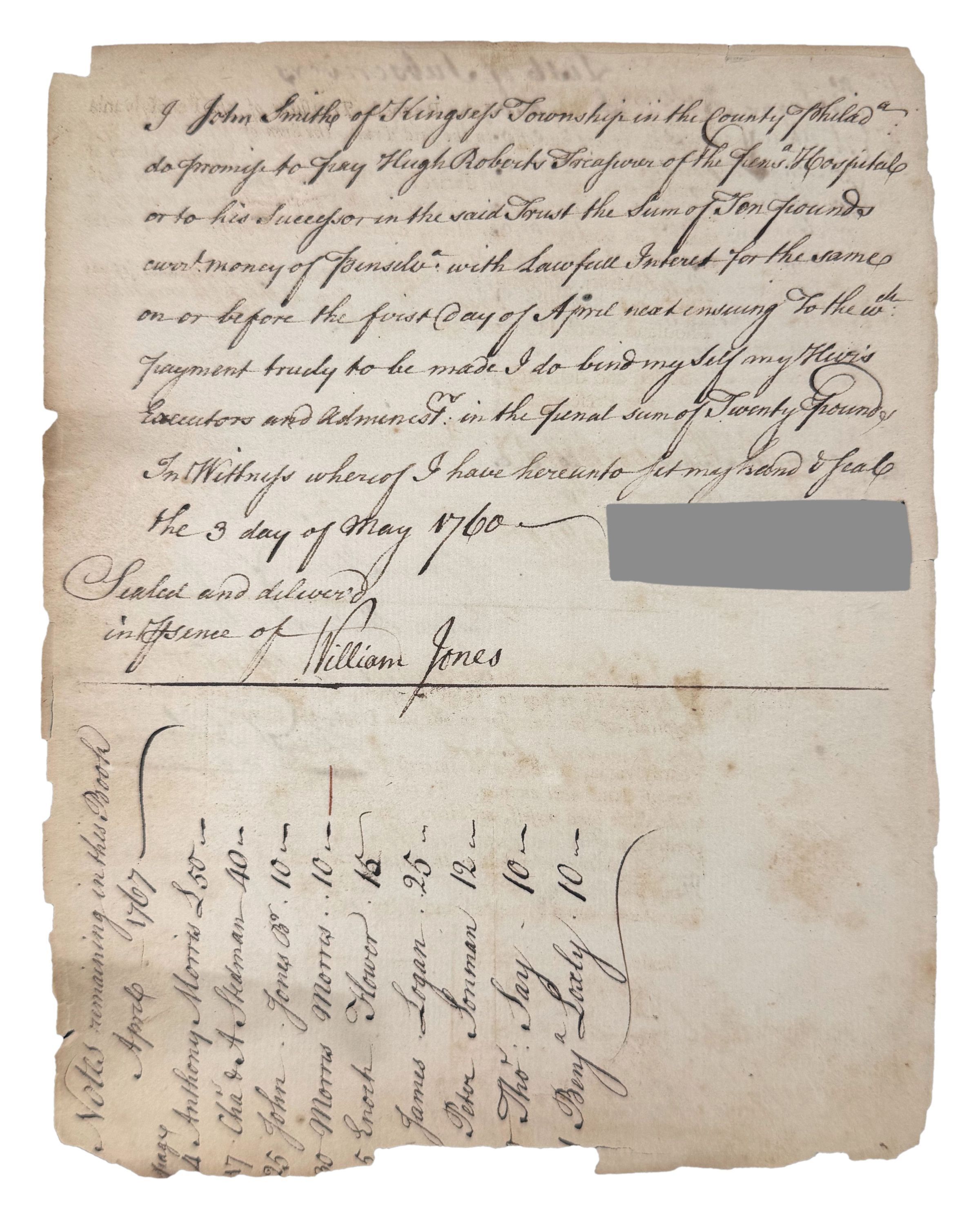
The volume opens with the clerk's finding aids. "An Alphabetical List of Subscribers to the Pensilvania Hospital" gives each man's surname, page and pledge, with heavy ink dots against the names whose bonds were paid, as a line at the foot explains: "Note, those that are dotted are Discharged." A second list in two leaves numbers the subscribers from 1 to 87 in the order of signing. Israel Pemberton is No. 1 at one hundred pounds, Joshua Crosby No. 3, Benjamin Franklin No. 5 on page 3 at twenty-five pounds, and Dr. Thomas Bond, whose idea the Hospital was, No. 11. The last leaf carries Hugh Roberts's signed receipt as Treasurer for ten pounds sixteen shillings from John Smith "by the hands of James Stephens." Its other side is the cancelled bond of John Smith of Kingsess, 3 May 1760, with the signature clipped away, which the clerk then turned sideways and reused for his memorandum "Notes remaining in this Book, April 1767," naming nine pledges still unpaid sixteen years after the founding.
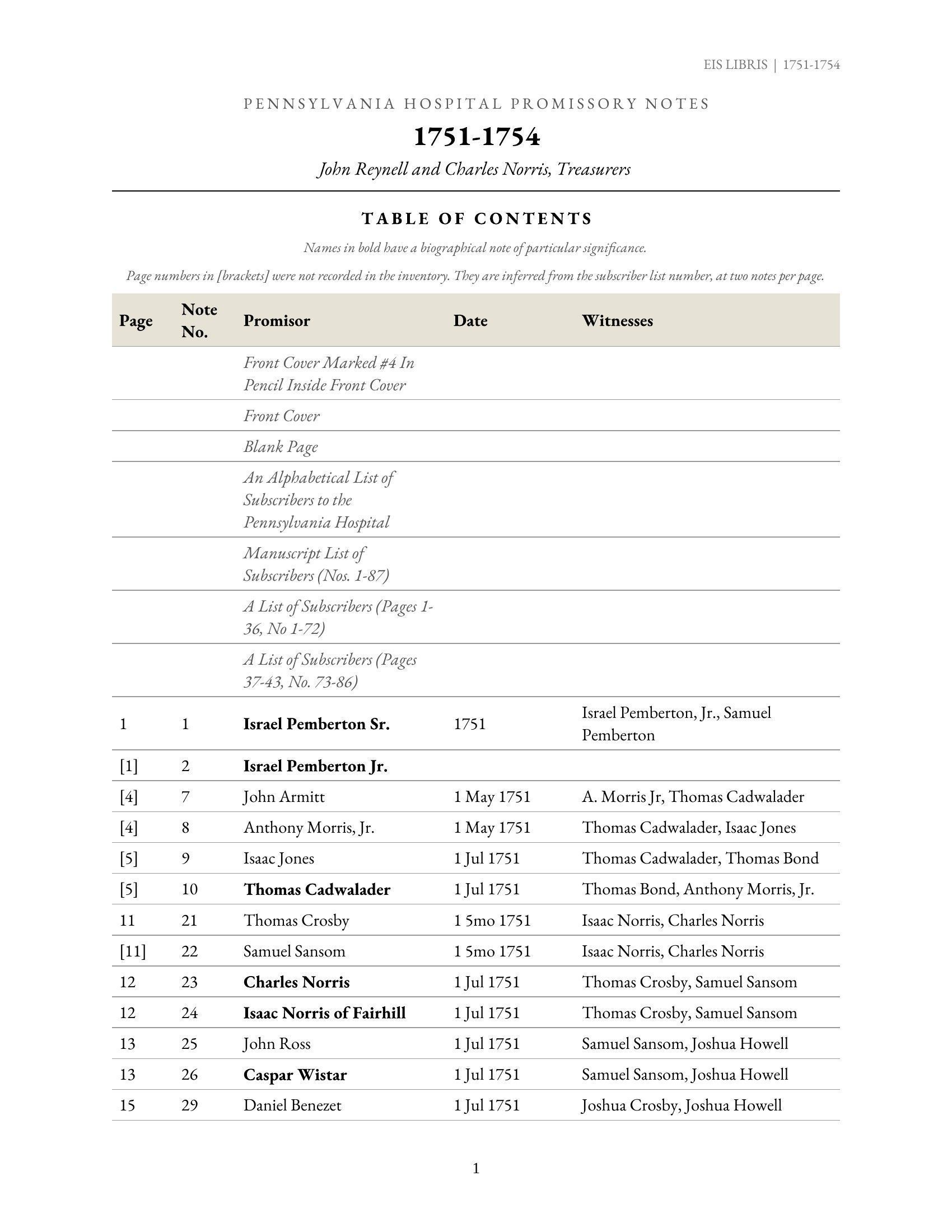
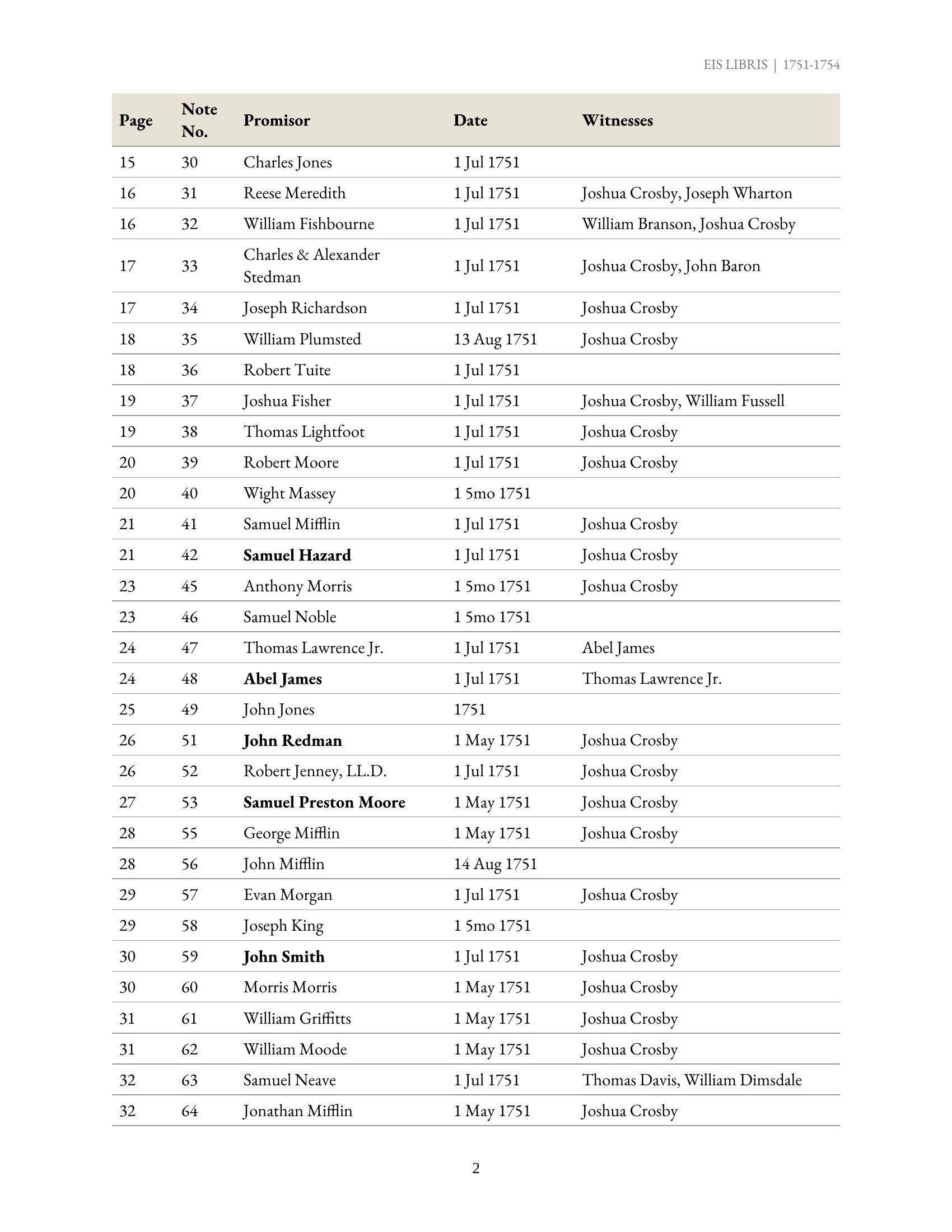
The notes of several of the first subscribers, Franklin's and Bond's among them, were removed from the volume long ago, and the lists are now the record of their place in it. What remains is an extraordinary survival, the founding bonds still gathered in the Treasurer's own volume: the Pembertons, the Norris brothers, Cadwalader, Redman, Phineas Bond, the elder Shippen, Caspar Wistar, Abel James, John Hughes, and some sixty more, many witnessed by the first Managers and several by the young Timothy Matlack, then an apprentice in the Treasurer's counting house.Other Names and Numbers
Other Numbers
Number Type
ReferencesOther Number
The printed form of 1751 is the earliest version and is not recorded in Miller. Franklin, Autobiography, Part Three, for the conditional grant. Some Account of the Pennsylvania Hospital (Philadelphia: Franklin and Hall, 1754).General Notes
Note Type
Cataloging NoteNote
NOTABLE NAMES
Israel Pemberton Sr. (1685-1754). No. 1. Quaker merchant and Assemblyman whose hundred pounds opened the subscription.
Israel Pemberton Jr. (1715-1779). No. 2. "King of the Quakers," original Manager with Franklin, exiled to Virginia in 1777.
Thomas Cadwalader (c. 1707-1779). No. 10. Physician, original Library Company director, author of the Essay on the West-India Dry-Gripes printed by Franklin in 1745.
Charles Norris (1712-1766). No. 23. Original Manager and second Treasurer of the Hospital.
Isaac Norris of Fairhill (1701-1766). No. 24. Speaker of the Assembly, Franklin's ally and fellow commissioner at Albany. His library went to Rush's Dickinson College.
Caspar Wistar (1696-1752). No. 26. Founder of the Wistarburgh glassworks, which supplied Franklin's electrical tubes. Grandfather of Dr. Caspar Wistar.
Samuel Hazard (1714-1758). No. 42. Original Manager. Father of Ebenezer Hazard, Rush's lifelong friend.
Abel James (c. 1724-1790). No. 48. The merchant whose letter urging Franklin to continue his memoirs opens Part Two of the Autobiography.
John Redman (1722-1808). No. 51. Hospital physician, first President of the College of Physicians, and the master under whom Rush served his apprenticeship.
Samuel Preston Moore (1710-1785). No. 53. Consulting physician, Provincial Treasurer, later Treasurer of the Hospital.
John Smith (1722-1771). No. 59. Original Manager, diarist, and with Franklin a founder of the Philadelphia Contributionship.
John Hughes (c. 1712-1772). No. 69. Franklin's political lieutenant, ruined as Stamp Distributor in 1765.
William Shippen the elder (1712-1801). No. 71. Hospital physician and member of Congress. Father of Rush's great adversary.
Phineas Bond (1717-1773). No. 83. Brother of the founder and one of the three original attending physicians.
John Nixon (1733-1808). No. 86. Gave the Declaration of Independence its first public reading, 8 July 1776.
RELATED RECORDS
Eleven notes from this volume are catalogued separately and are listed in the table of contents at their original pages: Nos. 2 and 60 (BF-2023.032) and Nos. 7, 8, 9, 10, 51, 53, 71, 72 and 83 (BF-2023.051).