Name/Title
To Double or Not To DoubleDescription
This remarkable article is the first full-length piece to address doubling strategy. John Longacre begins by criticizing Georges Mabardi’s rejection of doubling as a meaningful addition to the game. He thinks Mabardi is wrong to declare that backgammon knowledge is “finite” and that “two experts will never disagree,” arguing instead that much of backgammon is unknowable and since the best any player can attempt is an “approximate estimate” of a position, there is plenty of room for disagreement. And yet he stops short of affirming that there are positions that can be both proper doubles and proper takes.
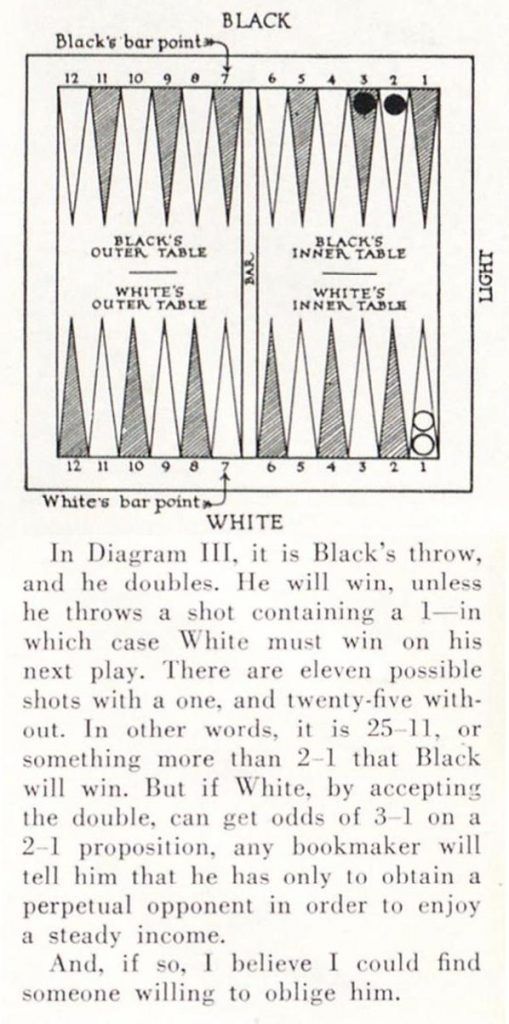
Worse, he revisits the “fallacious theory” that a player being doubled enjoys 3-to-1 odds topic (which he had ridiculed nine months earlier, in 'Backgammon of Today.' Not only does he double down on his opinion, he closes the article with a classic illustration of the theory (see below) and smugly puts it out there that he’ll happily play it out for money.
It seems remarkable that Longacre could have persisted so long in confusion over this crucial principle, when he must have been in regular competition and discussion with the “many first rate players” who adopted this “school of thought” about doubling. While Longacre is in dialogue with Mabardi in this article, he does not mention Walter Richard’s book, which had come out a month or so earlier and asserts the validity 3-to-1 principle with authority.
One wonders whether he got any takers — the position is worth only .778.Publication Details
Periodical
Vanity FairPeriodical Type
MagazineTime Period
Modern BackgammonOther Names and Numbers
Other Numbers
Number Type
SequenceOther Number
1931_07