Grosvenor Nicholas
Full Name
Grosvenor NicholasRole
AuthorPerson Description
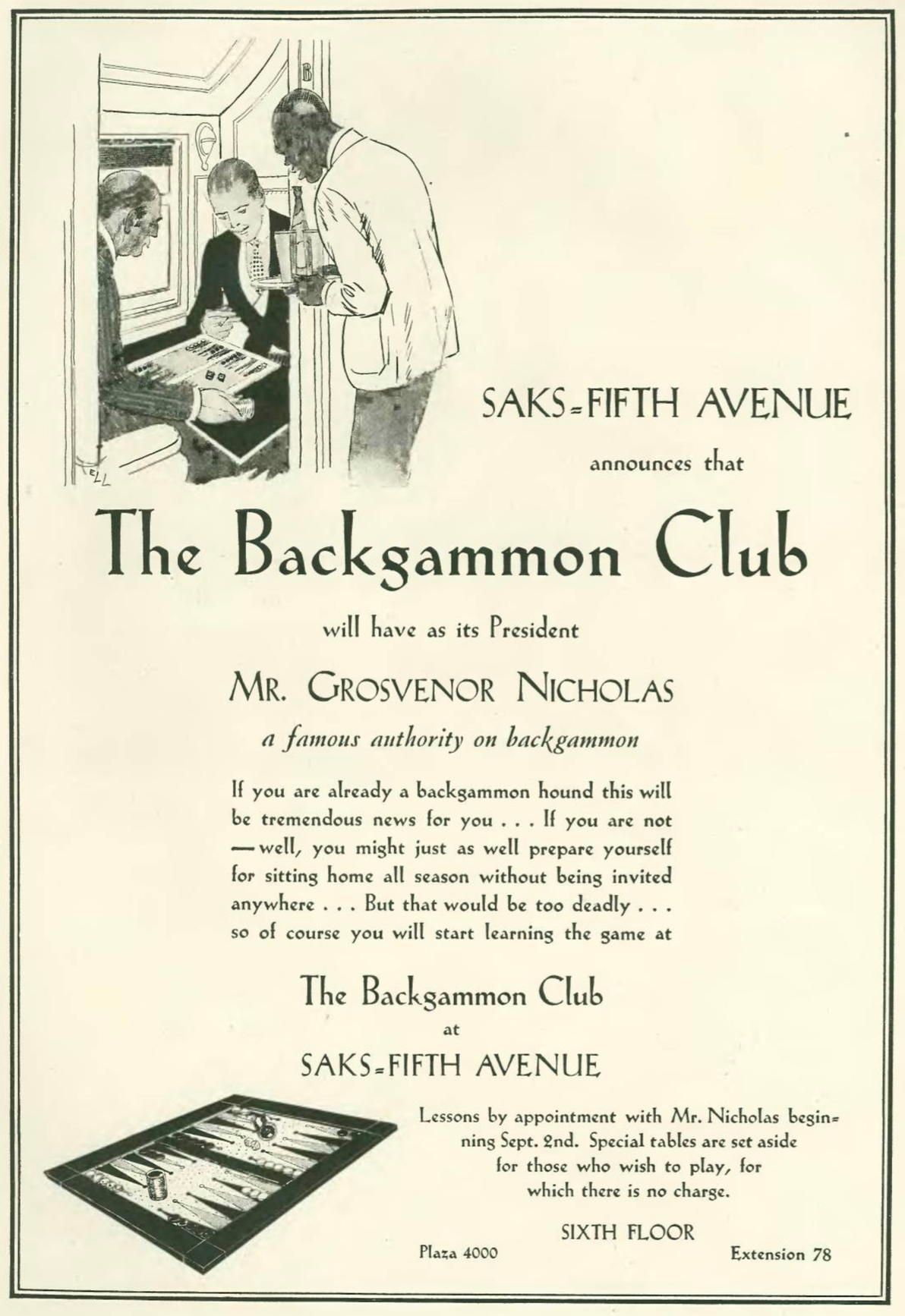
The role of Grosvenor Nicholas in the popularization of backgammon in the 20th century is probably greater than any other individual apart from Alexis Obolensky appeared in the 1960's. His 1928 book 'Modern Backgammon' was the first new material written about the game since the standard treatments by Hoyle and others in the mid 1800's, and was published two years ahead of the many books that would follow in 1930-31. Nicholas' book introduced the two great innovations that would revolutionize the game for a new generation: the practice of doubling, and the multi-player version of the game known as 'chouette.' The former transformed what had been a fairly sleepy game into a thrilling gambling contest, and the latter added a dimension of social dynamism perfectly suited to the club rooms and dinner parties, where participants might come and go, and enjoy conversation between turns in the player's chair. In early 1930, Nicholas' book earned a second release, and sometime in the spring he appears to have been the one to introduce the device we call the doubling cube, which became metonymous for doubling itself. So while Nicholas did not invent doubling, he did literally invent "the cube" to take the place of match sticks or other means of tracking the doubling value. In late October of the same year, he published his second book, in collaboration with C. Wheaton Vaughan, 'Winning Backgammon'. Another notable first, it is the prototype of the "problem book," later exemplified by Joe Dwek's 'Backgammon for Profit' (1975) and many others to follow. 'Winning Backgammon' also includes a revised version of “The Authorized Rules for Modern Backgammon,” and Nicholas would serve on the committee that ultimately codified the rules of modern backgammon in 'The Laws of Backgammon' (1931) by agreement among 23 exclusive clubs who regularly competed at the game. It seems likely, but not certain, that backgammon's Grosvenor Nicholas was the scion of wealthy New York liquor importer George Nicholas, who had disinherited his son after he left his father's business and opened a competing importing company in the city. Nicholas appealed the terms of his father's will but his siblings prevailed in a state supreme court hearing. This Grosvenor Nicholas does not otherwise appear in the news until brief notices of his death appear in 1955 newspapers, in which only his liquor business is mentioned. In a grim coda to the family story, his son, Grosvenor Nicholas Jr., died by leaping from the top of the Winslow Hotel in New York seven years later. -- but again, it has not been definitively shown that this is the same Grosvenor Nicholas.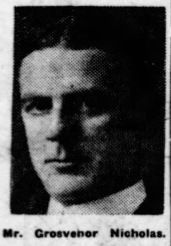
Evening Standard, London, May 5th, 1931