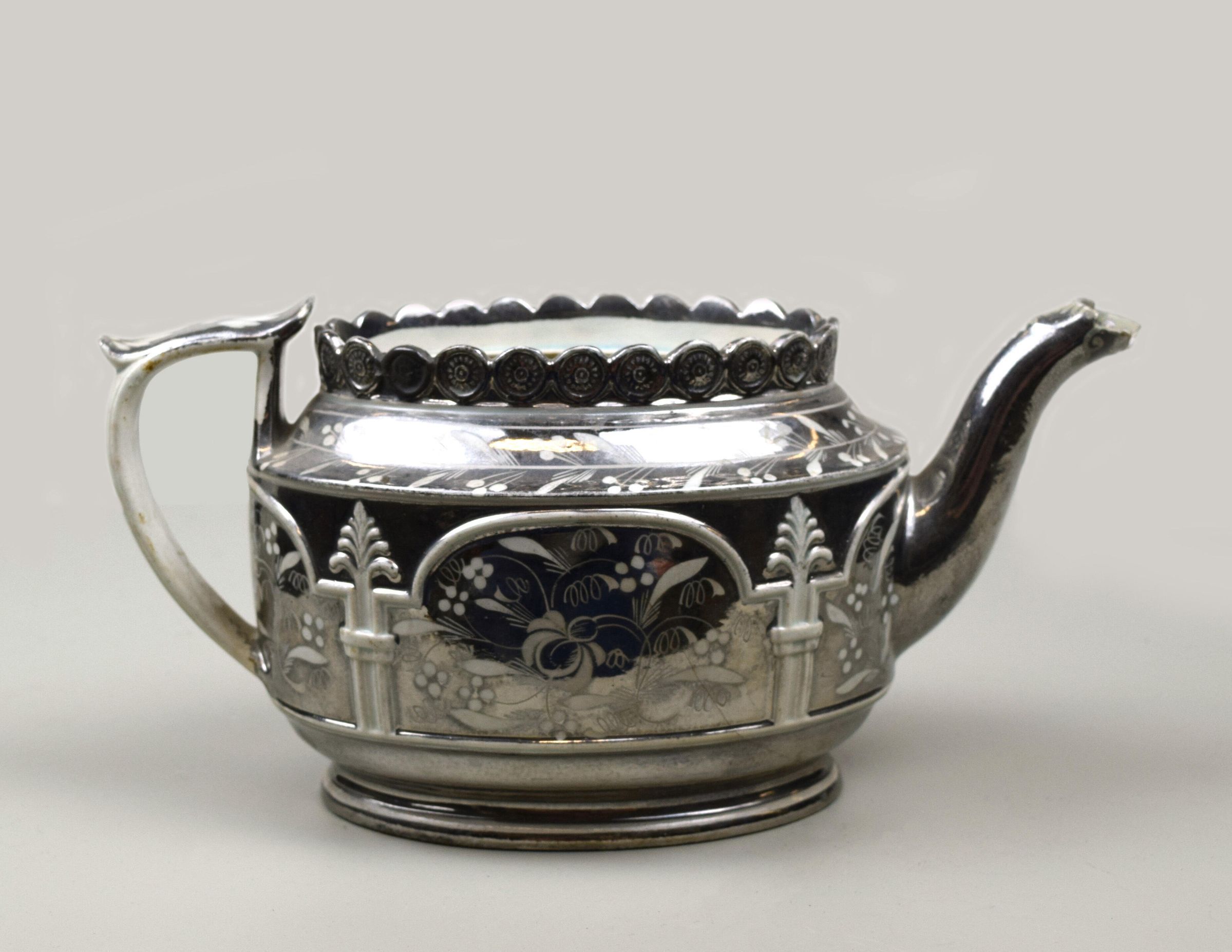
Silver Resist Lustre Teapot
Name/Title

Silver Resist Lustre Teapot

Entry/Object ID

3240

Category

Ceramic

Acquisition

Source (if not Accessioned)

Marjorie Ellis Kroha

Notes

Date: 1976 Credit Line: Bequest of Marjorie Ellis Kroha, Class of 1914, Home Economics Means of Accession: Bequest

Made/Created

Artist

Leeds Pottery

Date made

1815

Place

City

Stoke-on-Trent

State

Staffordshire

Country

England, United Kingdom

Continent

Europe

Dimensions

Height

5-5/8 in

Width

4-1/2 in

Length

9-3/4 in

Dimension Description

Height of Teapot without lid

Height

4-5/8 in

Material

Earthenware (lustreware), lead glaze

Exhibitions

Fired Works: Ceramics from Around the World
Curator Pick of the Month

Interpretative Labels

Label Type

Exhibition Label

Label

Lustreware was first invented in the Middle East in the ninth century and spread to Europe through Italy and Spain. Lustre is a type of overglaze where salts of metals, such as platinum, silver, copper, and gold, are mixed with an organic medium and applied to a ceramic body. During firing, the metallic salts oxidize and fuse with the body, creating a thin layer of metal. The resist technique seen on this teapot and cream jug adds an additional step where the design is painted on the surface in a wax-like substance to prevent the metallic glazes from penetrating the area.

General Notes

Note

Lid #3239 B from sugar bowl # 3239 A is being used with this teapot. Lustre is metallic decoration applied to ceramics through precipitation, using salts of silver, gold or copper that are dissolved and then mixed with an organic medium and painted onto the surface of the ceramic before firing. This style of decoration was invented in the Near East around the 9th century AD and then spread to the Islamic culture in Spain. The technique did not come to England until the 19th century when the potter William De Morgan began to develop lustrewares. (Trench, Materials & Techniques in the Decorative Arts, 2000)