Note
Per the Penn Museum's exhibit, Greeks were the preeminent merchants of the Mediterranean world. Pottery was widely produced for both commercial uses and for decorative uses. Some commodities could be loaded directly in the ships hull (marble, ivory, timber, buillion, metals), but finished textiles, hides, fruits,needed to be containted before transported. Terracotta cotnainers ranged from enormous grain storage jars to tiny perrfume flasks. Greek vases were also traded as objects of beauty, independent of the value of whatever they held inside. Finely decorated vasues turned up everwhere by 7th century and clearly possed their own commercial value.Athenian black and red figure vases flooded the Ancient world in the 6th and 5th centuries. Workshops varied in size, with some being just large enough for the owner and an assistant and others employing dozens or more workmen. Clay was dug up, cleaned of impurieis, wedged and beaten to remove air. Large pots were made in several sections, and done on a wheel. Red figure painting technique began around 530 BCE. Figures appeared red with a black background. Liquid glaze was used to draw figures in outline, with contours and inner liens added in raised relief. The backgroudn was then filled in with black and the pot would be fired. Heracles was the most popular subject matter.
Label 12/2014:
Greek pottery was used in commercial trade as containers for commodities like finished textiles, fruits and oils. However, Greek vases were also traded as objects of beauty, independent of the value of whatever was being transported inside of them. Finely decorated Greek vases possessed their own commercial value, as Greek vases could be found throughout the Mediterranean as early as the 7th century BCE. Greek pottery workshops varied in size; with some just large enough for an owner and assistant, while others employed dozens of workers. It was common for two painters to collaborate on a larger pot, as certain craftsmen specialized in particular shapes or glazing techniques.
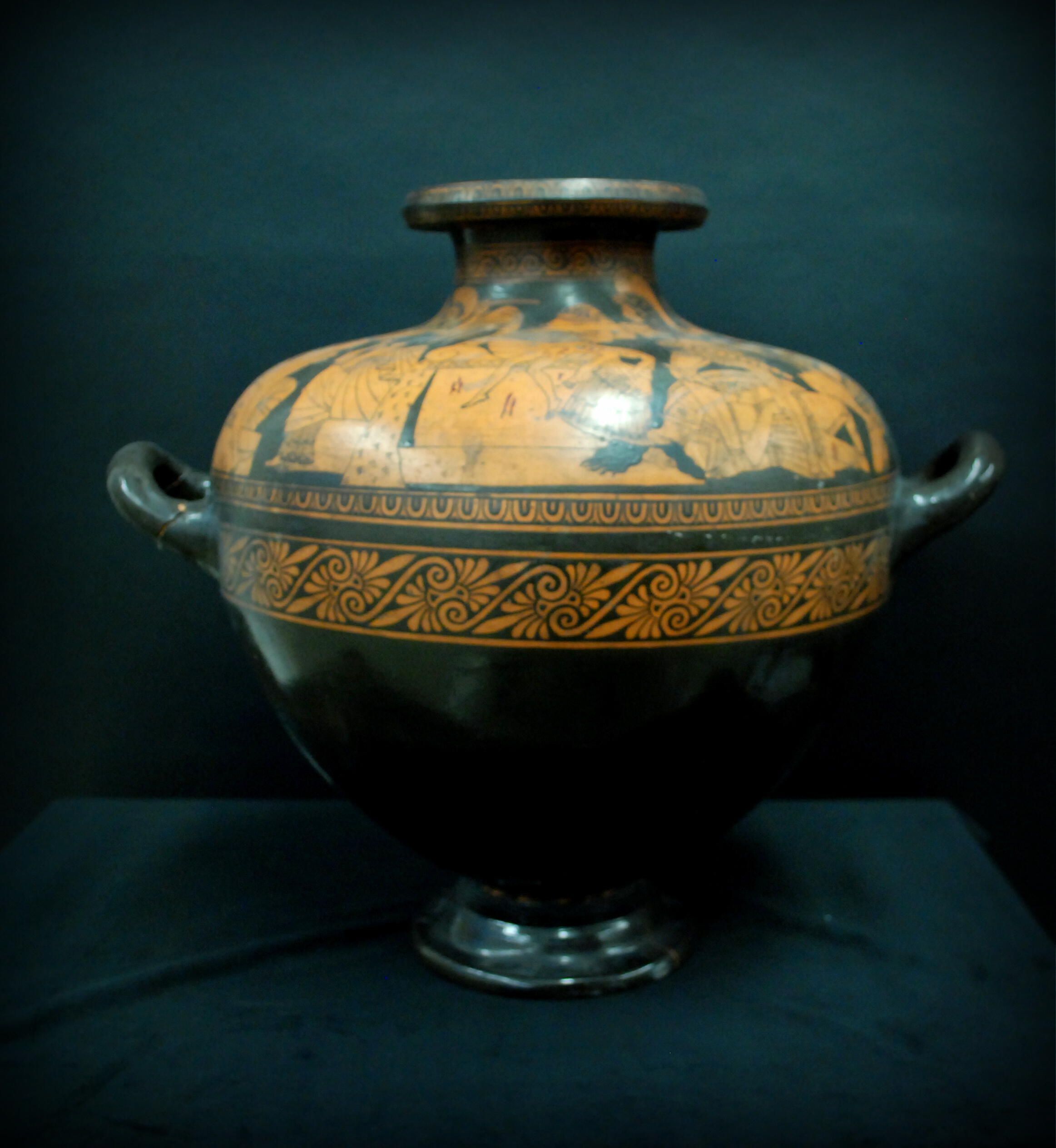
As per Ann Blair Brownlee, Associate Curator, Mediterranean Section, Penn Museum: the original is an Attic red-figure hydria (the particular shape of hydria called a kalpis) in the Archaeological Museum in Naples, attributed to the Kleophrades Painter. Early 5th century B.C.E. It is sometimes called the Vivenzio hydria because its first (post-antique!) owner was Pietro Vivenzio. The vase was excavated in the 1790s on land belonging to his father Nicola.