Note
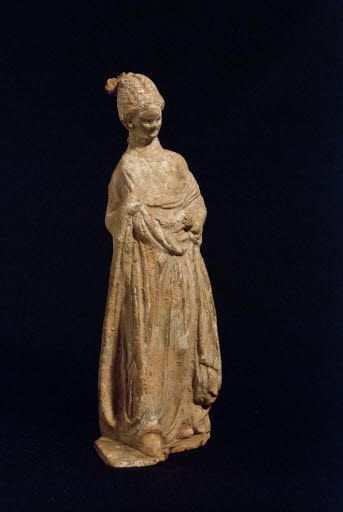
Per the Met Museum's website (http://www.metmuseum.org/toah/hd/tafg/hd_tafg.htm), Tanagras were figurines that depicted fashionable women or girls in elegantly wrapped cloaks. Unlike the previous production of statuettes in the 5th and 4th century BCE, these were not for religious purposes and instead depicted scenes from daily life. The pose and dress of the figurines varied greatly due to a complex production technique that used two part clay molds. Britannica's website also explains the use of the two part mold, a technique that became widely adopted shortly before 350 BCE.
Per "Classical Terracotta Figures" by Kames Chesterman (1974), Tanagras tell us a great deal about the ancient Greek and romans through their portrayal of people, dress, and everyday occupations.The figurines were modeled with considerable naturalism. The figurines often had accessories, such as hats. If they were hattless, they usually wore their hair in a melon coiffure, the hair style trend of the time. The craftsman who made the terracottas were called "coroplats" (Koroplathos means doll maker in Greek). These workshops frequently made and sold other articles such as vases and toys. The figurines were attached to a base to give them greater stability. The earliest date for a Hellenestic Tanagra is 330 BCE.
Per "Tanagras: Musee du Louvre" directed by Violaine Jeammet (2010), Tanagras were new genre of figurines at the time. The most important change in the traditional world of coroplast at time was that the craftsmen began to represent Comody characters. Before this, divine figures were pretty much the only figures represented. With the New Comedy of Meander came new themes, and figurines to represent nurses, teachers, and children. Tanagra (the place) became the most active craft center in the region after 335 BCE, and is where the figurines derive their name.Tanagras were often found in tombs and thus were used for funerary pratices. They were also used as cult objects, the specialization of offerings centered on sanctuaries of divinties linked with the world of women. Some figurnies had considerable amounts of gilding, and were originally painted in vibrant colors. The clothing worn by the Tanagras- in addition to reflecting the stylistic and sculptural tendencies of their time, the figurines reveal a lot of about contemporary fashion. Greek clothing can be divided into three categories: the himation, peplos, and chiton.These are all essentially rectangular pieces of different sized fabric, fashioned with various broaches and girdles. #535 exemplifies the himation.
Label 12/2014:
In Greece, pottery workshops often produced a variety of objects such as vases, toys and terracotta figurines. Figure painted vases often depicted scenes of daily life, religious rituals and mythological events, revealing what was important to Greeks at the time. Terracotta figurines also tell us a lot about the daily lives of ancient Greeks through their portrayal of people and dress.
In the absence of any surviving clothing, Tanagra figurines provide valuable evidence of trends in classical dress. Named “Tanagras” after the location of their original workshop, these statuettes are small terracotta figures that depict fashionable women in statuesque poses. The figurines wear elegantly wrapped cloaks stretch tightly around their bodies. These cloaks not only reflect the artistic skill of Greeks at the time, but also reveal the styles of contemporary fashion. Because the subject of clothing was not regarded as important to ancient writers, there is not much recorded about clothing at this time.
Tanagra figurines embody the three typical types of garments worn by the Ancient Greeks: the himation, the peplos and the chiton. These articles of clothing are essentially pieces of rectangular cloth that vary in size, shape and how they are fashioned with brooches and belts.
Label 12/2014:
While there are a number of scarf and mantle forms, the himation is perhaps the most distinctive form worn by both men and women at the time. Varying in size, quality and fabric, the himation could be draped in different ways, to serve as a shawl, cloak or head covering. Women often put on the himation when they went out, like a modern day jacket, with the purpose of protecting them from the cold.