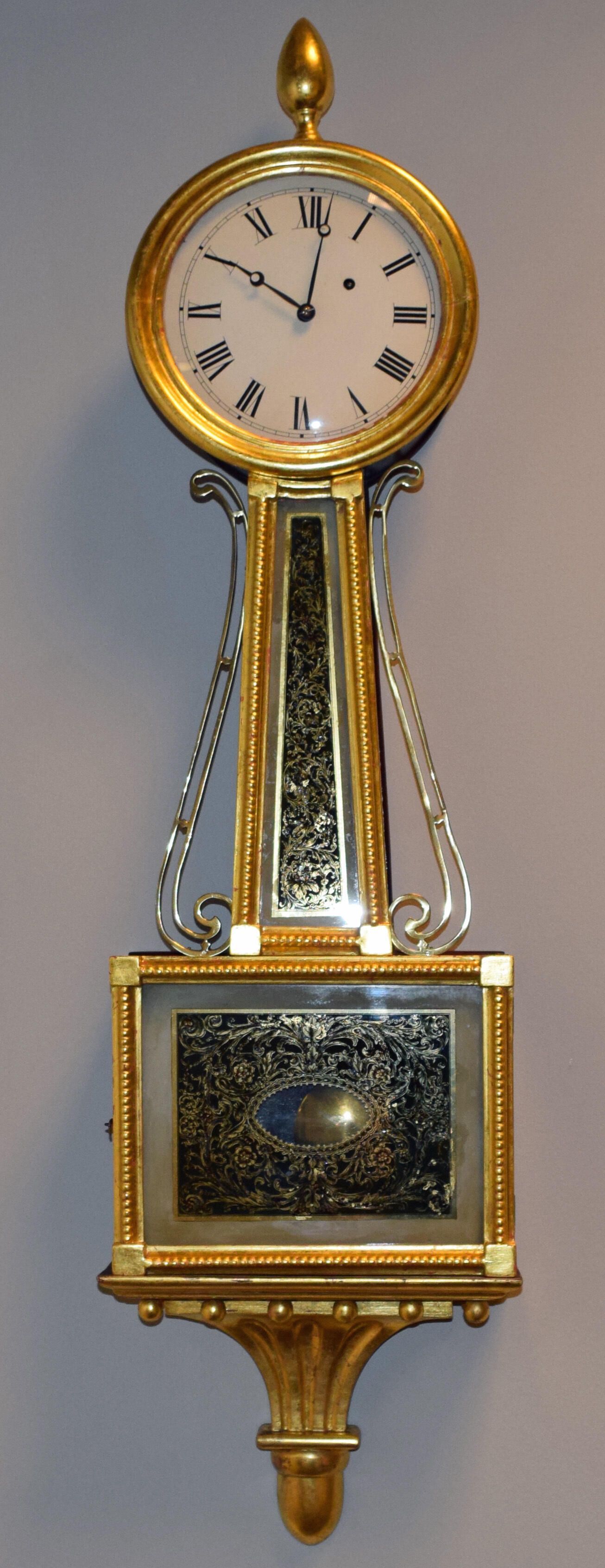
Banjo Clock

Name/Title

Banjo Clock

Entry/Object ID

3403

Category

Clocks & Watches

Acquisition

Source (if not Accessioned)

Marjorie Ellis Kroha

Notes

Date: 1976 Credit Line: Bequest of Marjorie Ellis Kroha, Class of 1914, Home Economics Means of Accession: Bequest

Made/Created

Artist

Unidentified

Place

Country

United States

Continent

North America

Dimensions

Dimension Notes

H, W, D: 40 1/2x10 1/4x4 in; H, W, D: 102.87x26.03x10.16 cm

Height

40-1/2 in

Width

10-1/4 in

Depth

4 in

Height

102.87 cm

Width

26.03 cm

Depth

10.16 cm

Material

Wood, Steel, brass, Glass, gilding

Exhibitions

Taking a Line for a Dance: Rhythm in the Arts
Curator Pick of the Month

General Notes

Note

Winding instructions: stand on stool so can see slit at the top of the neck. Wind carefully until you see the middle of the pulley line up with the slit. Give the pendulum a big push. (per Desrochers instructions 6/23/15). S-6, Shelf 7 Label 1/20/15 (S.Bernabei) This 19th-century banjo clock, named for its unique shape, is one of the many excellent examples of clocks and watches within The Drexel Collection. Both the case and the inner workings were conserved in 2013. The banjo clock is an American invention by Simon Willard of Grafton, Massachusetts and patented in 1802. Willard was a part of three generations of clockmakers, and is celebrated for his innovation and craftsmanship in clock production. Only 4,000 authentic banjo clocks were made by Willard, with variations and copies later produced by his relatives and manufacturers.