Tall Case Astronomical Musical Clock
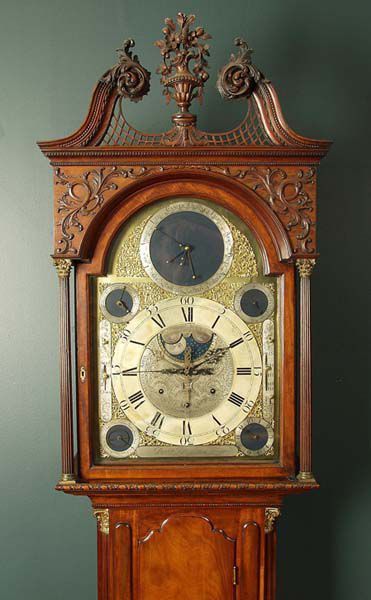
Name/Title
Tall Case Astronomical Musical ClockEntry/Object ID
49Category
Clocks & Watches
Acquisition
Source (if not Accessioned)
Mrs. George W. Childs, PhiladelphiaNotes
Date: 1894 Credit Line: Gift of Mrs. George W. Childs Means of Accession: Gift Source: William James SwainMade/Created
Artist Information
Artist
David RittenhouseRole
ClockmakerArtist
John FolwellRole
CarverDate made
1765 - 1766Time Period
18th CenturyPlace
* Untyped Place
Norriton Township, Montgomery CountyState
PennsylvaniaCountry
United StatesContinent
North AmericaInscription/Signature/Marks
Type
EngravingLocation
Center of dialTranscription
One is spatulate lobes of the leaves and the other is straight line shading around the outer edges. Attributed to Benjamin Rittenhouse, brother of David Rittenhouse.Notes
Signature: Engraved on Dial 4/9/2024 (E. Bartley) : "T Proyor/Chater/Tho Earnshaw" written on chalk on the back of the pendulum door. "Malvin Heller/1900" written in pencil on the left inside of the case. "Jm Futter" or "Jm Rutter" carved onto the right inside of the hood.Dimensions
Dimension Notes
H, W, D: 112x27 1/2x16 1/2 in overall Dial H, W : 28x19 3/4 inMaterial
Mahogany, Oak, brass, Metal, white cedar, Tulip Poplar, ChestnutProvenance
Provenance Detail
Joseph PottsAcquisition Date
1765Disposition Date
1744Notes/Remarks
(while previously speculated that Potts never accepted the clock, it has since been disproved)Provenance Detail
Thomas PriorAcquisition Method
PurchaseAcquisition Date
1774Disposition Method
SaleDisposition Date
1801Notes/Remarks
Passed from Thomas Prior to two unnamed individuals.Provenance Detail
Benjamin Smith BartonAcquisition Method
PurchaseAcquisition Date
1813Disposition Method
BequestDisposition Date
1815Provenance Detail
William James SwainAcquisition Date
1815Disposition Method
SaleDisposition Date
1879Provenance Detail
George W. ChildsAcquisition Method
PurchaseAcquisition Date
1879Disposition Method
BequestDisposition Date
1894Notes/Remarks
Bequeathed to Emma Peterson ChildsProvenance Detail
Emma Peterson ChildsAcquisition Date
1894Disposition Method
Gift/DonationDisposition Date
1894Notes/Remarks
gifted to Drexel University likely the same yearNotes
(4/9/2024 E.Bartley) Sourced from Fennimore, Donald and Hohmann III, Frank L., David Rittenhouse Philospher-Mechanick of Colonial Philadelphia and His Famous Clocks, New Haven: Yale University Press, 2023.Exhibitions
Gateway to the University: The Collections at Drexel
Curator Pick of the Month
250th Exhibition