Ecuell with Cover and Stand
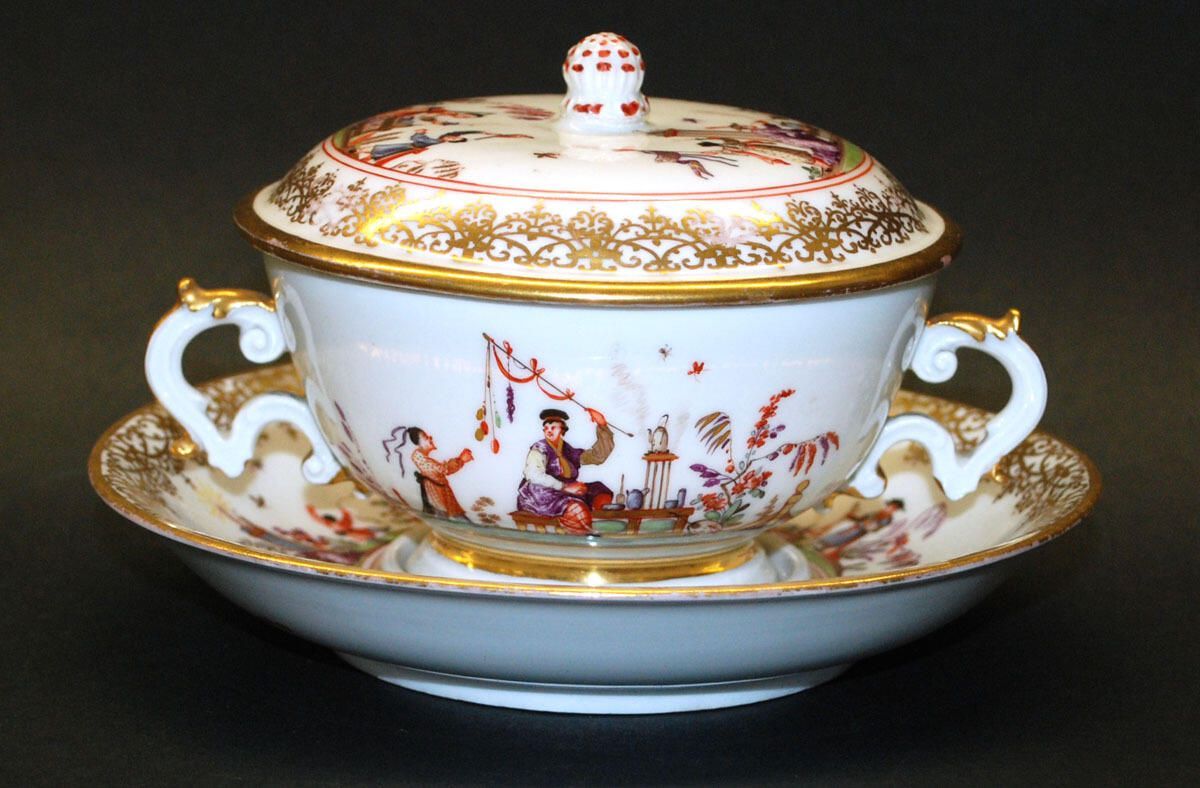
2006.00A.0005 A-C: Overall
2006.00A.0005 A-C

Overall

Name/Title

Ecuell with Cover and Stand

Entry/Object ID

2006.00A.0005 A-C

Category

Ceramic

Acquisition

Source (if not Accessioned)

Harold Shaub, Haddonfield

Notes

Date: 1991 Credit Line: Gift of Harold A. Shaub Means of Accession: Gift Source: Harold A. Shaub, former president of Campbell Soup Company

Made/Created

Artist

Meissen Porcelain Factory

Date made

circa 1730

Place

City

Meissen

Country

Germany

Continent

Europe

Inscription/Signature/Marks

Notes

Maker's mark: Underside saucer (A), Two crossed swords in underglaze blue Maker's mark: Underside cup (B), Two crossed swords in underglaze blue Mark: Underside cup (B), "5." handpainted in gilding Mark: Underside lid (C), "5." handpainted in gilding

Dimensions

Dimension Description

Part A

Height

1 in

Diameter

6-1/2 in

Dimension Description

Part B

Height

2-1/4 in

Width

4-1/4 in

Length

6 in

Dimension Description

Overall Height: Part B, C

Height

3-1/2 in

Dimension Description

Part C

Height

1-1/4 in

Diameter

4-5/8 in

Dimension Description

Overall Part A-C

Height

4 in

Diameter

6-1/2 in

Material

Hard paste porcelain, polychrome enamels, gilding, lime (alkaline) glaze

Exhibitions

Curator Pick of the Month
Fired Works: Ceramics from Around the World
Practical & Cultural: The Drexel Collection as Teaching Tool
Holding Your Drink: 3,000 Years of Drinking Vessels from the Drexel and Salzberg Collections
Gateway to the University: The Collections at Drexel

Interpretative Labels

Label Type

Exhibition Label

Label

The Meissen Porcelain Factory was the first European factory to discover the secret of hard-paste porcelain in the early 18th century. This covered cup is decorated with Chinoiserie motifs which were European interpretations of Chinese interiors, furniture, pottery, textiles and gardens, often depicting fanciful Chinese scenes.

Label Type

Exhibition Label

Label

The Meissen factory owes its discovery of the secret of making porcelain to Johann Friedrich Böttger. In the 18th century, King Augustus II kept Böttger in custody to create gold, after he claimed to have solved the centuries-old dream of alchemists of turning base materials into gold. After several years, Böttger ended up inheriting and refining the recipe to make porcelain upon the death of a scientist who was then experimenting to create the material. Within a week he announced to the king that he could make porcelain and thus, the factory was born and began production.

General Notes

Note

The Meissen Porcelain Factory (1710-present day) was the first European ceramics factory to discover true hard-paste porcelain. Chinoiserie is the European interpretation of Chinese interiors, furniture, pottery, textiles, and gardens, often depicting fanciful Chinese scenes. Previously dated c. 1815, but donor paperwork and reassessing the mark have redated the piece to c. 1730. (L. CLouser, 1/24/2018)