Note
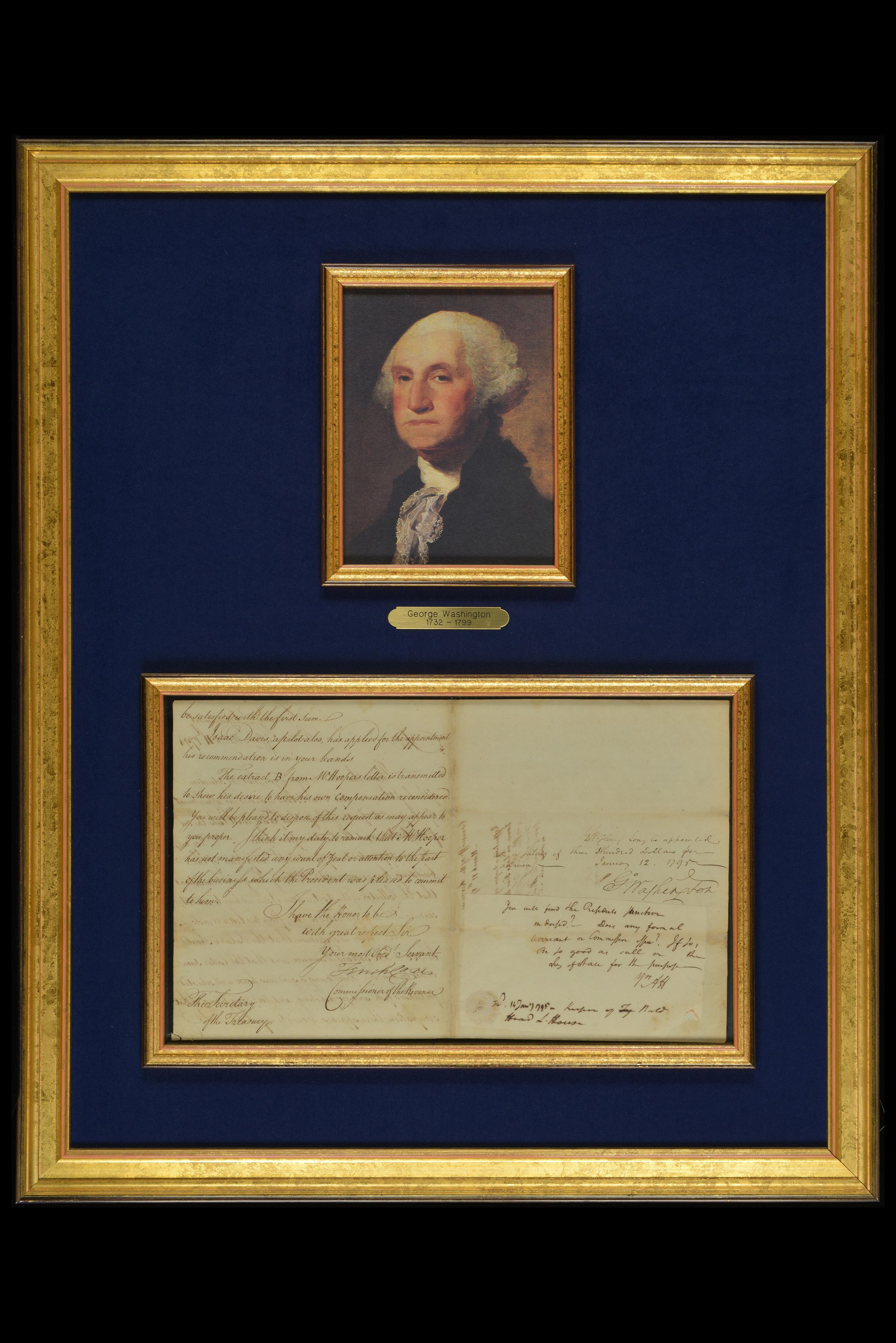
Letter from Commissioner of the Revenue, Tench Coxe, to Secretary of the Treasury, Alexander Hamilton. The letter discusses the various applicants for a position at Cape Fear Lighthouse, and decides upon salary and other notes.
This letter was initially sent by Tench Coxe, recommending Henry Long for the position of keeper of the Cape Fear Lighthouse in North Carolina. He mentions a salary of $300 to $350 per year, as suggested by a Mr. Hooper, who was chosen to oversee the completion of the lighthouse. Alexander Hamilton writes back accepting Coxe’s recommendation, and has George Washington sign this letter he wrote. Hamilton also includes a note telling Coxe that if he decides Long should receive a commission for this position, that he should write to the Secretary of State, Edmund Randolph, to facilitate it.
Both of the lighthouses mentioned, Cape Fear and Bald Head, were located in North Carolina. As a budding nation recovering from a war, protecting the coastlines was incredibly important. In 1790, President Washington signed in a tariff act that put into existence the Revenue Cutter Service to enforce tariffs on traded goods coming in across the Atlantic ocean. “Cutters” were large vessels working under the federal government. Under the Department of the Treasury, this service would later become known as the Coast Guard, which was the only armed sea force for the United States until the Navy’s foundation. When Coxe was writing to Hamilton, the Bald Head lighthouse had been newly built as a landmark for safe passage into Cape Fear River. Both Bald Head and Cape Fear would have been two of four lighthouses along this passage, although Cape Fear was still under construction at this time, and would eventually replace Bald Head due to erosion on the surrounding islands making its foundations structurally unsound. This set of lighthouses would have guided passing ships into the Port of Wilmington, which was one of the major seaports for international trade in the colonial era.
Tench Coxe was technically directly under Alexander Hamilton, having been appointed as Commissioner to the Revenue a mere two years before this letter was penned. He had strong beliefs in the right to bear arms, which led to his switching sides from the Loyalist party to join the Revolution in the late 1775. He was also deeply supportive of George Washington, both before and during his presidency, and emphasized his beliefs on citizens bearing arms as a check against the tyranny of rulers. However, a few months after the letter was written, the Whiskey Tax Rebellion among farmers in western Pennsylvania would break out. As Commissioner of the Revenue and working under the Secretary of the Treasury, Coxe would have enforced it as a measure that was meant to keep individual states from taking on more debt like they had during the Revolutionary War. At this point, Hamilton had suggested that the federal government take on all debt by the ex-colonies and then put taxes on certain goods in place to prevent vast debts from occuring again. In the summer of 1794, the attack on Bower Hill would occur, prompting President Washington to send a militia to end the conflict and bring the accused to trial. The Whiskey Tax would remain in effect until 1802.
L. Bros 6/7/2019
Bibliography:
1. "Alexander Hamilton (1789-1795)." U.S. Department of the Treasury. November 11, 2010. Accessed May 21, 2019. https://www.treasury.gov/about/history/pages/ahamilton.aspx.
2. "Bald Head Lighthouse." Ocean Isle Beach - North Carolina OceanIsleBeach.com. April 26, 2012. Accessed May 21, 2019. https://oceanislebeach.com/bald-head-lighthouse/.
3. Britannica, The Editors of Encyclopaedia. "Whiskey Rebellion." Encyclopædia Britannica. January 29, 2019. Accessed May 21, 2019. https://www.britannica.com/event/Whiskey-Rebellion.
4. "The Coast Guard: America's Oldest Maritime Defenders." The Coast Guard: America's Oldest Maritime Defenders | GoCoastGuard.com. Accessed May 21, 2019. https://www.gocoastguard.com/about-the-coast-guard/learn-the-history.
5. "The Story of Cape Fear Lighthouse." Shoreline OBX. 2018. Accessed May 21, 2019. https://shorelineobx.com/blog/cape-fear-lighthouse/.
6. "Tench Coxe." The James Madison Research Library and Information Center. February 1999. Accessed May 21, 2019. http://www.madisonbrigade.com/t_coxe.htm.