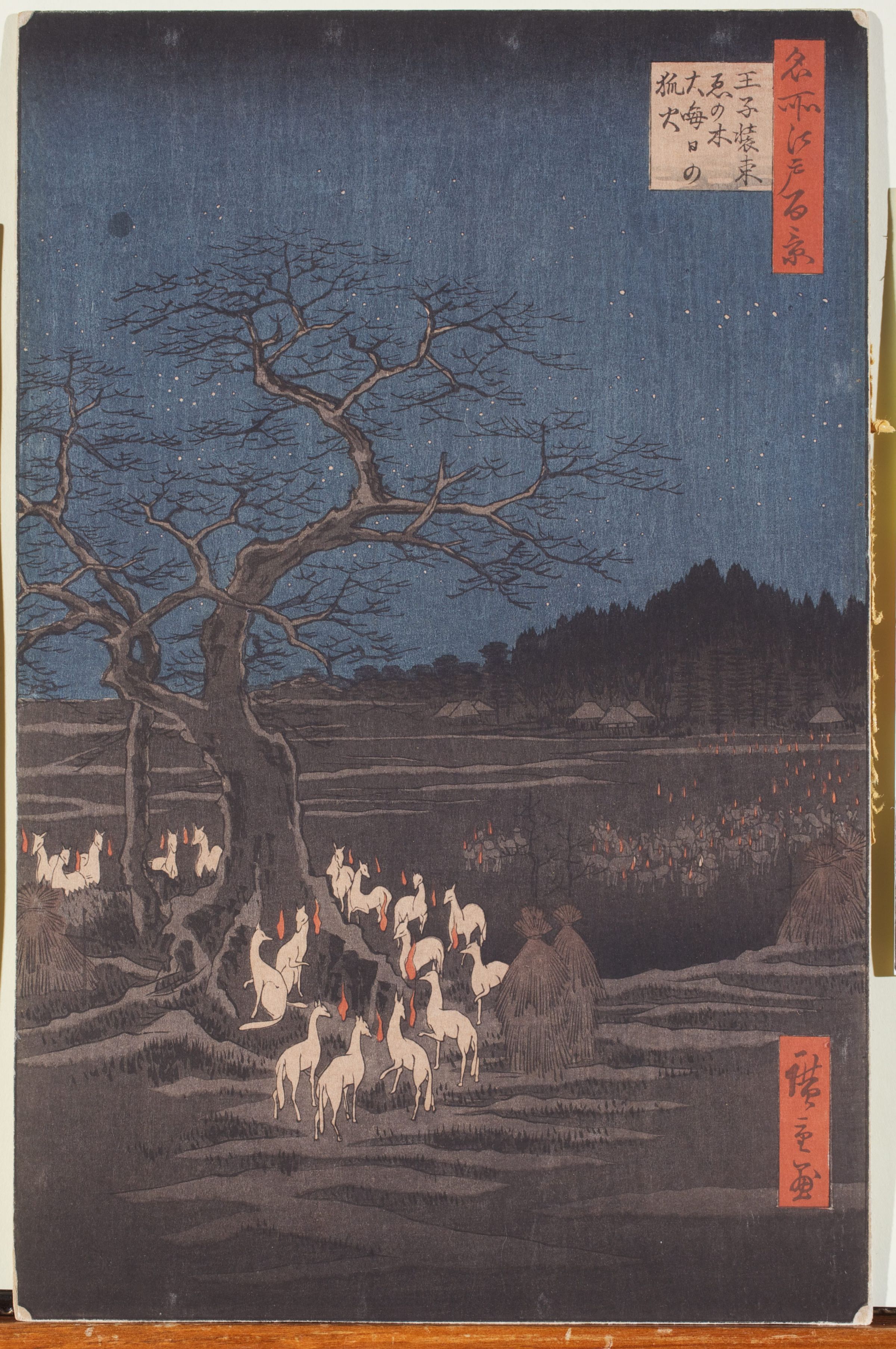
New Year's Eve Foxfires at the Changing Tree, Oji
1997 photo by William Brown

1997 photo by William Brown

Name/Title

New Year's Eve Foxfires at the Changing Tree, Oji

Entry/Object ID

1997

Category

Print

Acquisition

Source (if not Accessioned)

James W. Paul, Jr., Philadelphia

Notes

Date: 1969 Credit Line: Gift of James W. Paul, Jr. to the Drexel Library then transferred to The Drexel Collection Means of Accession: Transfer Source: James W. Paul, Jr. Donated to the Drexel Library 1906-1907

Made/Created

Artist

Utagawa Hiroshige

Date made

1857

Place

Country

Japan

Continent

Asia

Dimensions

Height

13-5/8 in

Width

8-3/4 in

Exhibitions

Curator Pick of the Month
A Legacy of Art, Science & Industry: Highlights from the Collections, Drexel University
Prints from the Drexel Collection: From Hogarth to Hiroshige to Rauschenberg
Gateway to the University: The Collections at Drexel

Interpretative Labels

Label Type

Exhibition Label

Label

Master woodblock painter, Utagawa Hiroshige is best known for his sensitive depictions of the Japanese landscape and the natural world. He was particularly interested in capturing the fleeting moments that mark the passage of time, the weather and seasons changing. Hiroshige’s success was not limited to Japan – he would in fact have a great influence on the Impressionists. This print from Hiroshige’s One Hundred Famous Views of Edo captures the magic of New Year’s Eve when, legend has it, foxes from all over Japan gather under a large tree near the Oji Inari shrine. There, the foxes change into formal clothes by firelight and process to the shrine for the first blessing of the new year.

Label Type

Curator Pick of the Month

Label

Happy New Year! This woodblock print is part of a large collection of Japanese prints donated to The Drexel Collection by James W. Paul Jr., Anthony J. Drexel’s son-in-law. In Japanese folklore, it is believed that on New Year’s Eve all of the foxes of the surrounding provinces would gather at a particular tree near the Oji Inari shrine, headquarters of the god Inari. The animals would emit distinctive flames by which local farmers were able to predict the crops of the coming year. This print was most recently part of Drexel’s celebratory exhibition A Legacy of Art, Science and Industry: Highlights from the Collections, Drexel University, Spring 2012.

General Notes

Note

Woodcut prints were typically carved from cherry blocks. Each color of a design had to have a separate block carved, except for the Japanese ukiyo-e artists who were able to print multiple colors from one block by painting the design using brushes and subtle coloring. The earliest European examples of woodblock prints were playing cards and religious images around the end of the 14th century. Woodcuts were also the main form of book illustration until the end of the 16th century. (Trench, Materials & Techniques in the Decorative Arts, 2000) A copy of this print was made for the CAT Engineering Building Dean's Suite, in 2012. From the Brookyln Museum's website: 118 New Year's Eve Foxfires at the Changing Tree, ōji (9th Month, 1857); 30.1478.118 In the late 1850s, while Japanese color prints were dominated by themes of the fantastic, Hiroshige emphasized the realities of the observed world in his work. However, here he has ventured into the world of spirits. It was believed that on New Year's Eve all the foxes of the surrounding provinces would gather at a particular tree near Oji Inari Shrine, the headquarters of the regional cult of the god Inari. There the foxes would change their dress for a visit to the shrine, where they would be given orders for the coming year. On the way, the animals would emit distinctive flames by which local farmers were able to predict the crops of the coming year. (http://www.brooklynmuseum.org/opencollection/research/edo/detail.php?view=9015.118.22&total=22)