Name/Title
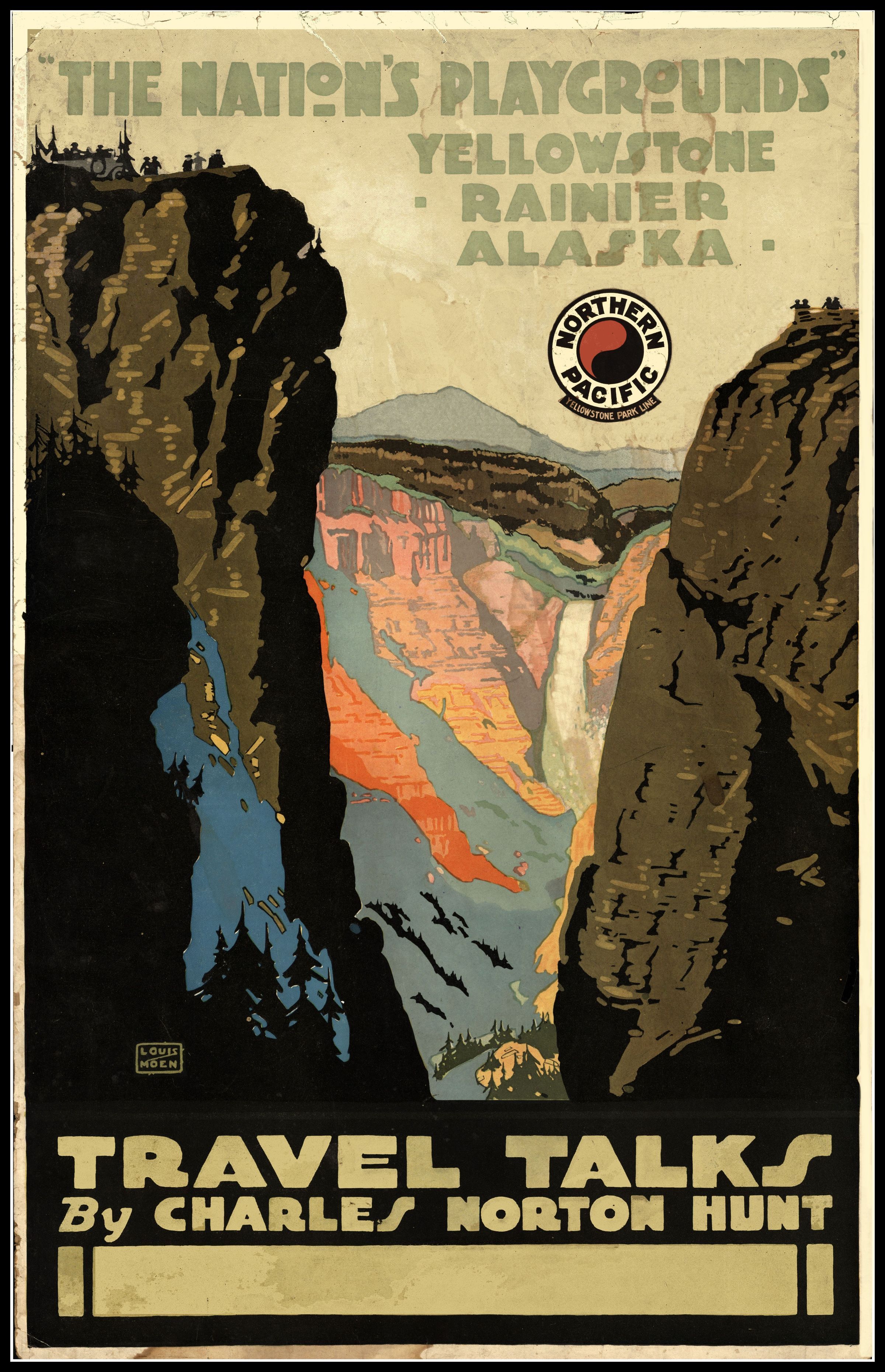
1917 circa - 'THE NATION'S PLAYGROUNDS' YELLOWSTONE * RAINER * ALASKA * / Northern Pacific Railroad / Louis MoenDescription
In addition to his “Great American Northwest” lecture series, Charles Norton Hunt, the independent lecturer sponsored by the Northern Pacific Railroad, offered a “Travel Talk” entitled “The Nation’s Playgrounds”. This poster advertises those talks. The presentation, featuring Yellowstone but also covering Rainier and Alaska, is known to have been presented in various American cities between the years 1917 and 1918.
“The Nation’s Playgrounds”, the title of this poster, was the name of a marketing campaign created by the United States Railroad Association (USRA), an organization that existed between 1917 and 1920. The USRA was established by the federal government to manage the railroads when President Woodrow Wilson nationalized that industry during World War I. The Northern Pacific Railroad participated in this war time campaign by issuing a set of posters promoting national parks; this poster is from that set.
Although this Moen poster is generally described as a silkscreen (a.k.a. serigraph), it is actually a combination of different printing methods. Below is a museum conservator’s assessment of its composition. The same assessment is applicable to other Northern Pacific Moen posters of this era.
“The poster is affixed to a thin (1mm) board that is fragile because of aging processes. The paper on which the poster is printed is machine made, coated with chalk and calendared to improve rendering of the print. The poster is a chromolithograph printed from a few plates that were created with aid of photography, with some brushwork. All the light color plates have a screen pattern present. Symmetric black areas on sides of the composition do not have the screen pattern and are somewhat glossy. This suggests those elements, as well as the text panel at the bottom, were printed with a different type of plate (stone?) and worked out in a different way. The circular badge, in the sky area, is adhered to the poster, made of wove paper of legible wire mesh texture and was printed with a different process, most likely a relief type.” Joanna Didik, Chief Conservator of the Gilcrease Museum, Tulsa, OK.Create Date
May 31, 2026Update Date
June 2, 2026