Transcription
De heer en mevrouw de Vries-van de Blink
Malibaan 90,
Utrecht,
Rotterdam, 19 augustus 1985 ... of wel ADD 45 jaar + één dag.
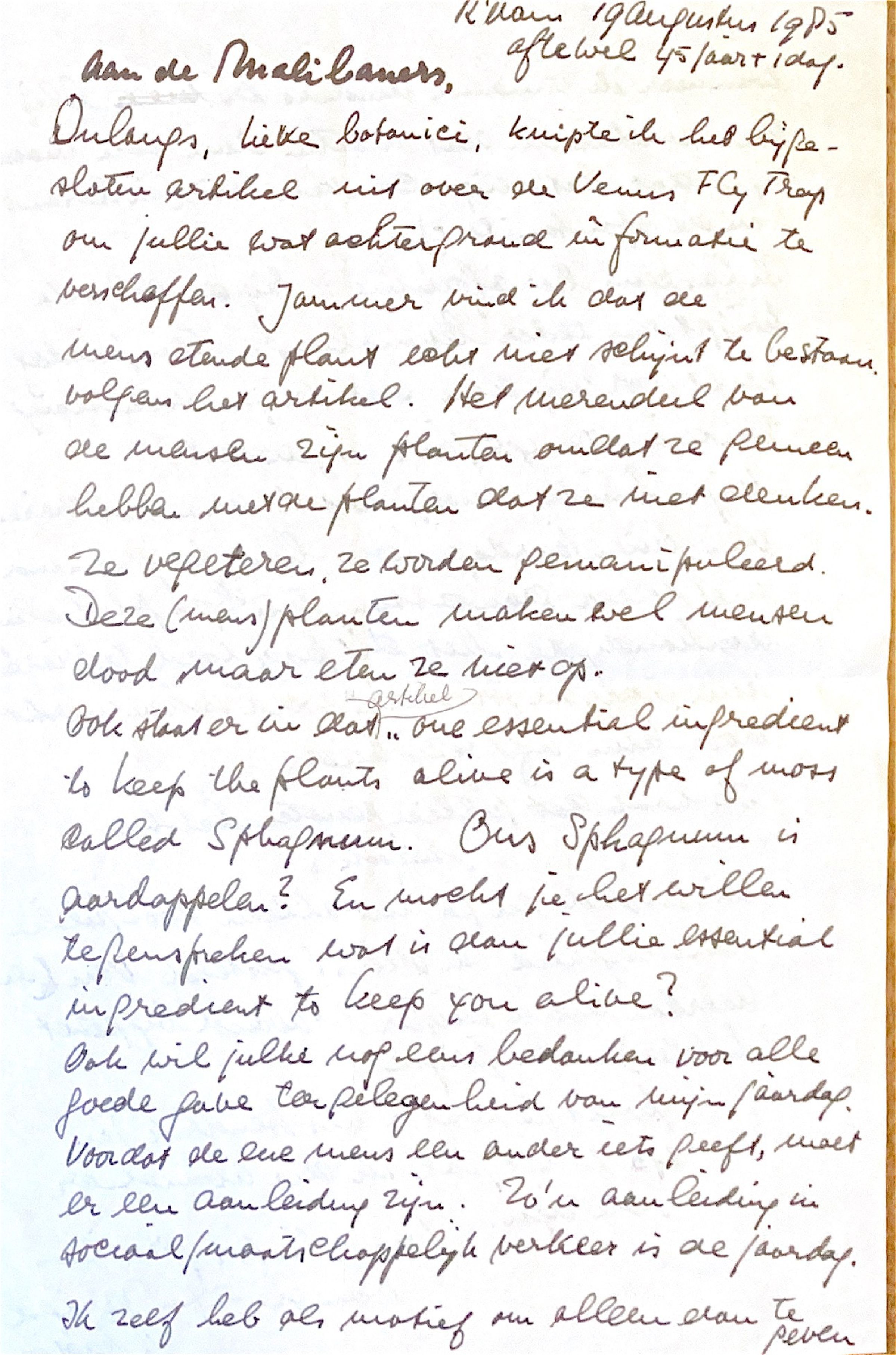
Aan de Malibaners,
onlangs, lieve botanici, knipte ik de bijgesloten column uit over de 'Venus Fly Trap' (hierna: VFT, om jullie wat achtergrond informatie over deze planten te geven. Jammer vind ik dat de mens-etende plant echt niet schijnt te bestaan, volgens de bijgesloten column. Het merendeel van de mensen gelijken op planten, omdat zij gemeen hebben met planten, dat ze niet denken. Deze (mens)planten maken wel mensen dood, eten die niet op.
Ook staat in die column over de VFT: "One essential ingredient to keep the plant alive is a type of moss called: Sphagnum. Ons 'sphagnum' is aardappelen. En mocht je het willen tegenspreken, wat is dan jullie "essentïal ingredient to keep you alive?"
Ook wil ik jullie nog eens bedanken voor alle goede gaven ter gelegenheid van mijn verjaardag. Voordat de ene mens een ander iets geeft, moet er een aanleiding`zijn. Zo'n aanleiding in het sociaal maatschappelijk verkeer is de jaardag.
Ikzelf heb als motief om alleen dan te geven, wanneer ik iemand anders er blij mee kan maken en dat moeten dan ook momenten zijn, dat het mij convenieert (inherent aan de spontaniteit).
Ik las eens het aforisme: " Bij de geboorte krijgt een ieder levenslang." Mijn verjaardag van gisteren stelde vast, dat mijn levenslang tenminste 45 jaar is geweest. Onze familie is niet zo vasthoudend aan het vieren van verjaardagen. Toen ik zo plotseling aankondigde, dat ik dit jaar wel mijn verjaardag wilde vieren op 18 augustus, konden mijn ouders hun programma niet meer veranderen. Hun 'acte de présence' werd gekenmerkt door hun afwezigheid.
Ik hoop dat jullie zelf ook genoten hebben van de avond en je niet alleen door jullie aanwezigheid, je in dienst gesteld hebben van (en daardoor meer luister tot de avond bijgedragen hebben) van de jarige.
Weet je wat ? Als HendrikJan 45 jaar wordt, dan zal ik die avond er ook zijn.
Veel liefs en groeten van de ex-jarige Aadje
Noot
H.J. is één jaar ouder dan Aadje en zal op 19 nov. 1985 46 jaar worden.
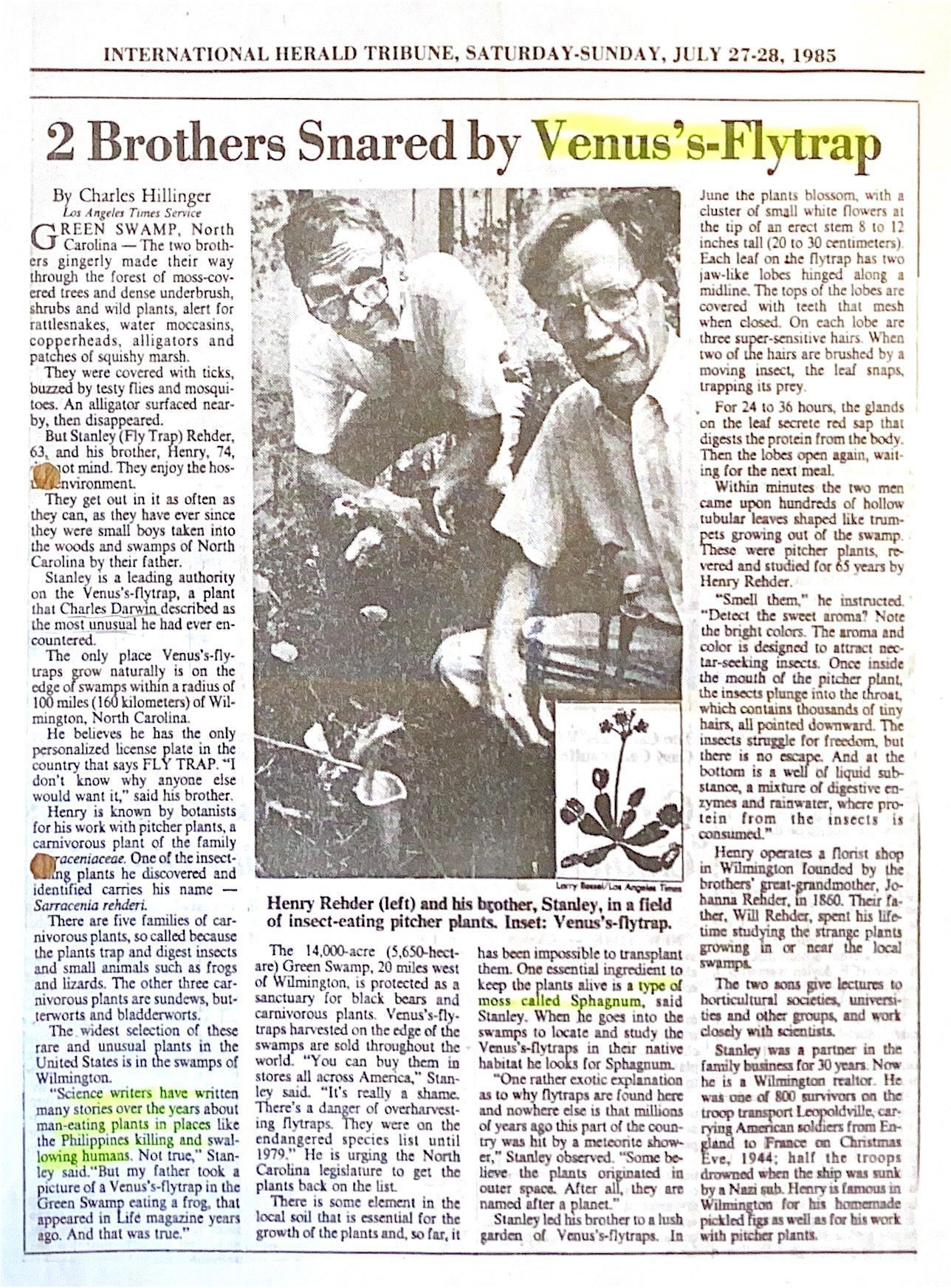
INTERNATIONAL HERALD TRIBUNE, SATURDAY-SUNDAY, JULY 27-28, 1985
2 Brothers Snared by Venus's-Flytrap
Henry Rehder and his brother, Stanley, in a field of insect-eating pitcher plants.
By Charles Hillinger Los Angeles Times Service GREEN SWAMP, North Carolina-The two brothers gingerly made their way through the forest of moss-covered trees and dense underbrush, shrubs and wild plants, alert for rattlesnakes, water moccasins, copperheads, alligators and patches of squishy marsh.
They were covered with ticks, buzzed by testy flies and mosquitoes. An alligator surfaced nearby, then disappeared. But Stanley (Fly Trap) Rehder, 63, and his brother, Henry, 74, do not mind. They enjoy the hostile environment. They get out in it as often as they can, as they have ever since they were small boys taken into the woods and swamps of North Carolina by their father.
Stanley is a leading authority on the Venus's-flytrap, a plant that Charles Darwin described as the most unusual he had ever encountered.
The only place Venus's-flytraps grow naturally is on the edge of swamps within a radius of 100 miles (160 kilometers) of Wilmington, North Carolina.
He believes he has the only personalized license plate in the country that says FLY TRAP. "I don't know why anyone else would want it," said his brother.
Henry is known by botanists for his work with pitcher plants, a carnivorous plant of the family raceniaceae. One of the insect-eating plants he discovered and identified carries his name Sarracenia rehderi.
There are five families of carnivorous plants, so called because the plants trap and digest insects and small animals such as frogs and lizards. The other three carnivorous plants are sundews, butterworts and bladderworts.
The widest selection of these rare and unusual plants in the United States is in the swamps of Wilmington.
"Science writers have written many stories over the years about man-eating plants in places like the Philippines killing and swallowing humans. Not true," Stanley said."But my father took a picture of a Venus's-flytrap in the Green Swamp eating a frog, that appeared in Life magazine years ago. And that was true." The 14,000-acre (5,650-hectare) Green Swamp, 20 miles west of Wilmington, is protected as a sanctuary for black bears and carnivorous plants. Venus's-flytraps harvested on the edge of the swamps are sold throughout the world. "You can buy them in stores all across America," Stanley said. "It's really a shame. There's a danger of over- harvesting flytraps. They were on the endangered species list until 1979." He is urging the North Carolina legislature to get the plants back on the list.
There is some element in the local soil that is essential for the grows of the plants and so far it has been impossible to transplant them. One essential ingredient to keep the plants alive is a type of moss called Sphagnum, said Stanley. When he goes into the swamps to locate and study the Venus's-flytraps in their native habitat he looks for Sphagnum.
"One rather exotic explanation as to why flytraps are found here and nowhere else is that millions of years ago this part of the country was hit by a meteorite shower," Stanley observed. "Some believe the plants originated in outer space. After all, they are named after a planet." Stanley led his brother to a lushmgarden of Venus's-flytraps.
In June the plants blossom, with a cluster of small white flowers at the tip of an erect stem 8 to 12 inches tall (20 to 30 centimeters). Each leaf on the flytrap has two jaw-like lobes hinged along a midline. The tops of the lobes are covered with teeth that mesh when closed. On each lobe are three super-sensitive hairs. When two of the hairs are brushed by a moving insect, the leaf snaps, trapping its prey.
For 24 to 36 hours, the glands on the leaf secrete red sap that digests the protein from the body. Then the lobes open again, waiting for the next meal.
Within minutes the two men came upon hundreds of hollow tubular leaves shaped like trumpets growing out of the swamp.
These were pitcher plants, rеvered and studied for 65 years by Henry Rehder.
"Smell them," he instructed. "Detect the sweet aroma? Note the bright colors. The aroma and color is designed to attract neсtar-seeking insects. Once inside the mouth of the pitcher plant, the insects plunge into the throat which contains thousands of tiny hairs, all pointed downward. The insects struggle for freedom, but there is no escape. And at the bottom is a well of liquid substance, a mixture of digestive enzymes and rainwater, where protein from the insects is consumed."
Henry operates a florist shop in Wilmington founded by the brothers' great-grandmother, Johanna Rehder, in 1860. Their father, Will Rehder, spent his life time studying the strange plants growing in or near the local swamps.
The two sons give lectures to horticultural societies, universities and other groups, and work closely with scientists.
Stanley was a partner in the family business for 30 years. Now he is a Wilmington realtor. He was one of 800 survivors on the troop transport Leopoldville, carrying American soldiers from England to France on Christmas Eve, 1944; half the troops drowned when the ship was sunk by a Nazi sub. Henry is famous in Wilmington for his homemade
pickled figs as well as for his work with pitcher plants.