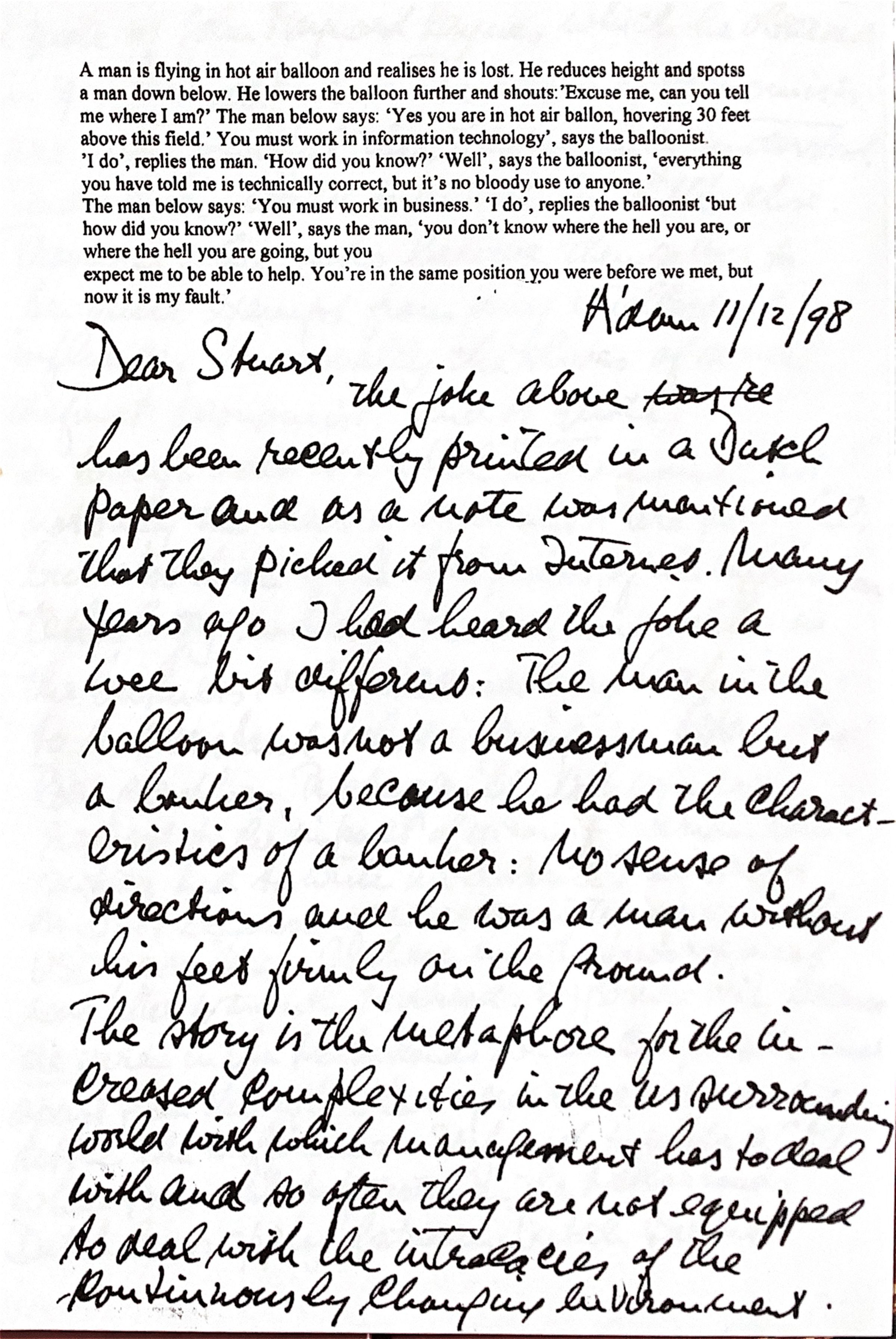
Transcription
çç
Amsterdam, 11 december 1998
Dear Stuart,
The above joke recently appeared in a Dutch magazine and a note stated that it was taken from the internet. Years ago I heard the joke slightly differently: the man in the balloon was not a businessman but a banker, because he had the characteristics of a banker: no sense of direction and he was a man whose feet were not firmly on the ground. The story is a metaphor for the increased complexity in our lives,
that management faces and is often ill-equipped to deal with the complexity of a constantly changing environment.
I was struck by the quote from John Maynard Keynes that he observed in 1936: “The ideas of economists are more powerful than is commonly believed.
Indeed, the world is governed by little else. Practical men, who think themselves exempt from any intellectual influence, are usually the slaves of a defunct economist.'
In today's world it is still a truism. But not only are the ideas of economists powerful, but also those of the high priests of information technology enslave the decision makers in the business world because they have no brains to understand what is going on. For example, Baringbrothers went bankrupt, Procter & Gamble, Volkwagen did not understand the risk of options and Adriaan Dirkzwager had to write an extensive report on exceeding the Bank's approved exposure to the Dutch company DSM by accepting a transfer risk of 75 million dollars, according to IT information received by the head office in London. It involved a three-month currency transaction that was reversed after one month; Exposure Nil. In the Netherlands, Bank 'De IURE' is entitled to compensation, so the exposure was fictitious. I had agreed with DSM that we would only settle the difference. I refused to write an “Affirmation of Action Report.”
If you operate in the Netherlands, Dutch law applies between Dutch parties
In Rome, do as the Romans do.
I recently read that the beginning of information technology (IT) is letter writing. Then you had the invention of the printing press and then the big leap forward was the computer. In this letter I have used the oldest and newest form of IT. I hope you will understand that I am not one of the lost generation.
Let's concern ourselves with the more trivial aspects of life. (Forget Europe for the moment, even if the currency 'the euro' will be a reality in twenty days.)
It seems to me that my life is quite busy. I notice this because I would like to read more than I actually do. You have to get all the chores done before you can hide in a chair with a book. Recently I read: "Uncommon Woman", written by Hannah Pakulah. It is a biography about Vicky, Queen Victoria's eldest daughter. She married at the age of 17 to a Prussian prince,
who ultimately became Emperor of Germany for only three months, because he was terminally ill. Interestingly however, she lived at the time when Bismarck was exercising political power and founding the Great German 'Reich'. You can draw parallels with what is happening in Europe today.
We experience that Amsterdam is a magnet and that we receive more friends than before. Furthermore, both Vera and I have taken FRENCH courses. Vera is more advanced in French than I am. We also noticed that we spend more time with our parents as they get older.
Vera really wants to visit England. The new Dutch ambassador in the Cort of St. James is a gentleman I know very well. If we could stay at the embassy at the expense of the Dutch State, I would have the good feeling of getting part of my taxes paid back.
We will continue our correspondence next year 1999
Love toUrsula from Veraand to you, All the best Adriaan D. Dirkzwager