Transcription
Open-tuinen weekend van Amsterdamse grachtentuinen.
GARDENING IN AMSTERDAM.
Hidden secrets that lie beyond the canals.
"The Dutch satisfy their natural nosiness by visiting rarely seen gardens", says lan Bickerton.
Under a purple sky that periodically unloaded its contents with the intensity of a power shower, we ventured into the garden, brollies at the ready. For the green-fingered Dutch, Amsterdam's annual "canal-gardens in bloom" event, now in its eighth year, is not to be missed even if, for many, it serves to underline what they are missing.
While any Dutch person ranks a house with a garden high on the wish-list, in Amsterdam rocketing prices and limited availability means for many it remains the stuff of dreams. Most make do with a small flat, usually at the top of a steep set of stairs, and a window box.
In June this year a record 8,320 people visited 26 gardens, usually out-of-bounds and out-of-sight to all but the occupants of the 17th and 19th century mansions that line Amsterdam's grandest canals.
The event itself is something of a well-kept secret. While every year the number of foreign visitors increases, it has yet to become part of the regular tourist beat and remains a very Dutch occasion.
So, while some had come for the gardens, others just wanted to root around. The Dutch share a love of gardening but their natural nosíness is also something of a national obsession.
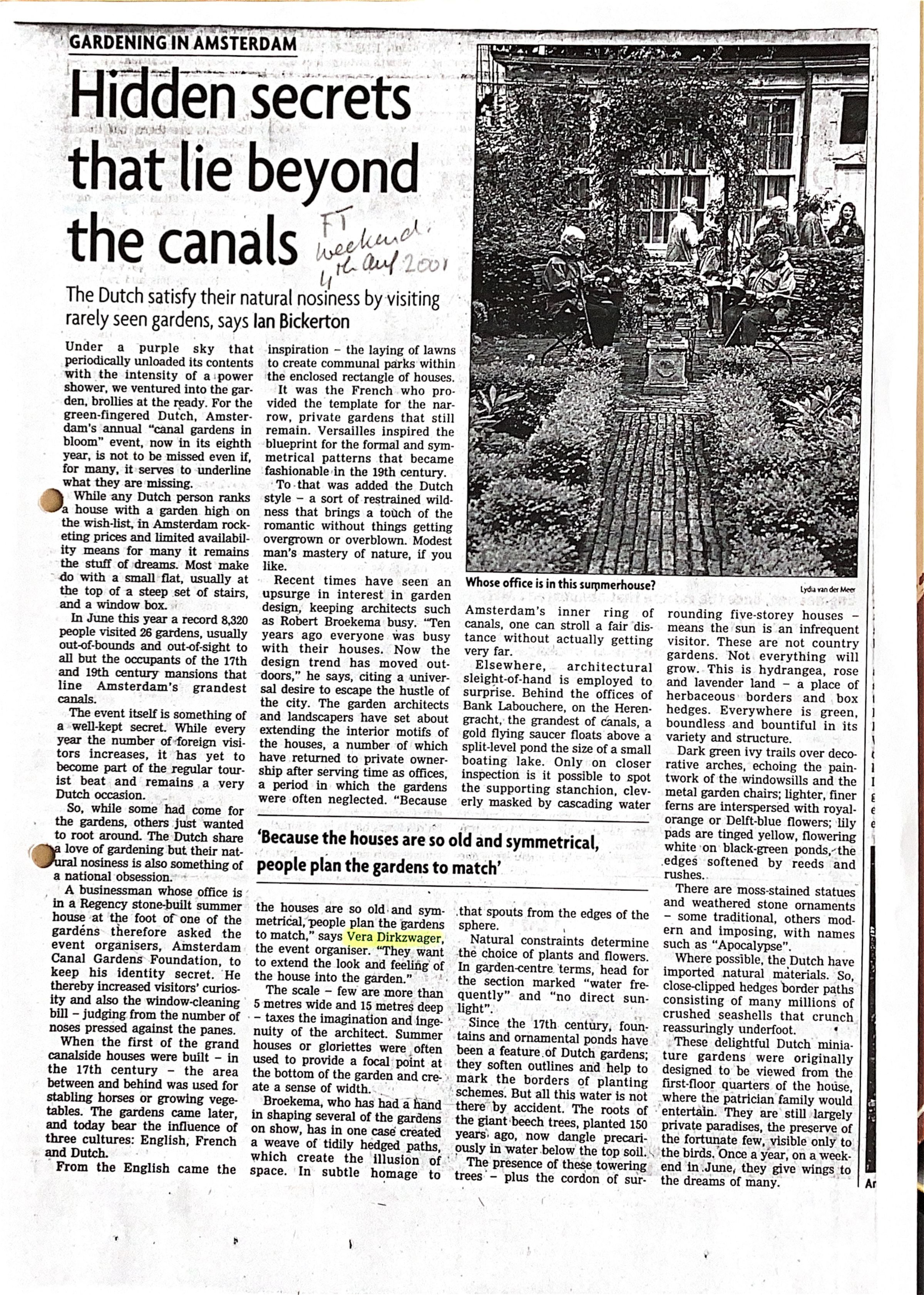
A businessman whose office is in a Regency stone-built summer house at the foot of one of the gardéns therefore asked the event organisers, Amsterdam Canal Gardens Foundation, to keep his identity secret. He thereby increased visitors' curiosity and also the window-cleaning bill - judging from the number of noses pressed against the panes.
When the first of the grand canal-side houses were built in the 17th century the area between and behind was used for stabling horses or growing vegetables. The gardens came later and today bear the influence of three cultures: English, French and Dutch.
From the English came the inspiration - the laying of lawns to create communal parks within the enclosed rectangle of houses. It was the French who provided the template for the narrow, private gardens that still remain. Versailles inspired the blueprint for the formal and symmetrical patterns that became fashionable in the 19th century. To-that was added the Dutch style -a sort of restrained wildness that brings a touch of the romantic without things getting overgrown or overblown. Modest man's mastery of nature, if you like.
Recent times have seen an upsurge in interest in garden design, keeping architects such as Robert Broekema busy. “Ten years ago everyone was busy with their houses. Now the design trend has moved outdoors," he says, citing a universal desire to escape the hustle of the city.The garden architects and landscapers have set about extending the interior motifs of the houses, a number of which have returned to private ownership after serving time as offices, a period in which the gardens were often neglected. "Because the houses are so old and symmetrical, people plan the gardens to match," says Vera Dirkzwager, the event organiser. "They want to extend the look and feeling of the house into the garden." The scale, few are more than 5 metres wide and 15 metres deep, taxes the imagination and ingenuity of the architect. Summer houses or gloriettes were often used to provide a focal point at the bottom of the garden and create a sense of width. Broekema, who has had a hand in shaping several of the gardens on show, has in one case created a weave of tidily hedged paths, which create the illusion of space. In subtle homage to Amsterdam's inner ring of canals, one can stroll a fair distance without actually getting very far.
Elsewhere, architectural sleight-of-hand is employed to surprise. Behind the offices of
Bank Labouchere, on the Herengracht, the grandest of canals, a gold flying saucer floats above a split-level pond the size of a small boating lake. Only on closer inspection is it possible to spot the supporting stanchion, cleverly masked by cascading water that spouts from the edges of the sphere.
Natural constraints determine the choice of plants and flowers.In garden-centre terms, head for the section marked "water frequently" and "no direct sunlight".
Since the 17th century, fountains and ornamental ponds havebeen a feature of Dutch gardens; they soften outlines and help to mark the borders of planting schemes. But all this water is not there by accident. The roots of the giant beech trees, planted 150 years ago, now dangle precariously in water below the top soil.
The presence of these towering trees, plus the cordon of surrounding five-storey houses, means the sun is an infrequent visitor. These are not country gardens. Not everything will grow. This is hydrangea, rose and lavender land, a place of herbaceous borders and box hedges. Everywhere is green, boundless and bountiful in its variety and structure.
Dark green ivy trails over decorative arches, echoing the paintwork of the windowsills and the metal garden chairs; lighter, finer ferns are interspersed with royal-orange or Delft-blue flowers; lily pads are tinged yellow, flowering white on black-green ponds, the edges softened by reeds and rushes.
There are moss-stained statues and weathered stone ornaments some traditional, others modern and imposing, with names such as "Apocalypse".
Where possible, the Dutch have imported natural materials. So, close-clipped hedges border paths consisting of many millions of crushed seashells that crunch
reassuringly underfoot.
These delightful Dutch miniature gardens were originally designed to be viewed from the
first-floor quarters of the house, where the patrician family would entertain. They are still largely private paradises, the preserve of the fortunate few, visible only to the birds. Once a year, on a weekend in June, they give wings to the dreams of many.