Transcription
A.D. Dirkzwager
Keizersgracht 702,
1017 EV Amsterdam,
Monsieur et Madame Gualthérie van Weezel-de Visser
"L'aigle Russe."
2134 Corniche André Tardieu,
06500 MENTON.
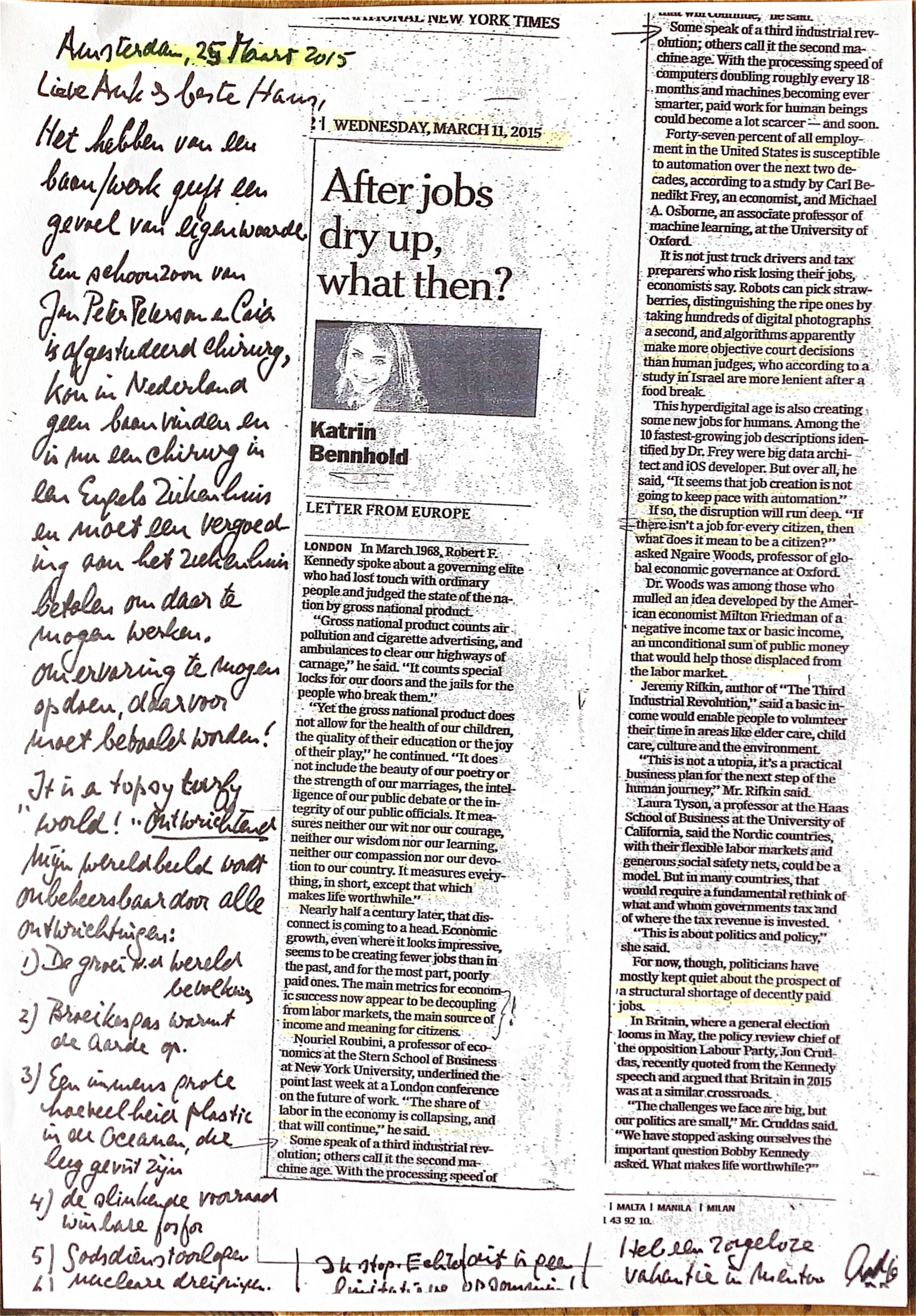
Amsterdam, 25 maart 2015.
Lieve Ank en beste Hans,
het hebben van een baan/werk geeft een gevoel van eigen waarde. Een schoonzoon van Jan Peter Peterson en Caia is een afgestudeerd chirurg. Kon in Nederland geen baan vinden en is nu chirurg in een ziekenhuis in Engeland en moet vergoeding aan het ziekenhuis betalen om daar te mogen werken en om ervaring te mogen opdoen. Daarvoor moet betaald worden ! "It's a topsy turvy world" of te wel ontwricht!
Mijn wereldbeeld wordt onbeheersbaar door alle ontwrichtingen:
1) De groei van de wereldbevolking.
2) "Broeikas" gas warmt het klimaat van de planeet Aarde op.
3) De immens hoeveelheid plastic in leeg geviste oceanen.
4) De slinkende voorraad winbare fosfor.
5) Godsdienst oorlogen
6) Nucleaire dreigingen
Ik stop met de opsomming, maar dit is niet een limitatieve opsomming van bedreigingen.
Heb een zorgeloze vakantie in Menton. Aadje
-------------------------------------------------------------------------------------------------------
WEDNESDAY, MARCH 11, 2015
" After jobs dry up, what then" by Katrin Bennhold
Letter from Europe
LONDON In March 1968, Robert F. Kennedy spoke about a governing elite who had lost touch with ordinary people and judged the state of the nation by gross national product
"Gross national product counts air. pollution and cigarette advertising, and ambulances to clear our highways of carnage," he said. "It counts special locks for our doors and the jails for the people who break them.
"Yet the gross national product does not allow for the health of our children, the quality of their education or the joy of their play," he continued. "It does not include the beauty of our poetry or the strength of our marriages, the intelligence of our public debate or the integrity of our public officials. It measures neither our wit nor our courage, neither our wisdom nor our learning neither our compassion nor our devotion to our country. It measures every- thing, in short, except that which makes life worthwhile."
Nearly half a century later, that disconnect is coming to a head. Economic growth, even where it looks impressive, seems to be creating fewer jobs than in the past, and for the most part, poorly paid ones. The main metrics for economic success now appear to be decoupling from labor markets, the main source of income and meaning for citizens. Nouriel Roubini, a professor of economics at the Stern School of Business at New York University, underlined the point last week at a London conference on the future of work.The share of labor in the economy is collapsing and that will continue," he said. Some speak of a third industrial revolution; others call it the second machine age.
With the processing speed of computers doubling roughly every 18 months and machines becoming ever smarter, paid work for human beings could become a lot scarcer and soon "Forty-seven percent of all employment" in the United States is susceptible to automation over the next two decades, according to a study by Carl Benedikt Frey, an economist, and Michael A. Osborne, an associate professor of machine learning, at the University of Oxford.
It is not just truck drivers and tax preparers who risk losing their jobs, economists say. Robots can pick strawberries, distinguishing the ripe ones by taking hundreds of digital photographs a second, and algorithms apparently make more objective court decisions than human judges, who according to a study in Israel are more lenient after a food break.
This hyperdigital age is also creating some new jobs for humans. Among the 10 fastest-growing job descriptions identified by Dr. Frey were big data architect and iOS developer. But over all, he said, "It seems that job creation is not going to keep pace with automation."
If so, the disruption will run deep. "If there isn't a job for-every citizen, then what does it mean to be a citizen?" asked Ngaire Woods, professor of global economic governance at Oxford.
Dr. Woods was among those who mulled an idea developed by the American economist Milton Friedman of a negative income tax or basic income, an unconditional sum of public money
that would help those displaced from the labor market.
Jeremy Rifkin, author of "The Third Industrial Revolution," said a basic income would enable people to volunteer their time in areas like elder care, childcare, culture and the environment.
"This is not a utopia, it's a practical business plan for the next step of the human journey," Mr. Rifkin said.
Laura Tyson, a professor at the Haas School of Business at the University of California, said the Nordic countries, with their flexible labor markets and generous social safety nets, could be a model But in many countries, that would require a fundamental rethink of what and whom governments tax and of where the tax revenue is invested."This is about politics and policy," she said,
For now, though, politicians have mostly kept quiet about the prospect of a structural shortage of decently paid jobs.
In Britain, where a general election looms in May, the policy review chief of the opposition Labour Party, Jon Cruddas, recently quoted from the Kennedy speech and argued that Britain in 2015
was at a similar crossroads. "The challenges we face are big, but
our politics are small," Mr. Cruddas said. "We have stopped asking ourselves the important question Bobby Kennedy asked. What makes life worthwhile?