Transcription
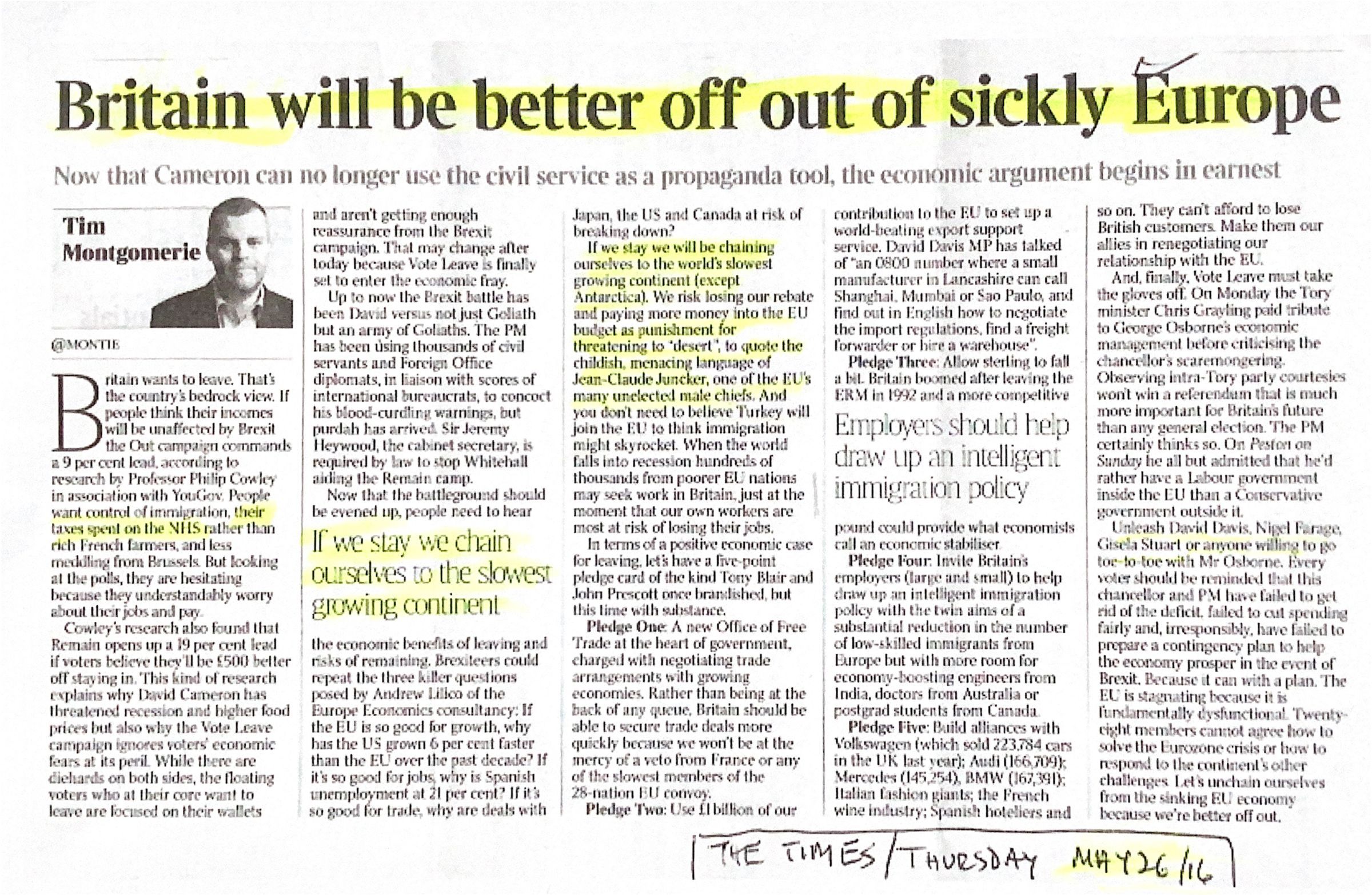
BRITAIN WILL BE BETTER OFF OUT OF SICKLY EUROPE
"Now that Cameron can no longer use the civil service as a propaganda tool, the economic argument begins in earnest," by Tim Montgomerie.
Britain wants to leave. That's the country's bedrock view If people think their incomes will be unaffected by Brexil the Out campaign commands a 9 per cent lead, according to research by Professor Philip Cowley in association with "YouGov. People" want control of immigration, their taxes spent on the NHS rather than rich French farmers, and less meddling from Brussels. But looking at the polls, they are hesitating because they understandably worry about their jobs and pay. Cowley's research also found that Remain opens up a 19 per cent lead if voters believe they'll be £500 better off staying in.
This kind of research explains why David Cameron has threatened recession and higher food prices, but also why the Vote Leave campaign ignores voters economicfears at its peril. While there are diehards on both sides, the floating voters who at their core want to leave are focused on their wallets and aren't getting enough reassurance from the Brexit campaign. That may change after today because Vote Leave is finally set to enter the economic fray.
Up to now the Brexit battle has been David versus not just Goliath, but an army of Goliaths. The PM has been using thousands of civil servants and Foreign Office diplomats, in liaison with scores of international bureaucrats, to concoct his blood-curdling warnings, but purdah has arrived. Sir Jeremy Heywood, the cabinet secretary, is required by law to stop Whitehall aiding the Remain camp.
Now that the battleground should be evened up, people need to hear
"IF WE STAY WE CHAIN OURSELVEST TO THE SLOWEST CONTINENT."
the economie benefits of leaving and risks of remaining. Brexiteers could repeat the three killer questions posed by Andrew Lillco of the Europe Economics consultancy: If the EU is so good for growth, why has the US grown 6 per cent faster than the EU over the past decade? If it's so good for jobs, why is Spanish unemployment at 21 per cent? If it's so good for trade, why are deals with Japan, the US and Canada at risk of breaking down?
If we stay we will be chaining ourselves to the world's slowest growing continent (except Antarctica). We risk losing our rebate and paying more money into the EU budget as punishment for threatening to 'desert", to quote the childish, menacing language of Jean-Claude Juncker, one of the EU's many unelected male chiefs. And you don't need to believe Turkey will join the EU to think immigration might skyrocket. When the world falls into recession hundreds of thousands from poorer EU nations may seek work in Britain, just at the moment that our own workers are most at risk of losing their jobs.
In terms of a positive economic case for leaving, let's have a five-point pledge card of the kind Tony Blair and John Prescott once brandished, but this lime with substance.
Pledge One: A new Office of Free Trade at the heart of government, charged with negotiating trade arrangements with growing economies. Rather than being at the back of any queue, Britain should be able to secure trade deals more quickly because we won't be at the mercy of a veto from France or any of the slowest members of the 28-nation EU convoy.
Pledge Two: Use £ l billion of our contribution to the EU to set up a world-beating export support service. David Davis MP has talked of "an 0800 number, where a small manufacturer in Lancashire can call Shanghai, Mumbai or Sao Paulo, andfind out in English how to negotiate the import regulations, find a freight forwarder or hire a warehouse".
Pledge 'Three: Allow sterling to fall a bit. Britain boomed after leaving the ERM in 1992 and a more competitive pound could provide what economists call an economic stabiliser
"EMPLOYERS SHOULD HELP
DRAW UP AN INTELLIGENT
IMMIGRATION POLICY."
Pledge Four. Invite Britain's employers (large and small) to help draw up an intelligent immigration-policy with the twin aims of a substantial reduction in the number of low-skilled immigrants from Europe but with more room for economy-boosting engineers from India, doctors from Australia or postgrad students from Canada.
Pledge Five: Build alliances with Volkswagen (which sold 223.784 cars): in the UK last year); Audi (166,709); Mercedes (145,254), BMW (167,391); Italian fashion giants; the French wine industry; Spanish hoteliers and so on. They can't afford to lose British customers. Make them our allies in renegotiating our relationship with the EU.
And, finally, Vote Leave must take the gloves off. On Monday the Torу minister Chris Grayling paid tribute to George Osborne's economic management before criticising the chancellor's scaremongering.
Observing intra-Tory parly courtesies won't win a referendum that is much more important for Britain's future, than any general election. The PM certainly thinks so. On Pestorn on Sunday he all but admitted that he'd rather have a Labour government inside the EU than a Conservative government outside it.
Unleash David Davis, Nigel Parage, Gisela Stuart or anyone willing to go toe-to-toe with Mr Osborne. Every voter should be reminded that this chancellor and PM have failed to get rid of the deficit, failed to cut spending fairly and, irresponsibly, have failed to prepare a contingency plan to help the economy prosper in the event of Brexit. Because it can with a plan. The EU is stagnating because it is fundamentally dysfunctional. Twenty-eight members cannot agree how to solve the Eurozone crisis or how to respond to the continent's other challenges. Let's unchain ourselves from the sinking EU economy because we're better off out.