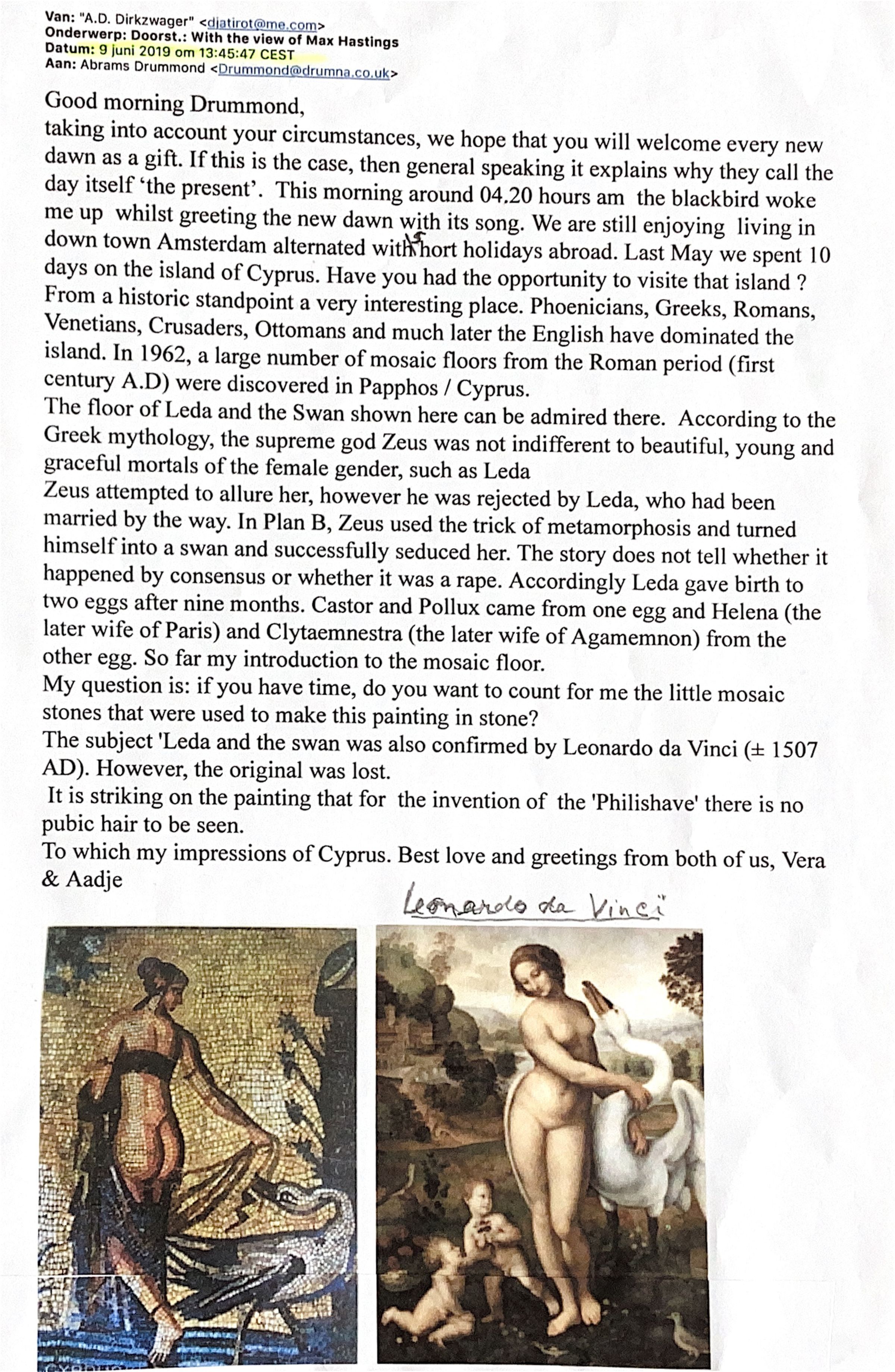
2019-06-09 Mail to Drummond Abrams about the mosaic floor of Leda and the swan.
Transcription
Van: "A.D. Dirkzwager" <[email protected]>
Onderwerp: With the view of Max Hastings
Datum: 9 juni 2019 om 13:45:47 CEST
Aan: Abrams Drummond <[email protected]>
Good morning Drummond,
Given your circumstances, we hope that you will welcome each new dawn as a gift. In fact, this explains why, in English, the day itself is referred to as 'the present' (a term that means both 'the current moment' and 'a gift'). This morning, around 4:20 a.m., I was awakened by a blackbird greeting the new dawn with its song. We continue to enjoy our life in the center of Amsterdam, interspersed with short vacations abroad. Last May, we spent 10 days on the island of Cyprus. Have you had the opportunity to visit that island?
From a historic standpoint a very interesting place. Phoenicians, Greeks, Romans, Venetians, Crusaders, Ottomans and much later the English have dominated the island. In 1962, a large number of mosaic floors from the Roman period (first century A.D) were discovered in Papphos / Cyprus. The floor of Leda and the Swan shown here can be admired there. According to the Greek mythology, the supreme god Zeus was not indifferent to beautiful, young and graceful mortals of the female gender, such as Leda.
Zeus attempted to allure her, however he was rejected by Leda, who had been married by the way. In Plan B, Zeus used the trick of metamorphosis and turned himself into a swan and successfully seduced her. The story does not tell whether it happened by consensus or whether it was a rape. Accordingly Leda gave birth to two eggs after nine months. Castor and Pollux came from one egg and Helena (the later wife of Paris) and Clytaemnestra (the later wife of Agamemnon) from the other egg. So far my introduction to the mosaic floor.
My question is: if you have time, do you want to count for me the little mosaic stones that were used to make this painting in stone?
The subject 'Leda and the swan was also confirmed by Leonardo da Vinci (+ 1507 AD). However, the original was lost. It is striking on the painting that for the invention of the 'Philishave' there is no pubic hair to be seen.
To which my impressions of Cyprus. Best love and greetings from both of us, Vera
& Aad