Buell, Erik
Name/Title
Buell, ErikTags
Ambassadors & Industry, Design & EngineeringDescription
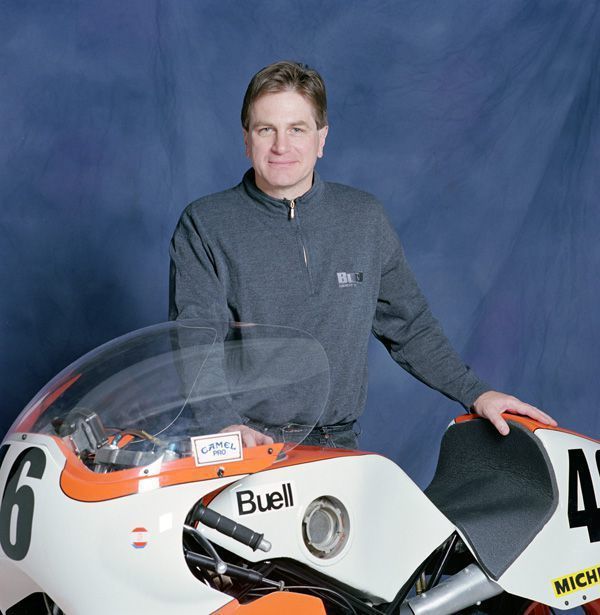
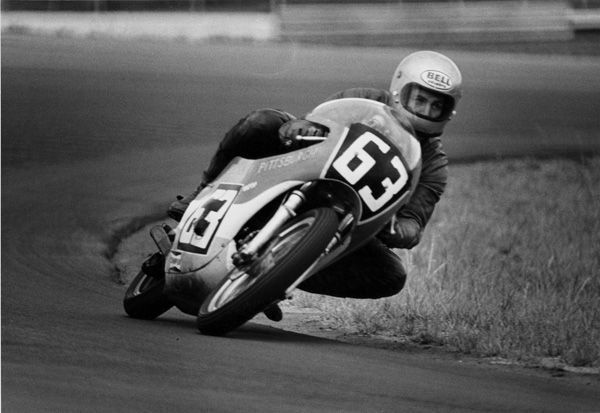
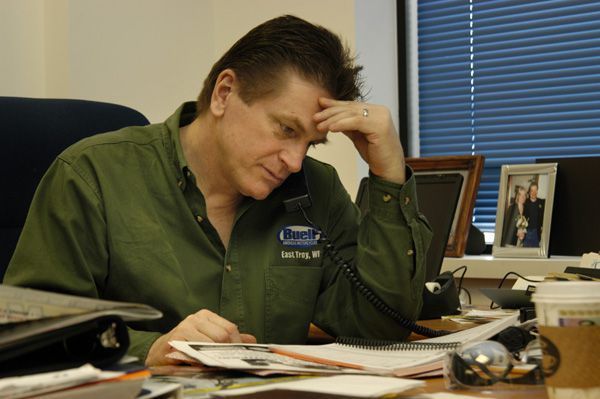
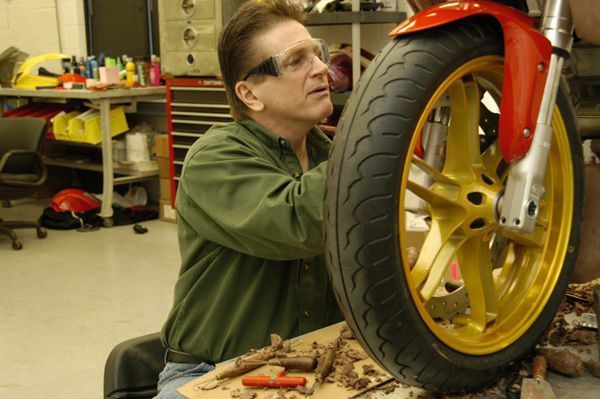
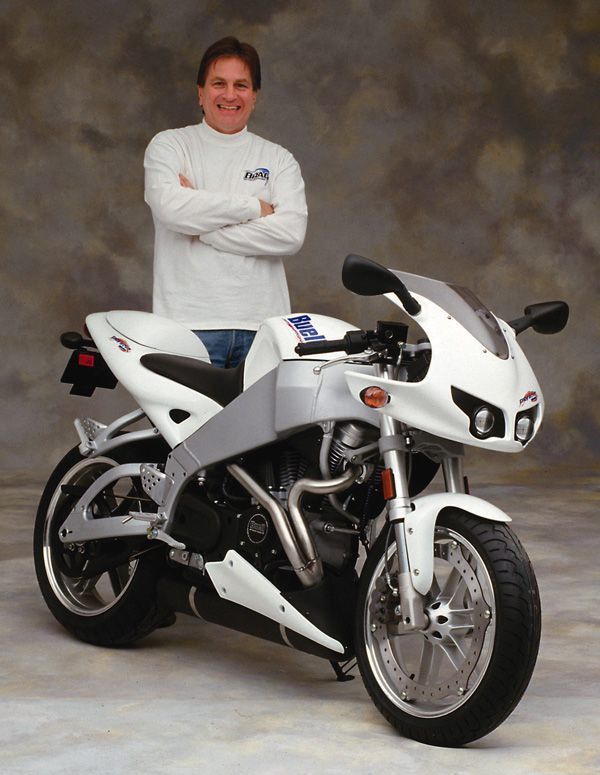
- Visionary American sportbike designer and engineer who created innovative machines like the RW750, RR1000, X1 Lightning, XB9R Firebolt, 1190RS and more - Founder of Buell Motorcycle Company, Erik Buell Racing and FUELL - Former AMA road racer and multi-time National Championship-winning team owner The most impactful and influential American motorcycle designer of the modern era, Erik Buell began his career as a chassis engineer at Harley-Davidson who competed on the AMA national road racing circuit in his spare time. Buell left his original position at Harley-Davidson in 1982 to pursue his dream of building his own racing motorcycle, a two-stroke racer called the RW750, which was built specifically for competition in AMA Formula One racing. When the AMA dropped the Formula One class shortly after he sold his first RW750, Buell abandoned the racebike project and instead turned his attention to creating the first world-class sportbike designed and built in America. This effort led to the creation of the Buell RR1000 — released in 1987 and powered by a Harley-Davidson V-twin engine — which kicked off a three-decade-long roller coaster ride that saw Erik Buell reinvent himself and his American Sportbike dream multiple times, pulling off some of the most remarkable comeback stories the American motorcycle industry has ever witnessed in the process. Buell was born in Pittsburgh on April 2, 1950. He grew up on a farm and learned to work on mechanical equipment from a young age. As a teenager, Buell, like many of his generation, took up motorcycling. His first machine was an Italian-made Parilla 90cc moped. He then progressed through a series of bigger bikes and even raced motocross before becoming interested in road racing in his early 20s. Buell progressed through the club ranks and by the mid-1970s began competing in AMA national road races. By the late 1970s, Buell was a top privateer racing a Yamaha TZ750 in AMA Formula One and a Ducati Super Sport in Superbike, where he even scored a few top-10 finishes. After earning his engineering degree from the University of Pittsburgh in 1979, Buell turned down more lucrative offers from other major companies to pursue a career with Harley-Davidson instead. He flew himself to Milwaukee to beg for an interview and basically “beat my way in the door,” Buell later said. Once inside Harley-Davidson, Buell worked on chassis design and applied his considerable racing expertise to testing Harley-Davidson’s heavyweight cruiser motorcycles. Buell’s rigorous test riding, along with the state-of-the-art electronic chassis testing instrumentation and development test methodology he implemented, helped to greatly improve the handling of Harley’s street bikes during that crucial period in the company’s history. With Harley-Davidson going through tough times in the early 1980s, Buell didn’t feel comfortable racing a Japanese or Italian motorcycle. He’d heard about a small manufacturer named Barton in England that was producing a 750cc two-stroke GP racing motorcycle. He purchased one of the bikes with the idea of racing it in Formula One, but he found the bike was so poorly manufactured that it was far from race-ready. He began improving the engine and building a new chassis himself when he found out that Barton had gone out of business. Instead of abandoning his project, he purchased what little remained of the Barton operation and had it shipped to his home workshop in Wisconsin. Buell refined the bike as much as he could and dubbed it the RW750 (RW standing for “Road Warrior”). He did well enough at the club level with the machine, but its temperamental and overpowered motor made the RW750 a difficult bike to ride, and the reliability wasn’t sufficient for AMA racing. “The bike was incredibly hard to ride,” Buell recalled. “The power was like a light switch. This thing was a monster. It was terrifying to ride.” Buell eventually left his job at Harley-Davidson and dedicated himself full time to developing the RW750 for sale, eventually offering it to racers for $17,000 — a steal at a time when Yamaha TZ750s were becoming unobtainable and Honda GP bikes were well over $30,000. Unfortunately, his timing couldn’t have been worse. Superbike had supplanted Formula One as the premier AMA road racing class and the AMA decided to discontinue Formula One, leaving Buell with little to no market for his two-stroke racer. This was the first of many crossroads for Buell. He could have begged for his old job back at Harley-Davidson, but, instead, he turned the setback into an opportunity. He had built a solid road racing chassis. All it needed was a good motor. Through his relationship with Harley-Davidson, he knew the factory had some unused XR1000 racing engines available. Buell had ridden an XR1000 to a podium finish at the 1983 Road America Battle of the Twins National, so he knew the engine had potential. The wheels started turning. In 1985, Buell mated a Harley-Davidson XR1000 engine to his custom, Grand Prix-style chassis and created the Buell RR1000. From the very start, Buell established a reputation for building excellent-handling motorcycles. Riders looking for an American sportbike finally had a place to turn. Buell sold 50 of the original RR1000s — most of which were sold through Harley-Davidson dealers — before he released his second generation of Harley-Davidson-powered bikes, the RR1200 and RS1200 motorcycles, which used the new-and-improved Harley-Davidson Evolution engines. Over the next several years, Erik Buell refined those original concepts into his own line of street-legal motorcycles, all while maintaining close relations with Harley-Davidson. In the mid-‘90s, H-D began to invest in the motorcycle company its former engineer founded, eventually increasing its ownership to 100 percent of the Buell brand by 2003. With Erik’s unflinching vision backed by Harley-Davidson’s financial muscle, the Buell brand went on to create some of the most innovative motorcycles of the early 2000s — including the Firebolt XB9R that carried its fuel inside the frame, oil inside the swingarm, and featured a massive perimeter-mounted front brake and compact, underbike exhaust. The closely related Buell Lightning XB9S streetfighter was a leader ushering in the “Naked Bike” era of the mid-2000s, all while Buell remained deeply committed to road racing, with Buell-supported riders winning countless AMA nationals in the Formula Xtreme and Pro Thunder classes, as well as other championships around the world. In 2009, a liquid-cooled Buell 1125R piloted by Danny Eslick won the AMA Daytona SportBike Championship; however, due to financial strains caused by an economic recession, Harley-Davidson suspended production of the Buell product line in October of that year — after selling more than 136,000 Buell motorcycles. Once again, it looked like Erik Buell had reached the end of his rope. And once again, Erik Buell rose like a phoenix from the ashes, this time launching a new venture named Erik Buell Racing (EBR). Freed from the boardrooms and business meetings that consumed his attention at Harley-Davidson, Buell was now free to focus full time on his true passion — creating world-class American sportbikes. The first product released by EBR arrived in 2011 — the breathtaking 1190RS, an all-carbon-fiber beauty powered by a liquid-cooled V-twin that produced 175 horsepower and featured the latest iterations of Buell’s various chassis, suspension and braking innovations. This latest machine reaffirmed Buell’s reputation as one of the most talented and tenacious designers and engineers working in the motorcycle industry, in any country. The limited-production 1190RS was quickly followed by two more accessible production models: the 1190RX superbike and the 1190SX naked bike. In 2013, Indian motorcycle giant Hero MotoCorp paid $25 million for a 49.2% stake in Buell’s latest venture, positioning EBR as a technology provider for Hero and resulting in a rush of innovative concept bikes ranging from hybrids to commuters and utility bikes for the developing world. Despite this investment, EBR remained under financial stress and once again was forced into receivership in spring 2015. Unbelievably, Erik Buell transformed what many thought would be yet another dead end into his next great opportunity. This time Buell pivoted toward the emerging electric vehicle market, co-founding a venture with French entrepreneurs Frédéric Vasser (a legendary F1 team manager for Ferrari, Renault, Sauber and Alfa Romeo) and François-Xavier Terny. Operating under the FUELL banner, Buell developed a futuristic electric motorcycle dubbed Fllow and a sophisticated eBicycle dubbed Flluid, but post-pandemic supply chain disruptions and EV market headwinds put the new venture deep into debt and saw it shuttered in late 2024. (A separate firm named Buell Motorcycle Company, which bought the EBR assets in 2016 and acquired the rights to the Buell name from Harley-Davidson in 2021, announced some new models based on the old EBR platforms in 2025, but it is important to note that Erik Buell has no involvement with this entity at all.) At the time of this writing (2026), Buell was mostly focused on recording with his blues band “The Thunderbolts,” but we know better than to ever count him out. During his remarkable career in the motorcycle industry, he has become seemingly immune to disappointment. Whether it’s breaking bikes (and bones) as a professional road racer, facing financial ruin after changing racing rules made his first motorcycle instantly obsolete, or even losing the rights to his patents and the use of his own name, Erik Buell has truly mastered the art of overcoming hardship. His is one of the most remarkable stories in all of motorcycling, and very worthy of the AMA Motorcycle Hall of Fame.Category
Class of 2002