Christenson, T. C.
Name/Title
Christenson, T. C.Tags
Specialty CompetitionDescription
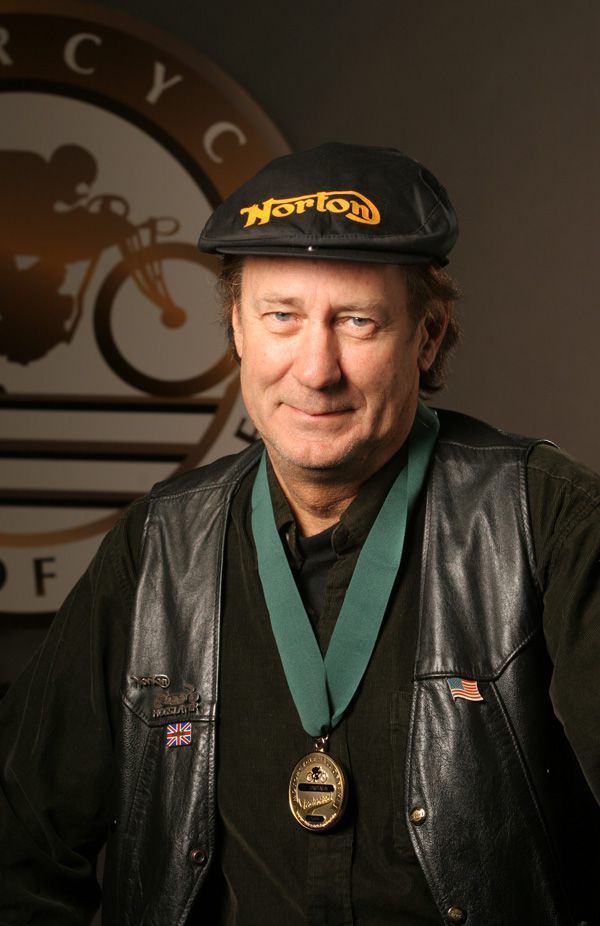
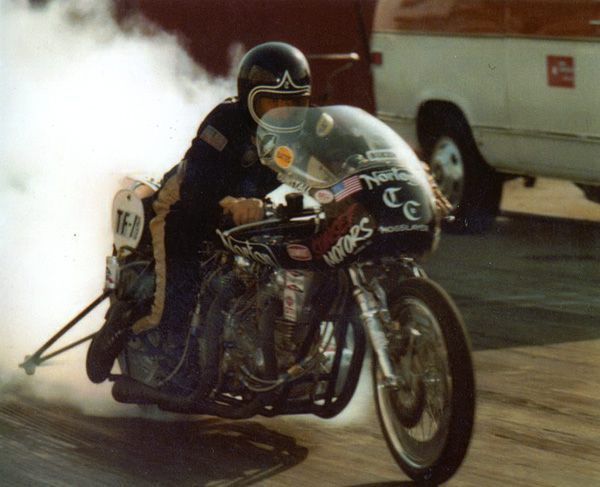
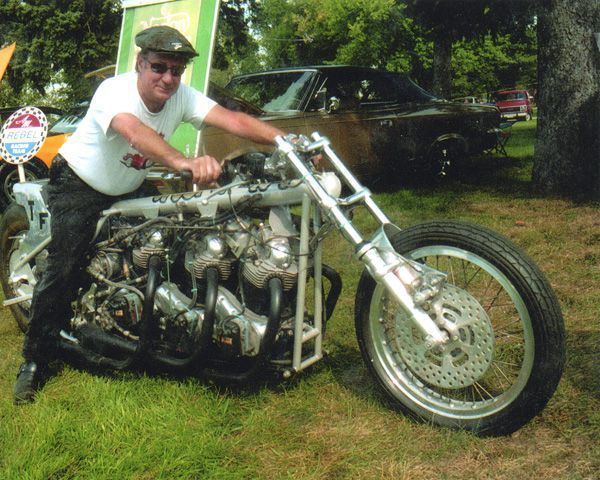
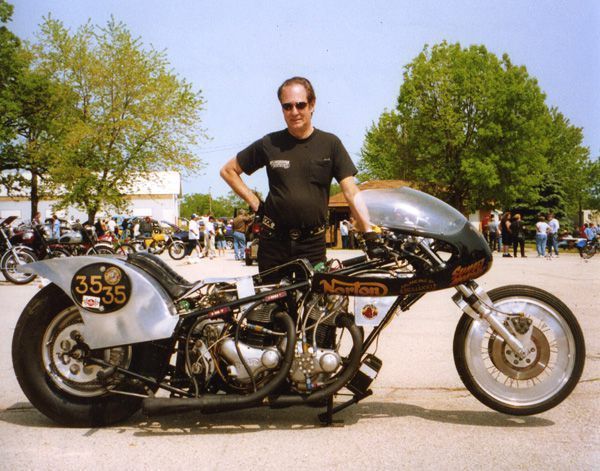
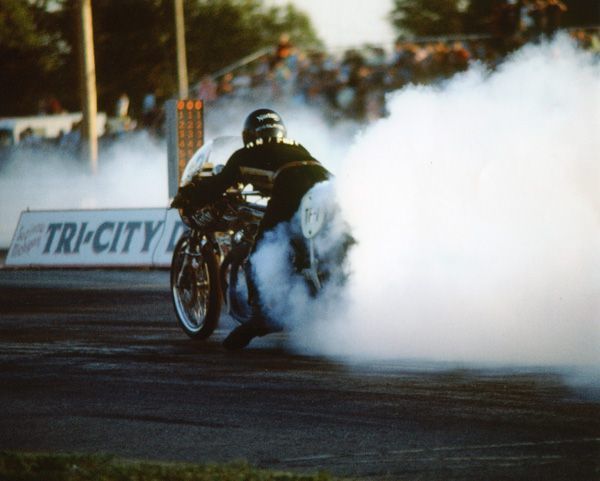
• Dominant American drag racer of the 1970s • Four-time NHRA Motorcycle Drag Racing World Champion • Creator of the famed “Hogslayer” twin-engined Norton drag bike Thomas Lee “T.C.” Christenson set the drag racing world on fire in the 1970s when he emerged from Kenosha, Wis. — just a few miles south of the Harley-Davidson factory in Milwaukee — and set a slew of speed and e.t. records on his twin-engined Norton Top Fuel drag bike he provocatively named “Hogslayer.” Wearing his trademark mirror sunglasses, Christenson exuded an aura of cool that made him a fan favorite. He became a drag racing legend during a golden era of the sport that saw a seemingly endless array of new innovations every season — many of them pioneered by Christenson and his tuner/partner John Gregory. Hogslayer was an extremely influential motorcycle, and with it Christenson bridged the gap between motorcycle drag racing’s unorganized and amateur days to the professional sport it would soon become. Christenson was born in 1943 and raised in Kenosha, Wis. During the 1950s, Kenosha was a blue-collar town that was home to a large American Motors auto manufacturing plant. As a teen, Christenson went through what he described as his “juvenile delinquent” stage. He played in the high school band and was thinking of starting a rock band, but a chance encounter with a motorcycle rider changed the young Christenson’s mind. “I got out of school one day and was walking down the street,” Christenson recalled. “Up to the light comes this guy on a brand-new Triumph with a beautiful blonde riding on the back. The light turned green, he gave me a wave and roared away. I thought, ‘Man, this motorcycling stuff is pretty cool. That’s what I should get into.’” At 15, he bought a dilapidated Whizzer motorbike for $10 from a buddy’s brother. “It was the middle of winter, and I had to dig the thing out of a snowbank,” Christenson said. During the rest of the winter, he worked on the bike to try to get it running, but to no avail. In the spring, he took the bike to a local Harley-Davidson dealership and one of the mechanics said he could get it running for $25. When he came to pick up the motorbike, the Harley mechanic gave him a quick run-through on the controls and off he went into the crowded downtown streets of Kenosha. “American Motors had just let out and the traffic was thick,” Christenson remembered. “I started peddling this thing and let out the clutch and the engine started and ran wide open. I couldn’t shut it off and I’m going 40 mph dodging traffic in a panic. I came to a red light and blew right through it. The only thing that saved me was the thing had open pipes, and they all heard me coming. My motorcycling career was nearly over less than a minute after it started. My heart didn’t slow down for two days.” Before long, Christenson dove headlong into motorcycling. During the early 1960s, he started hanging out with other riders and eventually got a job at a local BSA shop. It was then that he began drag racing. At first, it was strictly outlaw drags on rural roads racing for beers and bucks. Another one of the unusual forms of racing he also participated in was so-called “lime bag runs,” where an advance rider would throw down baseball-sized lime bags at intersections and street racers would follow the bags for 50 or 60 miles in a continuous street race. He said many of those illegal races ended in the riders taking off in every direction running from the police. By 1963, Christenson began to take his drag racing talent from the street to the strip when nearby Union Grove Drag Strip began to hold all-bike drag competitions. Even though he rode his bike to the race, Christenson’s BSA was deemed by drag racing officials too highly modified to run the Street Bike class, so they made him sign up in the Gas division. He ended up in the final against a Vincent and he and the Vincent were wheel to wheel at the start, but the Vincent rider missed a shift and Christenson cruised to victory in his very first sanctioned race. Christenson moved on to drag racing Nortons and went to work at Sunset Motors, a nearby Norton dealership owned by John Gregory. Gregory was a very clever tuner, and he and Christenson soon became a winning team with the Nortons. Christenson quickly became the rider to beat all across the Upper Midwest. In the mid-1960s, Christenson also took up motorcycle road racing for a short period and had some success racing a 250cc Ducati Diana as a novice in the Lightweight division at Daytona. In 1969, Christenson bought the Sunset Motors motorcycle dealership from Gregory and the two continued to build 750cc Norton drag racing bikes. “John [Gregory] was the real brains behind the operation,” Christenson said. Their Norton was equipped with a fuel-injection system retrofitted from an Offenhauser race car engine. At the biggest motorcycle drag meet of 1969, held in Bowling Green, Ky., Christenson got his first national recognition by winning the C Fuel class against the nation’s best, setting a new class record in the high 9-second range at over 140 mph — from a stock bore-and-stroke Norton. It was at the Bowling Green event that Christenson first saw Boris Murray’s double-engine Triumph drag bike. That bike inspired him and Gregory to set to work building their first twin-engine Norton. “Kenosha was the perfect place to build racing motors,” Christenson said. “It was a factory town with machine shops everywhere and it seemed like the whole town got behind us and pitched in to help build our double-engine bikes.” Three different versions of the double-engine Norton were built in the early 1970s. By 1972, the third version of the Hogslayer (named for its ability to beat the dominant Harley-Davidson drag racers of the day) became the most advanced drag racing motorcycle in the country at the time. It featured many firsts, including: the first slipper clutch (using bronze-sintered plates adapted from a giant earthmover), fuel injection, a two-speed transmission (based on an overdrive unit from a Rambler automobile), revolutionary aerospace materials used in an aerodynamic frame, and a rear drag slick specially made for the Hogslayer by M&H that was eight inches wide, more than twice the normal tire width for that era. With the 300-plus horsepower produced by the combined 1,620cc, nitro-burning Hogslayer, Christenson ultimately ran in the mid-7s at more than 180 mph and for most of the early-to-mid-1970s he was the fastest drag racer on the planet. In 1972, he won the NHRA U.S. Nationals in the first year that Fuel Bikes were part of the program. In 1973, he lost only once and set the A/Fuel Bike elapsed time record with a 7.83-second run en route to his Top Fuel win at the NHRA National Motorcycle Record Championships in Bowling Green, Ky. He set numerous world records and was featured in countless motorcycle magazines. Christenson also won the official NHRA Fuel Bike National Championship in Indianapolis in 1976. Norton was duly proud of Hogslayer, and Christenson and Gregory were brought across the pond to England three times to give special demonstration runs in front of a national television audience with the now-famous machine. Christenson always seemed to have a pretty blonde by his side at the races, and he carefully cultivated his laid-back, rock-star status among drag fans. Terry Vance was a young, up-and-coming street-class drag racer during Christenson’s rise, and he vividly remembers Christenson’s influence. “T.C. was the Don ‘Big Daddy’ Garlits of bike racing — part gunslinger, part rock star, always ready to set the world on fire. He made a big impression on me,” said Vance, who would become a dominant Top Fuel motorcycle drag racer in the 1980s. Christenson saw many awesome crashes among his fellow Top Fuel riders. He escaped a long career relatively unscathed, despite suffering one of the most memorable crashes in Top Fuel motorcycle racing. It was in Columbus, Ohio, in 1974. Christenson was making a simple warm-up pass. Everything seemed normal until he shut off the throttle. At that point, Hogslayer went into a high-speed wobble. Christenson takes it from there: “That wobble was so violent that it literally broke the steering-stop right off the frame,” he said. “Then it ripped off the hydraulic steering dampeners, and it was shaking so hard it nearly pitched me off. At that point, I would have hit a guardrail. The front end was falling off the bike and just before I hit the ground, I nailed the throttle and that lifted the front end off the ground and suddenly I’m going straight down the drag strip beautifully. “I knew I had to shut it off sooner or later, so I decided I would shut off and bail at the same time. I shut the bike down and pushed off the back of the bike. I caught my foot under the bike as I slammed to the ground, and it spun me around and now the bike was chasing me down the strip. I went through the speed trap at 150 mph, the bike following right behind me at 149.5. I slid for a quarter mile and my leathers were smoking. The bike dug in and started doing huge end-over-end flips. When I finally came to a smoldering stop, I was in the fetal position, and I started moving different parts of my body. When I got out of that thing with fairly minor injuries, I felt like I’d just hit the lottery.” By the late 1970s, the supercharged single-engine Japanese bikes began surpassing the twin and triple-engined bikes of the early-to-mid-’70s era. The biggest blow to Christenson’s racing career was when Norton ceased production in 1975. The sales of Nortons in his motorcycle dealership had subsidized the tremendous expense of keeping Hogslayer running and, when that source dried up, Christenson’s racing career began to wind down. By the early 1980s, he was only making limited exhibition and reunion runs with the bike. He also was forced to scrap a side-by-side twin-engine supercharged Norton project. In 2004, Hogslayer was made part of the NHRA’s “Golden 50” display at the U.S. Nationals in Indianapolis. It was the most comprehensive collection of historic drag racing vehicles ever assembled in one location. The British National Motorcycle Museum in Birmingham, England, now keeps Hogslayer on permanent display. It was one of the featured motorcycles in the grand re-opening of the museum. The bike even had a song written about it. When inducted in the Motorcycle Hall of Fame in 2005, Christenson was still running Sunset Motors in Kenosha, as he continued to build his legacy as one of the elite riders in the history of motorcycle drag racing. In the 2010s, Christenson’s remarkable story reached a new generation with the release in 2011 of James Cutting’s documentary titled Hogslayer: The Unapproachable Legend, which detailed the partnership and success between Christenson and Gregory in the 1970s. T.C. Christenson passed away peacefully on September 21, 2023, following a brief illness. His passing was noted by the NHRA, the AMA and drag racing fans from all around the world. The Hogslayer was even brought out of the National Motorcycle Museum to make a few exhibition passes at Santa Pod Raceway’s Dragstalgia event in July 2024, to honor Christenson’s memory and impact on both British and American drag racing.Category
Class of 2005