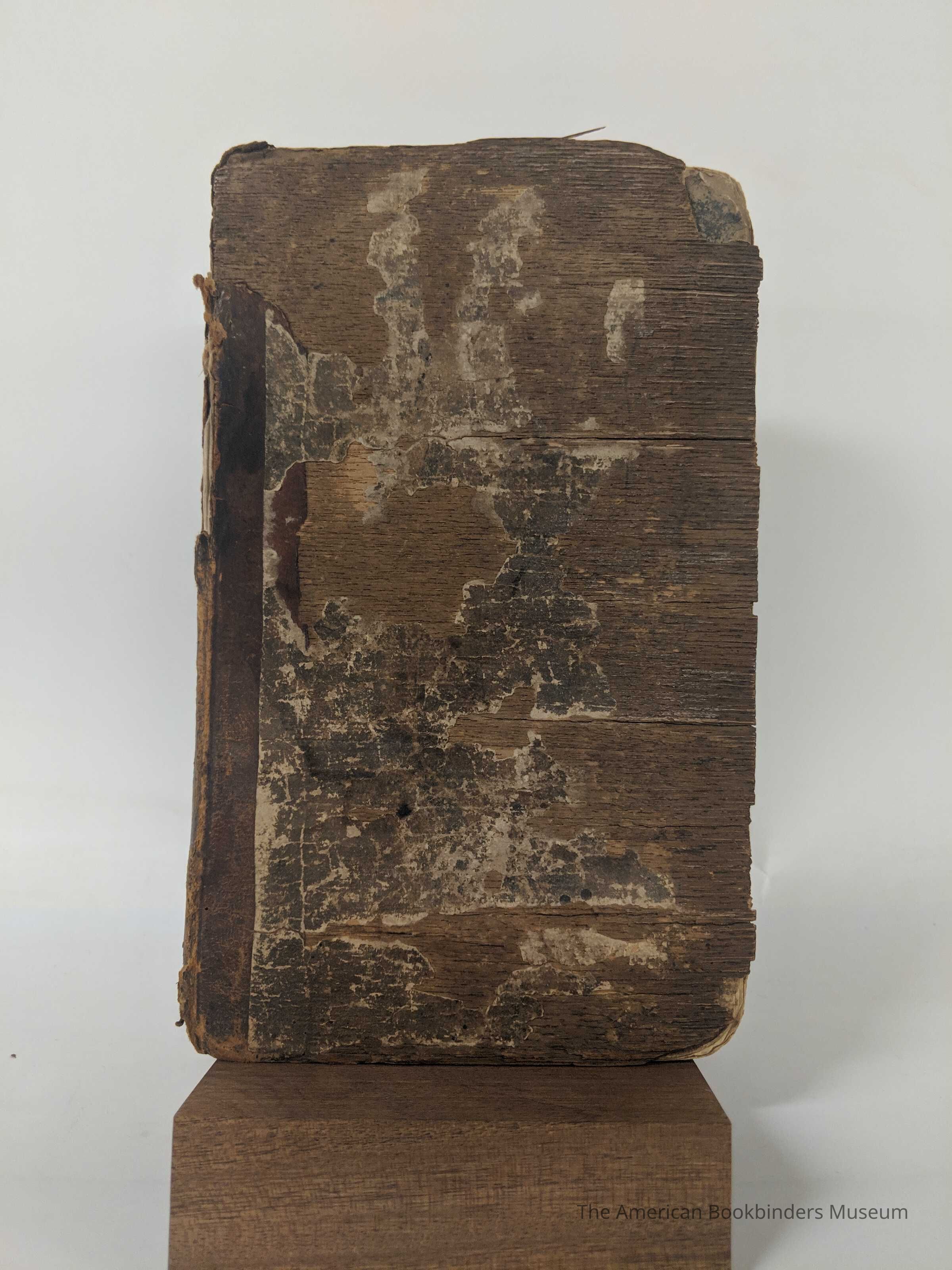
The scholar's arithmetic; or, Federal accountant ... The whole in a form and method altogether new, for the ease of the master and the greater progress of the scholar

Name/Title

The scholar's arithmetic; or, Federal accountant ... The whole in a form and method altogether new, for the ease of the master and the greater progress of the scholar

Entry/Object ID

2017.13.2

Description

iv, 224 pages. Illustrations. Spine and hinges worn, but partially holding. Possibly pre-cut channels for signature stitching. Contemporary calculations and notes throughout. At 5x8.5", this book is larger than most surviving examples of this early American "text-book" style binding. Per WorldCat, Prentiss issued several editions (from stereotype plates) between 1806 and 1826. The book is relatively rare but available in microfilm, reprint, and digital formats. With custom drop-spine box, trays lined with Cockerell Paper.

Collection

Representative Bindings

Lexicon

Search Terms

Arithmetic, Scaleboard

Dimensions

Height

8-1/2 in

Width

5 in

Book Details

Author

Daniel Adams

Edition

Stereotype, revised and corrected with additions.

Publisher

J. Prentiss

Place Published

City

Keene

State/Province

New Hampshire

Country

United States

Continent

North America

Date Published

1819

Binding

Binding Type

Scaleboard

Binding Notes

Scabbard or scaleboard binding - fragile and rare. Quarter calf, partially worn away, over very thin wooden boards with grain across the board (not parallel to the spine). The corners of the boards are chipped, and only fragments of the paper covering remain.

Interpretative Labels

Label Type

Cultural/Historical Context

Label

Scaleboard bindings were a quintessential 17th and 18th century American binding style. An abundance of local wood led to the use of thin, planed boards of oak, maple, birch, and ash (called scaleboards) to protect the text block, rather than expensive and imported pasteboard. American scaleboards were typically cut with a horizontal grain and were used to cover schoolbooks, religious texts, tracts, and pamphlets; their earliest American usage dates back to 1635. Scaleboard bindings were typically small, economical, and meant for every-day use. They were bound by stabbing the text block, speeding-up the binding process and reducing the cost of the finished book. Decoration was fairly plain: most were untitled, flat spined, tight back books, covered in full sheep- or calf-skin, stained a dark brown and blind tooled with simple panel decorations. Later scaleboard bindings were typically bound in quarter leather with paper covering the rest of the boards, such as the one on display here.

Label Type

Object Label

Label

The scholar's arithmetic; or, Federal accountant ... The whole in a form and method altogether new, for the ease of the master and the greater progress of the scholar. Daniel Adams J. Prentiss, New Hampshire (1819) Sidney F. Huttner Collection 2017.13.2 Quarter calf, partially worn away, with fragments of the paper sides, over very thin wooden boards with horizontal grain (perpendicular to the spine). The corners of the boards are chipped, a common defect in scaleboard bindings due to the thinness of the wooden boards.