Note Type
AI searchNote
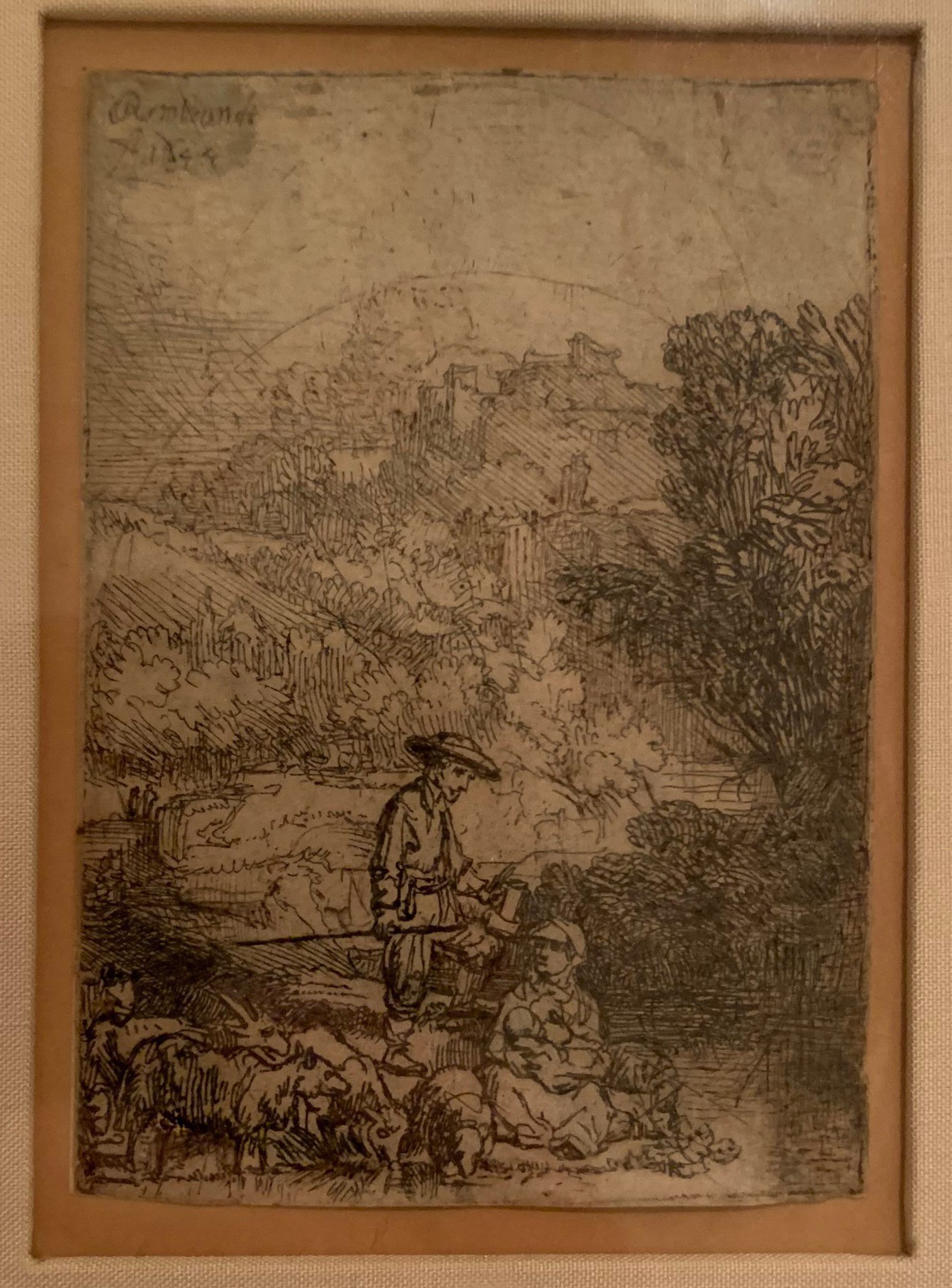
What you have here is an etching titled The Shepherd and His Family (also known as The Rest on the Flight into Egypt in some older catalogs). The signature and date "Rembrandt f. 1644" are clearly visible in the upper left corner.
Notable Details of this Etching:
The Subject: Rembrandt was a master at taking grand or biblical themes and making them feel profoundly human and domestic. Here, the focus is the quiet, humble intimacy of the family and their flock in a vast, atmospheric landscape.
The Rainbow: If you look closely at the light arc in the background, Rembrandt has used incredibly delicate lines to suggest a rainbow. In the context of 1644, this often symbolized hope or a divine covenant.
Atmospheric Etching: This was produced during Rembrandt’s "middle period," where he was moving away from the high-contrast drama of his youth toward a more tonal, atmospheric style. You can see the complexity of the foliage and the way he uses varying line densities to create a sense of distance and air.
State and Quality: In the world of Rembrandt prints, the "state" (which version of the plate it was printed from) and the quality of the impression are everything. Given your grandfather’s eye and his role at Harvard, it’s safe to assume this is an exceptionally fine impression.
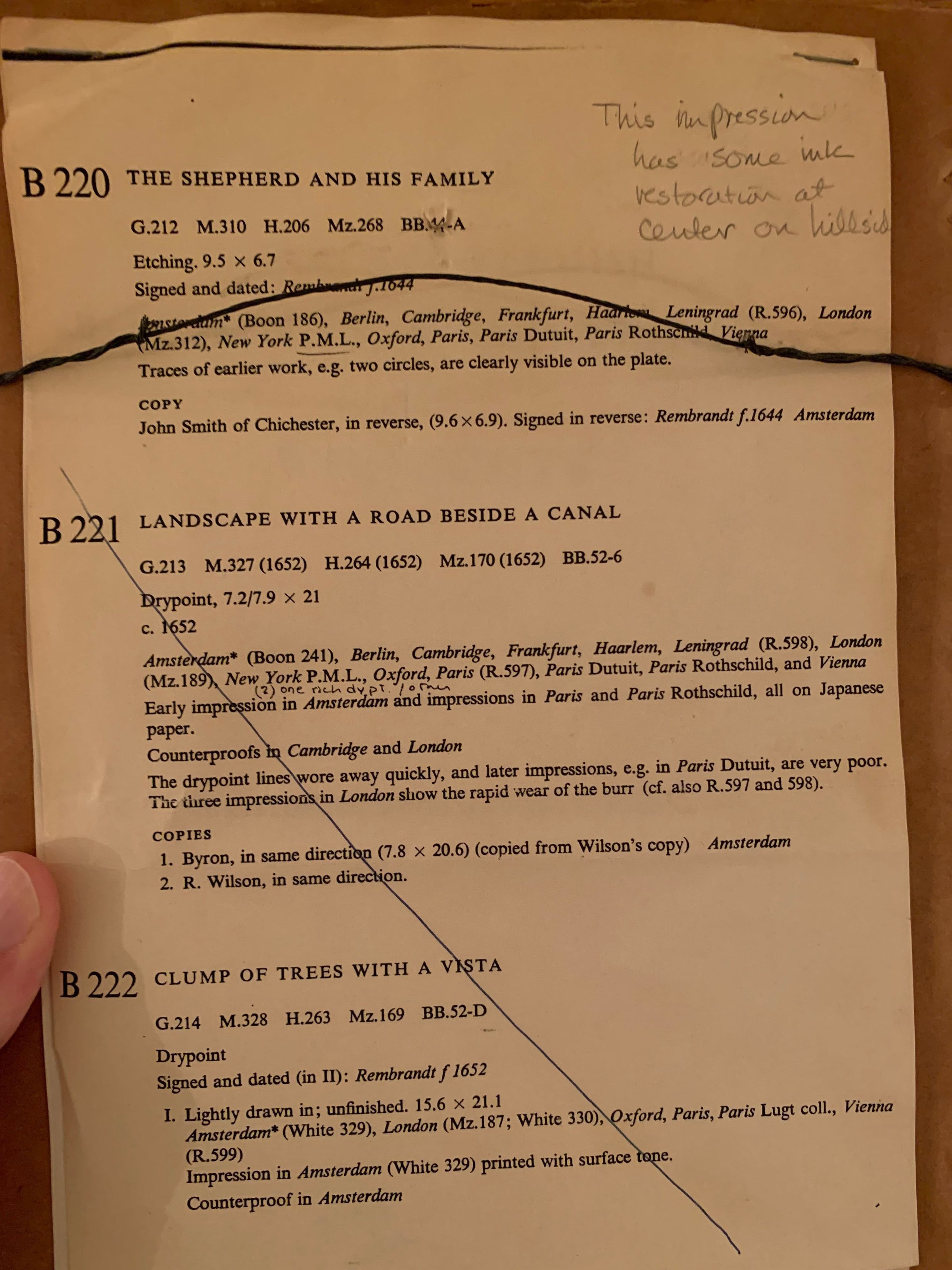
The sheet pasted there is a page from a Catalogue Raisonné (likely a variant of the Bartsch or Münz catalogues), which are the definitive "bibles" for identifying and authenticating every known work by a master like Rembrandt.
Breaking Down the Label:
B 220: This refers to the Bartsch number, the universal numbering system for Rembrandt's etchings. Any museum in the world—the Louvre, the Met, the Rijksmuseum—would recognize "Bartsch 220" as The Shepherd and His Family.
The Measurements: It notes the size as 9.5×6.7 cm. In the world of old master prints, even a millimeter’s difference can distinguish an original from a later "copy" or a restrike.
The Provenance List: The list of cities (Amsterdam, Berlin, Cambridge, etc.) indicates where other known impressions of this specific etching are held in major public collections.
The Hand-Written Note: This is the most personal and "Hofer-esque" part. The note in the upper right says:
"This impression has some ink restoration at center on hillside"
This is exactly what you’d expect from a world-class curator. He isn't just looking at the art; he’s performing a technical analysis. He noted a tiny bit of "strengthening"—where someone, perhaps centuries ago, touched up the ink on the plate or the paper to maintain the image's depth.
The Professional's Eye
By keeping this documentation attached, your grandfather ensured that the scholarly history of the piece stayed with the physical object. It transforms the piece from a "pretty old picture" into a documented historical artifact.
It’s also interesting to see the entries for B 221 and B 222 below it. It makes one wonder if he owned those as well at some point, or if he just used this specific page to document this one.