Note Type
AI searchNote
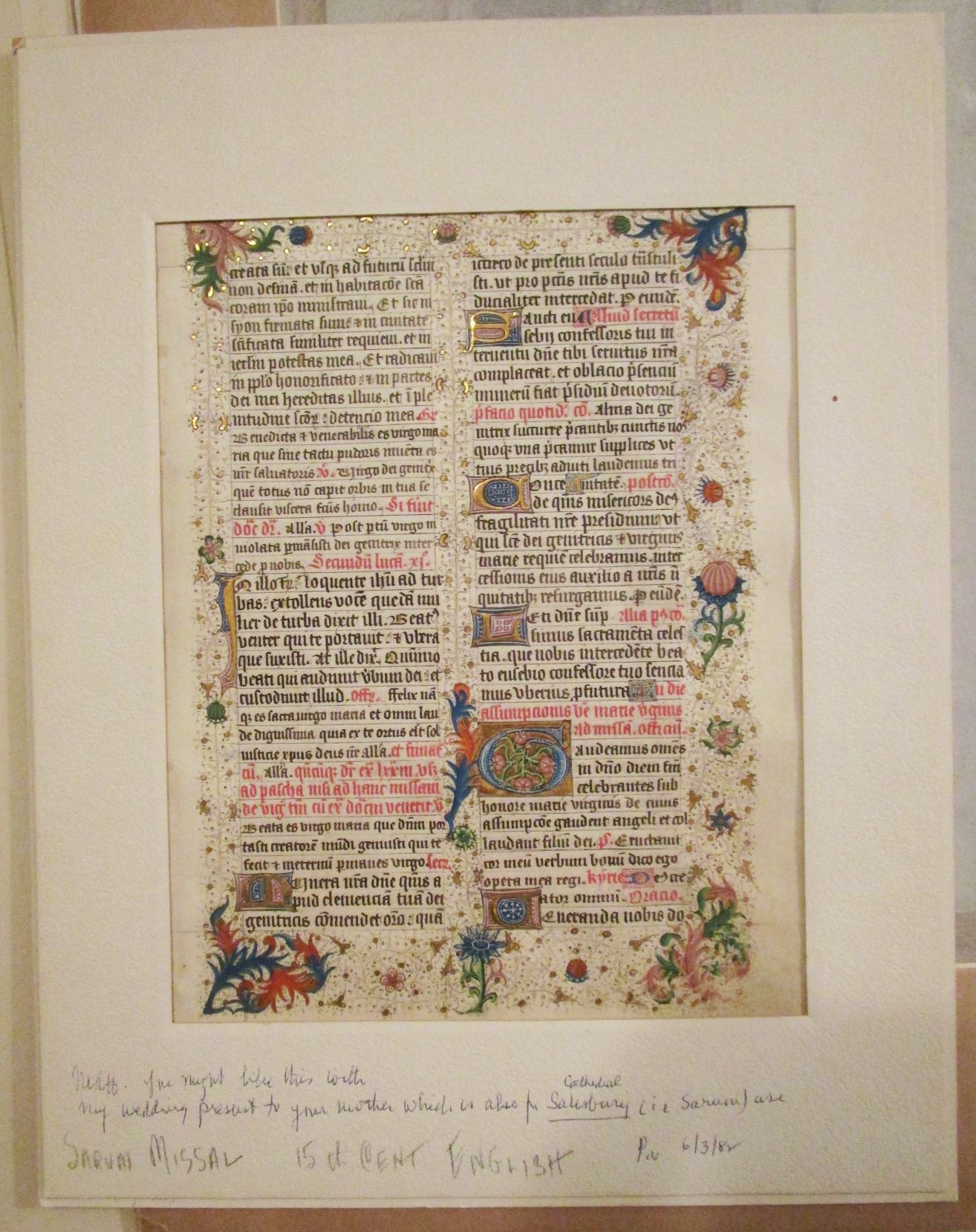
This is a leaf from a Sarum Missal, a medieval liturgical book, dating to the 15th century.
As the handwritten note at the bottom indicates, it is of English origin, specifically following the "Use of Sarum" (Sarum being the Latin name for Old Sarum/Salisbury). This was the most influential variation of the Roman Rite used in medieval England before the Reformation.
Visual and Liturgical Breakdown
The Script: This is written in Textura Quadrata (or "Blackletter"), a dense, vertical gothic script characterized by its sharp angles and "picket fence" appearance.
Illumination: The borders feature vibrant "acanthus leaf" motifs and delicate pen-work scrolls typical of English workshops in the 1400s. The use of burnished gold leaf on the raised "champ" initials (the small gold squares with blue and pink letters) indicates a high-status commission.
Rubrication: The text in red (from the Latin rubrica for red ochre) provides instructions to the priest on how to conduct the mass, while the black text is the actual prayer or scripture to be spoken.
The Content: A Mass for the Virgin Mary
The text contains specific prayers and readings. On the right column, you can see the "Introit" (opening chant) beginning with a large illuminated "G":
"Gaudeamus omnes in Domino diem festum celebrantes sub honore Mariae Virginis..."
(Let us all rejoice in the Lord, celebrating a festival day in honor of the Virgin Mary...)
This suggests the page is from a Votive Mass for the Virgin Mary, likely for the Feast of the Assumption or a similar Marian celebration.
The "Sarum" Context
The note mentioning "Sarum Use" is historically significant. While the Catholic Church generally followed a standardized rite, the Bishop of Salisbury (Sarum) developed a localized version in the 11th century that eventually became the standard for nearly all of Southern England. It was known for its elaborate processions and specific musical sequences.