Note Type
AI searchNote
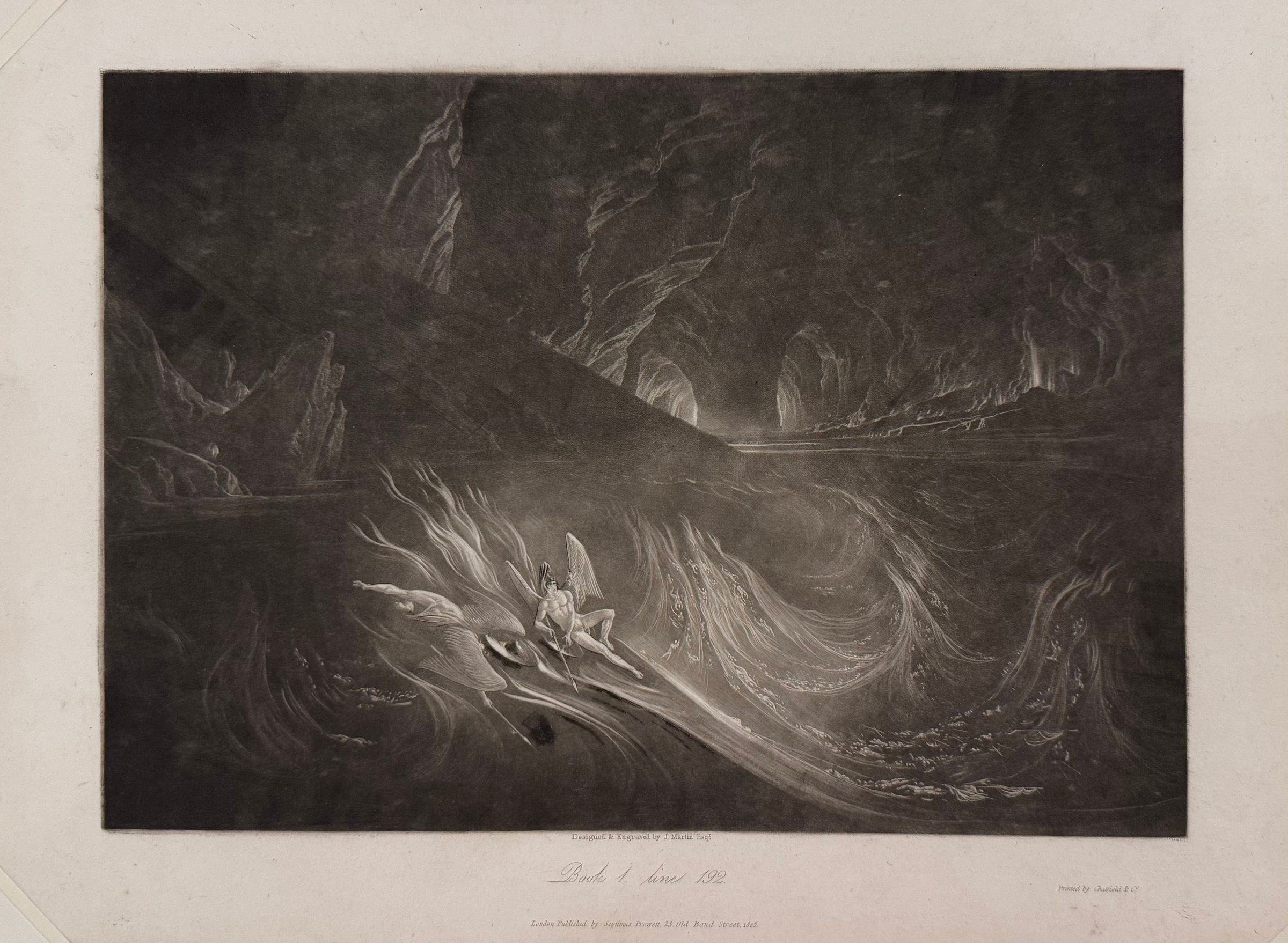
This is another masterpiece by John Martin from the same 1824–1825 series for Milton’s Paradise Lost. This plate is titled "Satan on the Burning Lake."
It captures one of the most famous and atmospheric moments in epic literature: the immediate aftermath of the Fall of the Rebel Angels.
Narrative: Book 1, Line 192
The inscription at the bottom points us to the very beginning of the poem. After being defeated in the War in Heaven, Satan and his legions have been cast down into Hell.
The Setting: Satan is depicted lying "floating many a rood" upon a lake of fire. Milton describes Hell not just as a pit, but as a vast, dismal world of "regions of sorrow, doleful shades."
The Action: In this specific moment, Satan is beginning to recover from the shock of his fall. He is shown raising his head and body out of the burning waves, preparing to address his second-in-command, Beelzebub (who is often identified as the shadowy figure near him in the waves).
The Scale: True to Martin's style, Satan—though a powerful archangel—is made to look tiny against the towering, jagged cliffs of the underworld and the infinite expanse of the fiery sea.
Key Visual Elements
The Mezzotint Texture: Notice how Martin uses the "burr" of the metal plate to create the swirling, misty texture of the "burning" water. It doesn't look like typical water; it looks like a thick, glowing, and viscous liquid, which perfectly matches Milton's description of "liquid fire."
Light and Shadow: The light source is the lake itself. The "darkness visible" is achieved by having the light glow from below, casting long, eerie shadows up the cavernous walls.
The "Sublime" Architecture: The rock formations in the background look like massive, crumbling cathedrals or desolate mountains, emphasizing the loneliness and despair of the fallen state.
Why this series matters
Before John Martin, most illustrators focused on the figures of the angels. Martin was the first to make the environment the main character. He used his knowledge of geology and vast perspectives to make Hell feel like a real, physical place of immense proportions.
It's a fantastic companion piece to the first image you shared—where the first showed Satan’s defiant pride in Eden, this one shows his initial ruin and the dark origins of his journey.