Raceboat, Displacement
Name/Title
Raceboat, DisplacementEntry/Object ID
1998.012Description
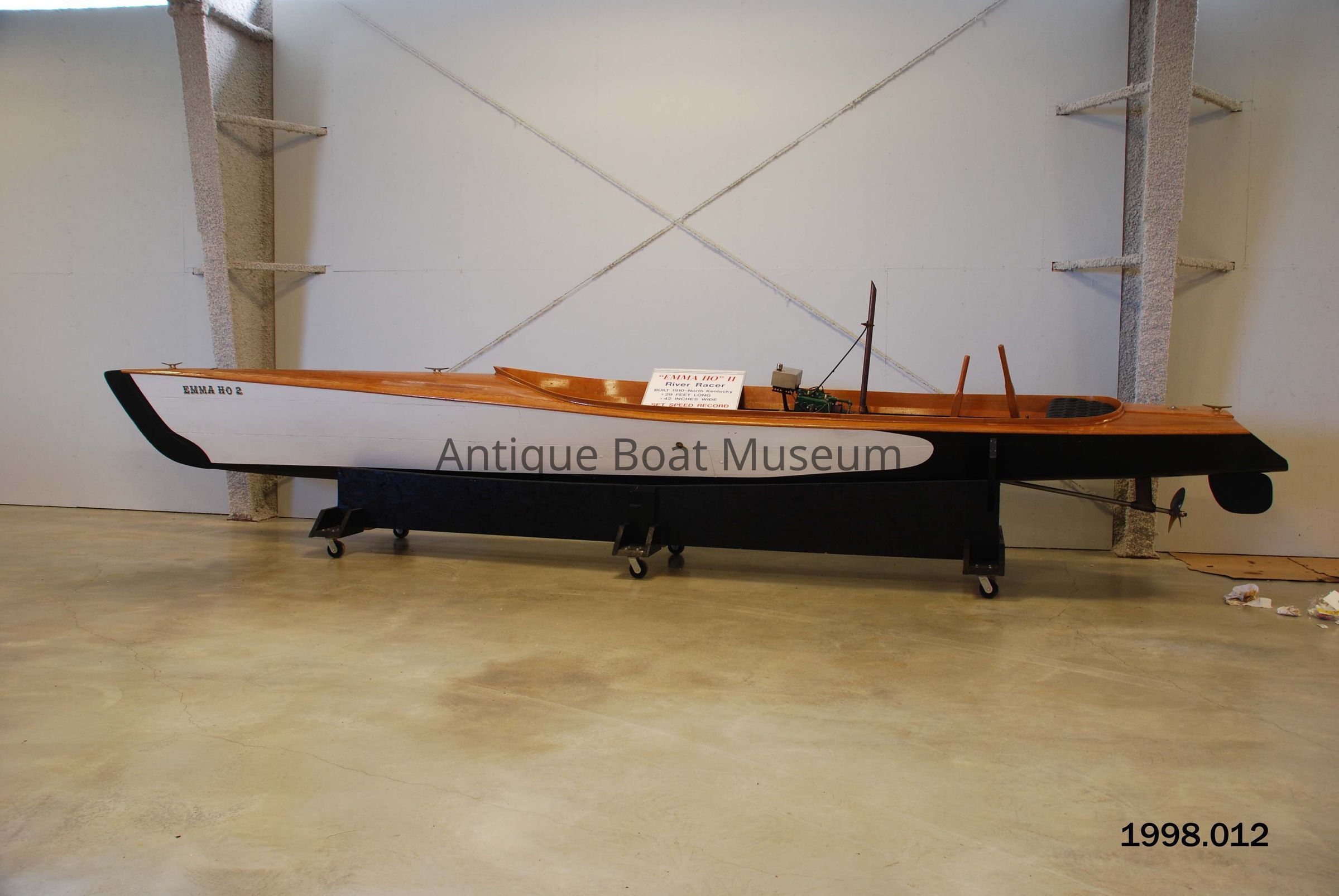
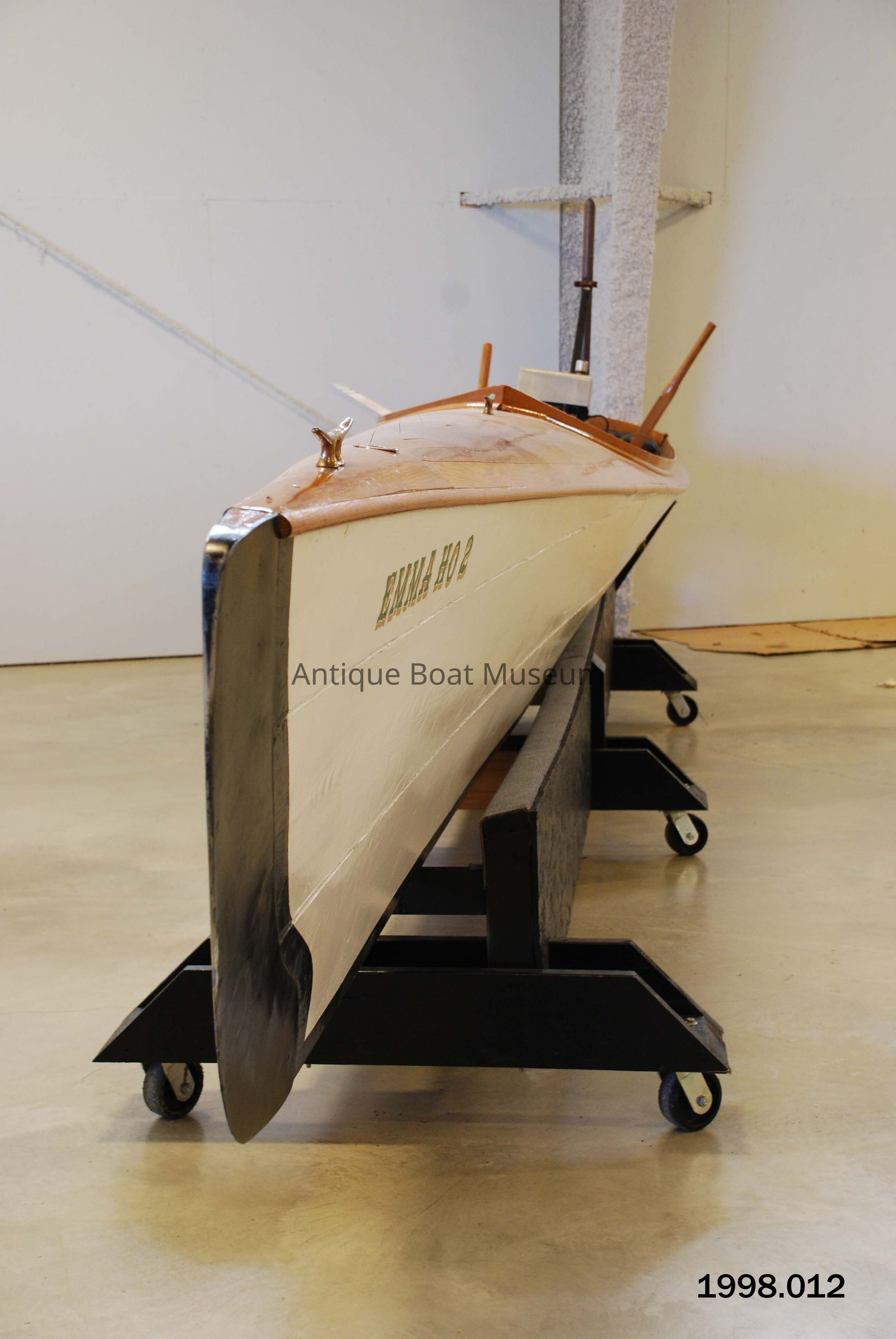
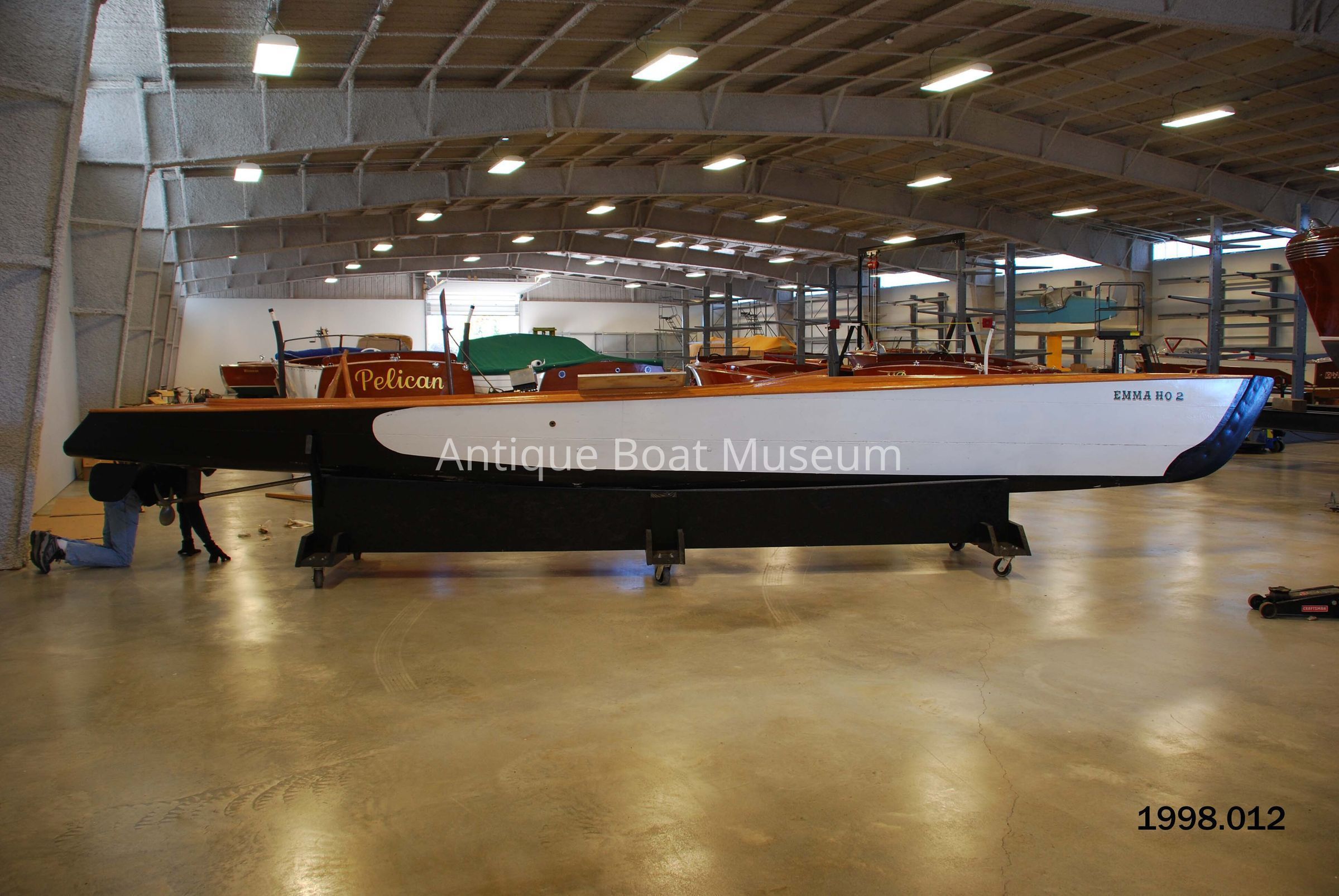
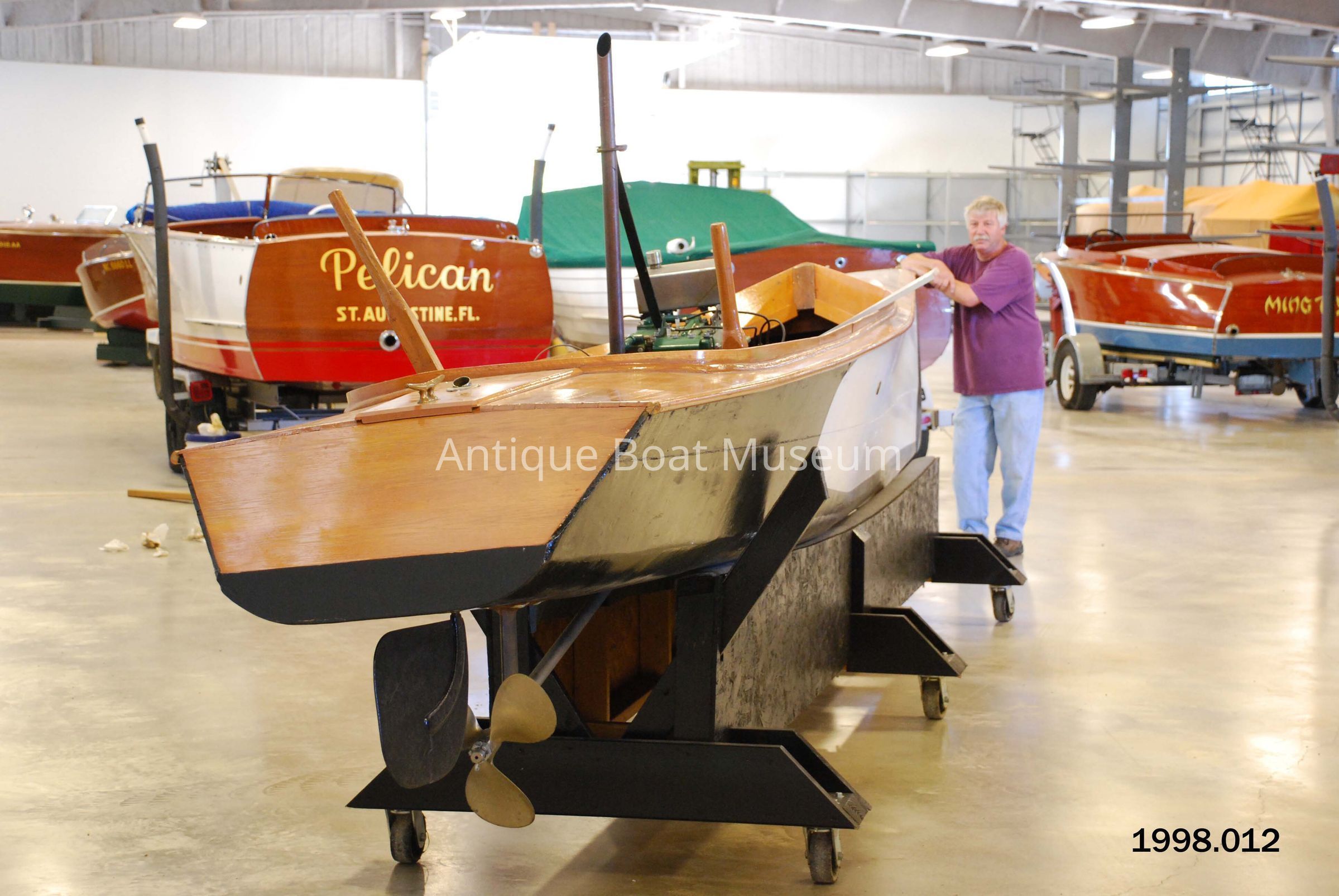
1998.012 Emma Ho II Boat Type: Displacement Raceboat Builder: Unknown Model: N/A Length: 29' Beam: 42" Date Built: 1910 In the early part of the twentieth century, one of the same principles of hull-design that had been used for centuries in the design of sailing vessels was applied to motor boats: length is speed. Or, more specifically, longer, skinnier boats were faster, and the sharper the entry lines, the better; blunt bows created drag. Emma Ho II is perhaps the pinnacle of this line of thinking. Built for racing in north Kentucky in 1910, Emma Ho II has perhaps the finest entry lines of any boat ever made, it is a wonder to think of her running with any stability. Twenty-nine feet long and only forty-two inches wide, she is long and thin, with a long bow like a knife-blade. She was built as a raceboat, and in 1911 broke the record for a non-stop trip from Cincinatti to Loiusville, turning the course in 265 minutes. In the 1990s she was restored by the Ohio chapter of the ACBS. Her construction, as well as her design, are very unusual. The taper from the very point of the bow to the widest point of the boat, perhaps twenty feet back, is virtually straight, without any of the usual convexity. In fact, there may even be a slight inward curve forward of the coaming, to give the entry point the sharpest angle possible. The wedge-shaped bow makes it difficult to think of a continuous curve under the keel from sheer to sheer, so she is necessarily slab-sided, with a separate curve joinging the bottom of her sides under water. She has no chine as such, but the separation between the flat plane of the sides and the round bottom is clearly evident. This turning point runs the length of the boat, and is most visible in the stern. In the era where boats were almost always bent-frame construction, this made the building of the boat awkward. The solution was sawn frames for the bottom section, joining rib-stock at the ends which ran up the virtually flat sides to join into the deck beams and sheer clamp. I use the term 'rib stock', because these peices are not sawn frames, nor do they have to take any bend to speak of; I think they are flat peices of the same oak stock that the boatbuilder would have bent to make ribs for a more traditional craft. The sides are carvel planked with wide, straight boards. The planking of the bottom is difficult to tell, because it was fiberglassed during restoration. The decks and coamings are oak, and the deck has a very high crown. Emma Ho II is powered by a Universal Blue Jacket Twin, model AFTL, s/n 47020. This is a two-cylinder gas engine, with a single Zenith updraft carburetor. It has electric start, single induction coil ignition, and an Auto-Lite motor generator. Directly off the end of this spins the distributor, which is somewhat unusual. It has a straight exhaust with a single copper stack. The engine is fitted with a one gallon aluminum gas tank, most likely added during restoration to replace an older tank. The boat is operated from a seat in back, and the rudder and transmission are controlled by enormous oak levers, rudder on the left, shift on the right. The throttle is a standard control mounted on the port side and connected to the carburetor by a push-pull cable. This is an interesting craft which illustrates the extremes of a certain era of high-speed hull design theory. It is in fine shape, displayable, and contains an engine which is unique in our collection.Collection
BoatsAcquisition
Accession
1998.012Source or Donor
Byers, GeorgeMade/Created
Manufacturer
unknownDate made
1910Place
Location
Kentucky, USANotes
Early Date: 1910 Propulsion: Inboard Engine: 0.000Dimensions
Width
39 inLength
348 inLocation
*Cleveland E. Dodge Memorial Launch Building
Wall
WestRoom
Bay 4Building
*Don Doebler Collections Storage FacilityWall
EastRoom
Bay 8Building
*Don Doebler Collections Storage Facility*William J. Morgan Building