Scow, Sailing
Name/Title
Scow, SailingEntry/Object ID
2009.001.001Description
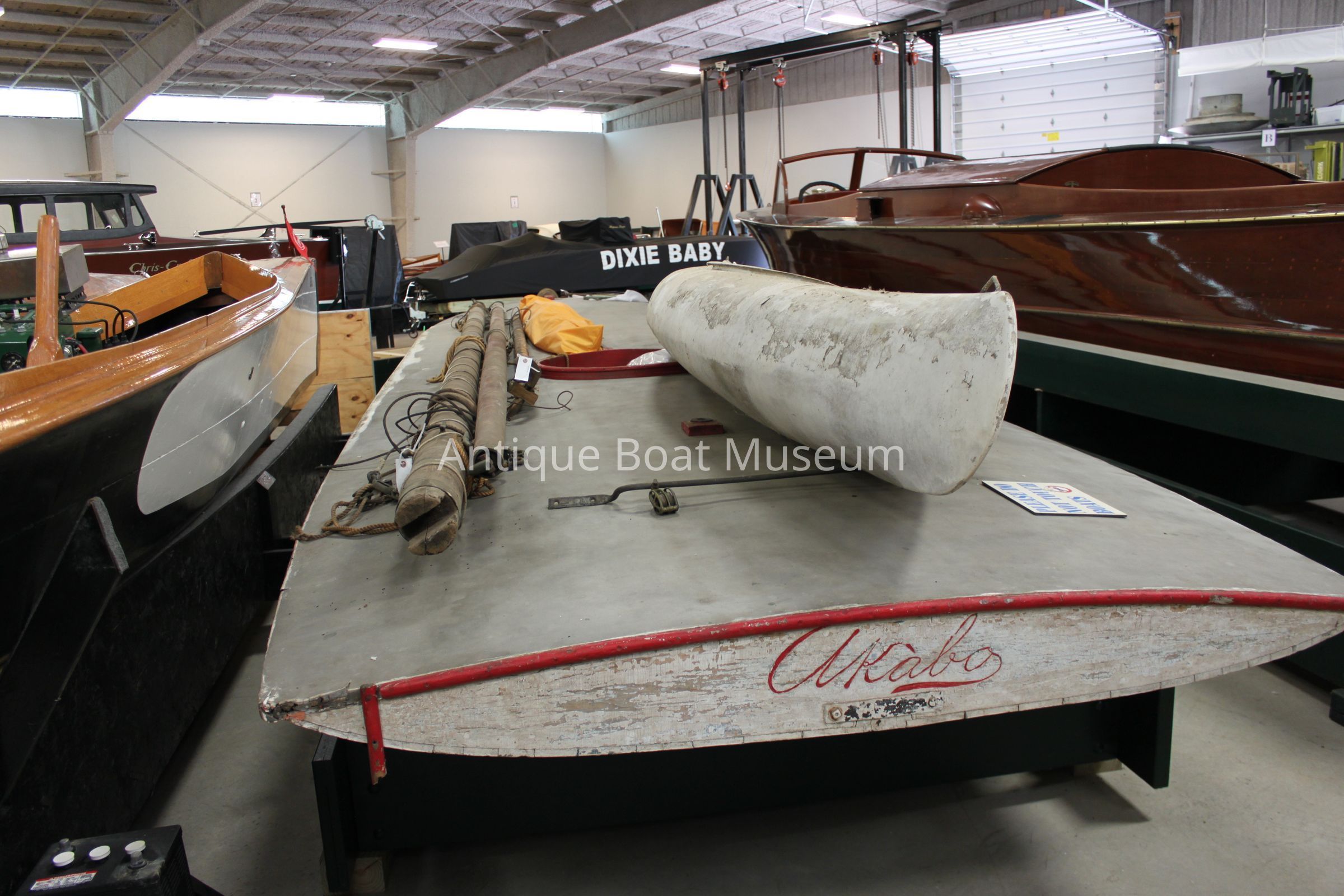
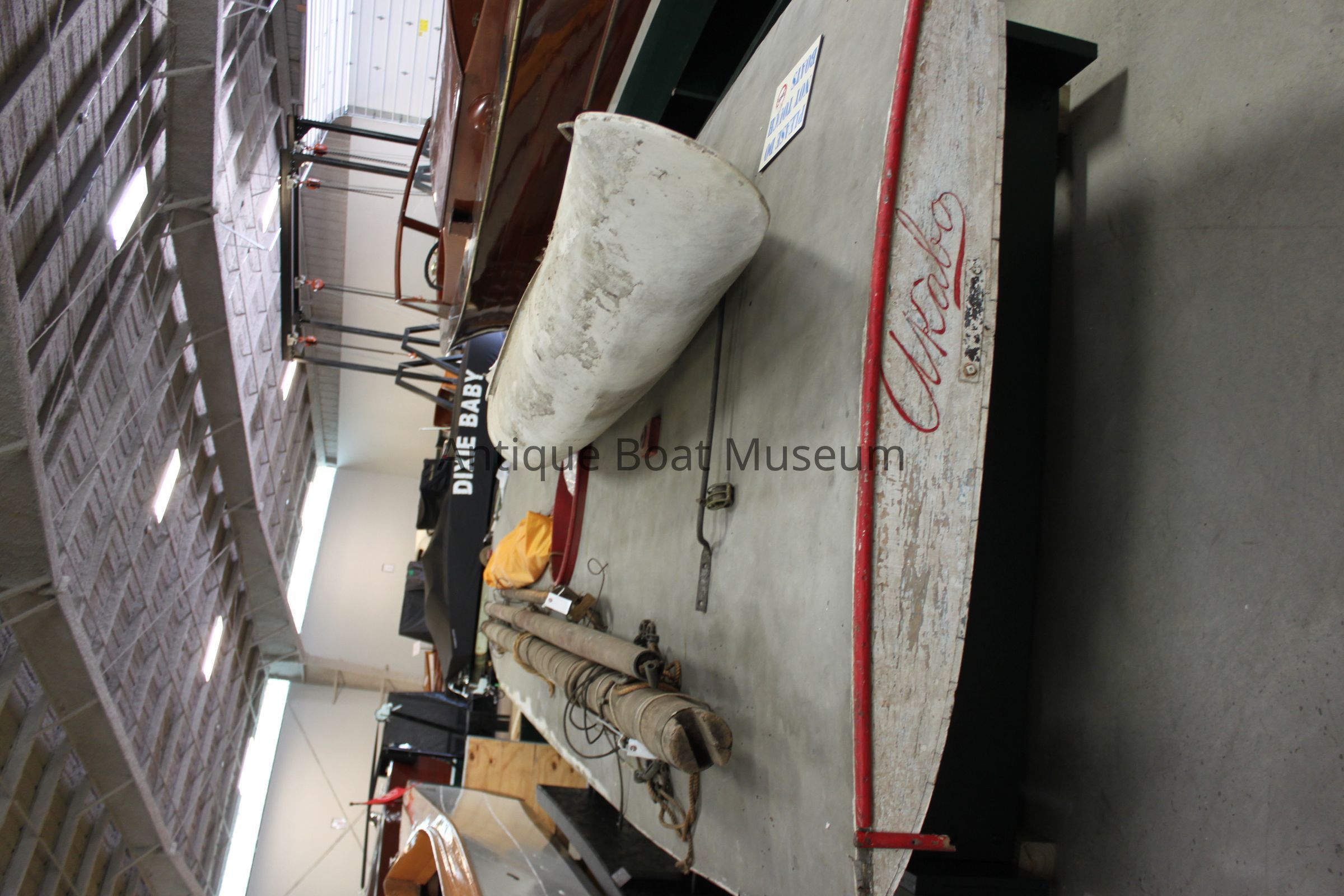
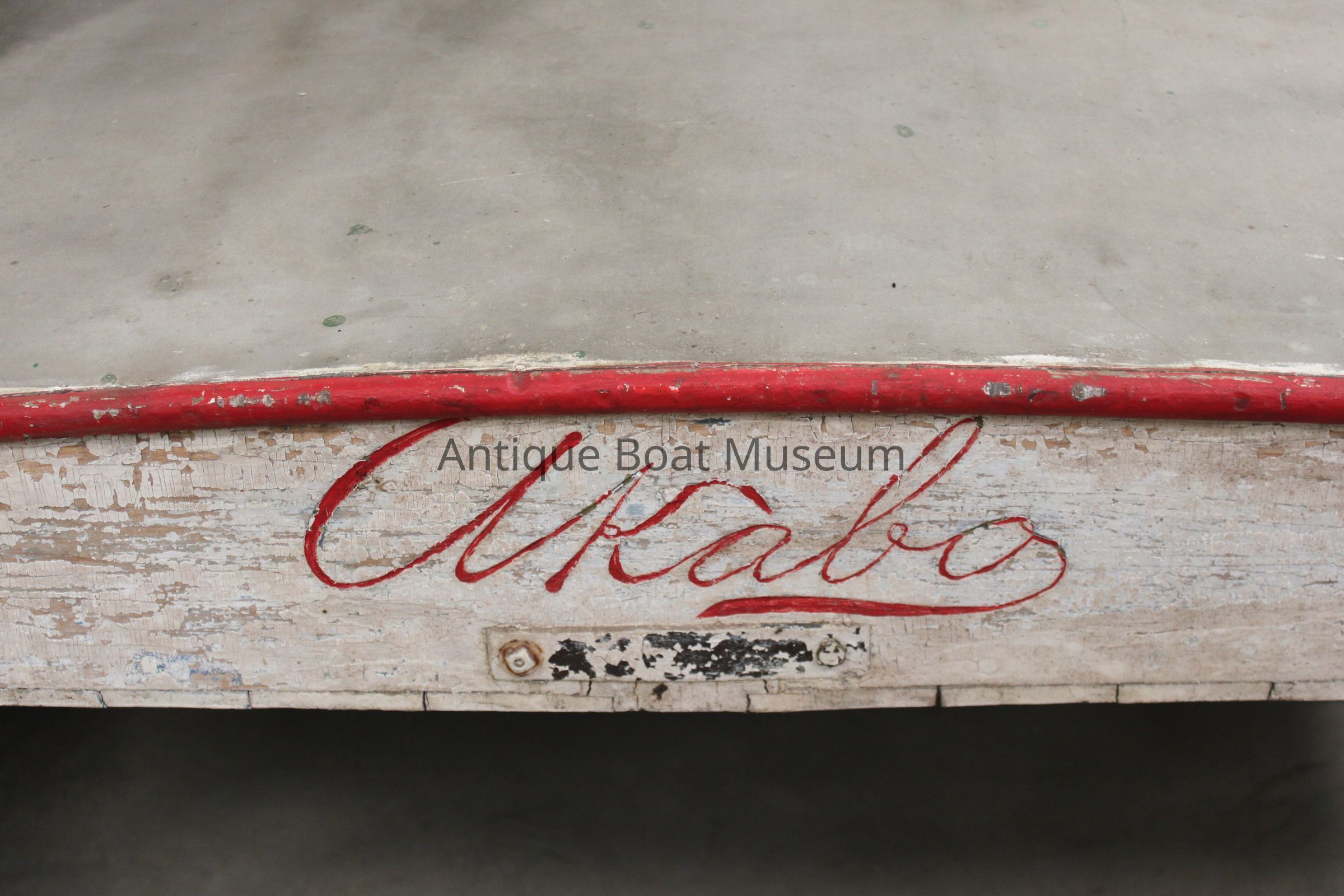
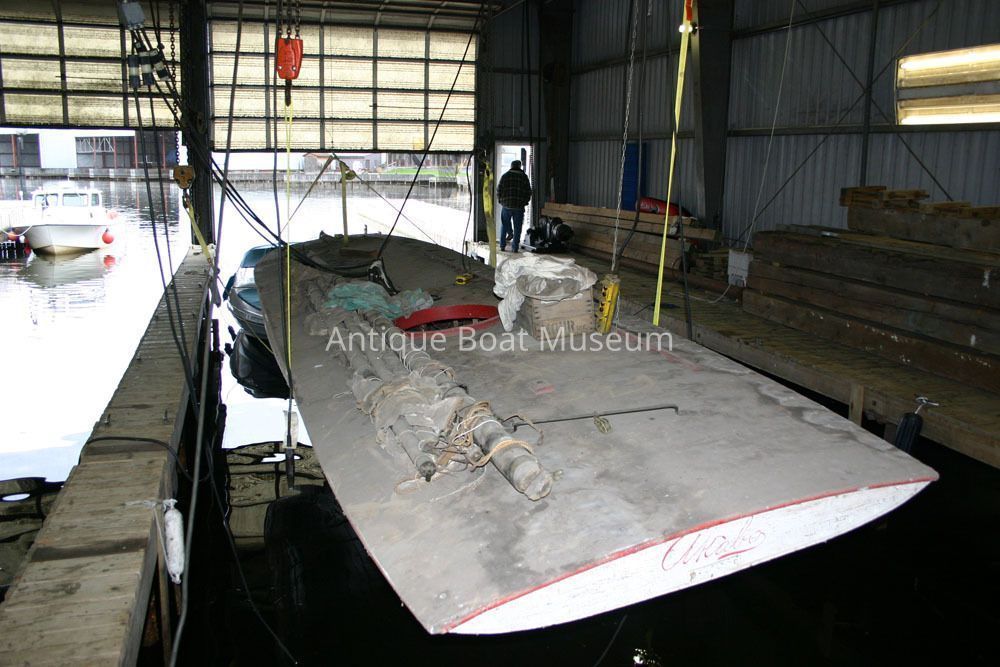
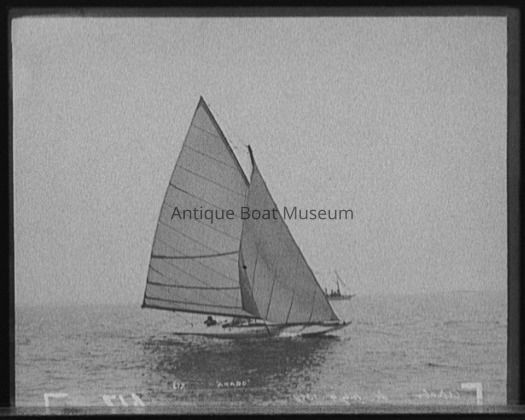
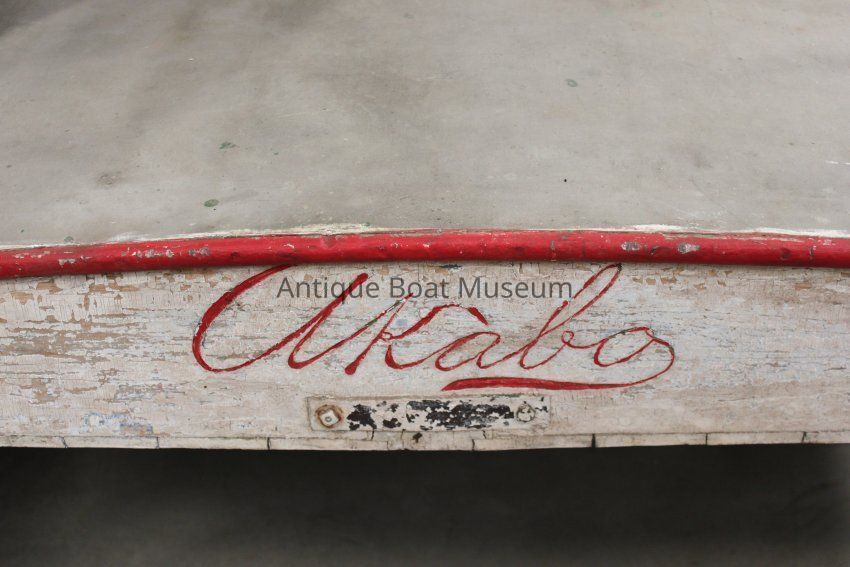
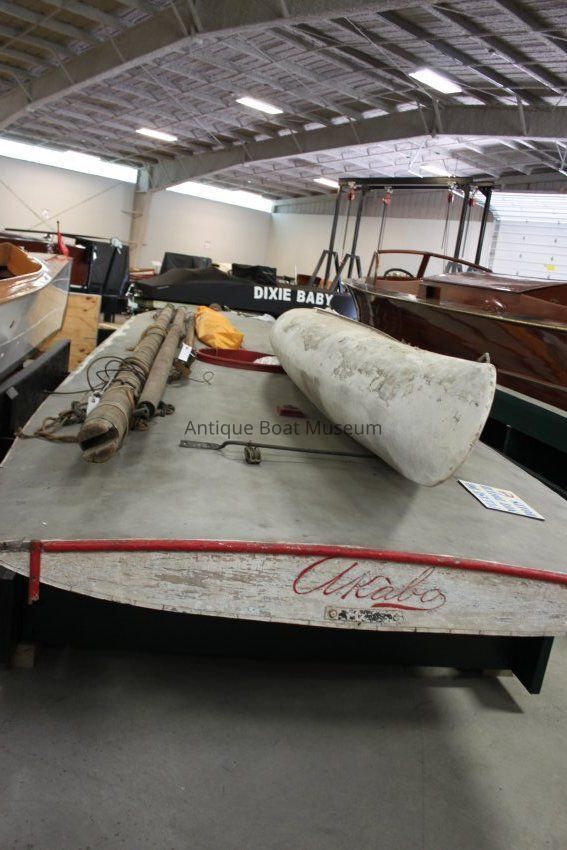
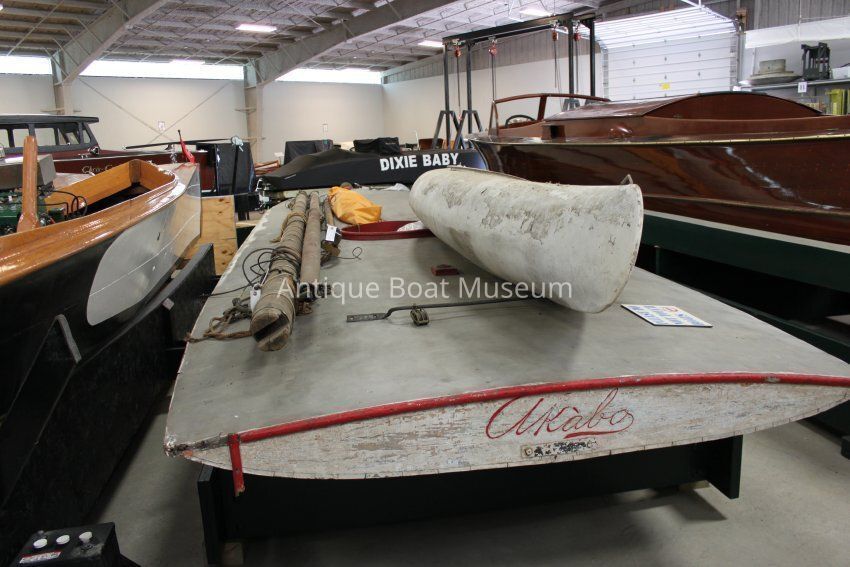
31' sailing scow Akabo Twenty-foot Class 31' LOA, 7' Beam Mast 24' 5.5" step to top Boom 25' 8.5" Gaff 16'2" Extremely well documented, more information in donor file and in contemporary newspapers. From Dan Miller Gazette Annual 2010 An historically important racing yacht, the 31' sailing scow Akabo, found a new home at the Antique Boat Museum in 2009. Donated by Trustee Emeritus Charles Snelling, Akabo has been on the St. Lawrence River since 1899. Built only a year earlier in 1898, Akabo is a significant artifact for both yacht racing in general and for Thousand Islands history. Development of the modern racing scow, such as the A-Scow and E-Scow, can be traced back to the creation of the Seawanhaka Corinthian Challenge Trophy for Small Yachts (Seawanhaka Cup) in 1895. One of many rules established over the years attempting to create fair yacht racing conditions, the Seawanhaka Rule adds together the waterline length of the hull and the square root of sail area, and divides this result by two. The result must fall within the length limits of the class in order to compete. The trade-off for this particular rule is that more sail area could be carried with a subsequent reduction in waterline length. Taken to the extreme, the rule resulted in boat designs that minimized waterline length while carrying long overhangs, so that effective waterline length increased while the vessel was underway and heeled over. In 1895 the class limit was 15-feet, or as they were known, "half-raters". In 1897, the class length was increased to 20-feet, and it is to this rule that Akabo was built. Taken to an extreme, these boats were referred to as "Out and Out Freaks" by the popular press at the time. In 1896, the Seawanhaka Cup was won by the Canadian boat Glencairn, owned by G. Herrick Duggan, who successfully defended the cup against an American challenger in 1897. It was to challenge for the cup in 1898 that Akabo was built. Designed and built at Oyster Bay, Long Island, by Lawrence Huntington, Jr. for Clark Miller, Akabo measures 31' length overall with a waterline length of 17.5, has a beam of 6' 7" and 6" draft with centerboard up. Akabo was one of five boats competing for the privilege of challenging for the Cup in a series of races held off Oyster Bay in July of 1898. Two of the other challengers, Seawanhaka and Cicada, are notable as they were designed by Clinton Crane and built by Spalding St. Lawrence Boat Company in Ogdensburg, NY. Clinton Crane, one of America's foremost boat designers, has connections to the current-day Museum; he designed the Gold Cup race boat Dixie II(III) and his firm built the houseboat La Duchesse, both of which are now part of the Museum's collection. A series of thirteen races were held to determine which boat would challenge G. Herrick Duggan for the Cup in 1898. Although Akabo performed admirably in these races, Clinton Crane and his crew sailing Seawanhaka won the right to challenge. Akabo very well may have earned the right to race for the Cup had one of her crew members not been so careless when tossing aside a cigar butt, setting her suit of silk racing sails on fire. She didn't sail as well with her spare set in the subsequent races. For what it's worth, Seawanhaka was so poorly built that Clinton Crane built a second boat, the Challenger to the same design with which to compete for the Cup. He was easily defeated by Duggan, who stretched the rules with Dominion, which had a novel catamaran-like hull. Through the late 1890s and early 1900s, many of the new racing scows were sold to the mid-west following the Seawanhaka Cup races. This type of racing yacht found favor on the many lakes of Wisconsin and Minnesota. Ultimately, these early boats evolved into the several scow classes still actively raced today, ranging from the 38-foot A-Scow to the 16-foot MC Scow. However, Akabo , Seawanhaka , and Challenger made their way up to the St. Lawrence instead. Akabo was purchased by Cotton Allen Hayden and brought to the Thousand Islands in 1899. Cotton Allen was the son of William Hayden, who had built his summer home on Estrillita Island, near Alexandria Bay. Cotton Allen, with his brother John Harold as crew, won the Bell Trophy, the Englis Cup and the Hayden Cup numerous times in races held by the Chippewa Yacht Club and Thousand Island Yacht Club. In the early 1980's Charles Snelling purchased the Hayden cottage on Estrillita Island. Shortly after this purchase, Mr. Snelling learned that Akabo still survived, and was in a boathouse on Sunnyside Island. Soon thereafter, he found himself towing it a half-mile up-river, back to its home at Estrillita. While intending to have it restored, other projects came first, and after a while, she was moved to a boathouse on the mainland, where she was kept dry and secure, until Mr. Snelling donated the boat to the Museum. Considering her age, Akabo is in a remarkably good state of preservation, largely due to Mr. Snelling's care of her over the last 25 years. As a racing boat, she is lightly constructed, so it is not surprising that her hull has changed shape some over the years. Apart from her centerboard, which lies somewhere on the bottom of the St. Lawrence River, she is complete with all of her rig and a set of sails accounted for. Museum staff are continuing to research her history further, and we hope to locate a set of original plans that would be a great aid to reshaping her hull properly. We'd love to raise enough funds to restore her properly and place her on exhibit - what a magnificent sight that would be! JMP 4/5/2010Collection
BoatsAcquisition
Accession
2009.001Source or Donor
Charles D. SnellingAcquisition Method
GiftMade/Created
Artist
Lawrence D. Huntington, Jr.Manufacturer
Huntington, Lawrence D., Jr.Date made
1898Place
Location
New Rochelle, NYNotes
Propulsion: SailDimensions
Width
7 ftLength
31 ftLocation
*Cleveland E. Dodge Memorial Launch Building
Wall
WestRoom
Bay 3Building
*Don Doebler Collections Storage FacilityBartlett Point Barn 4