Notes
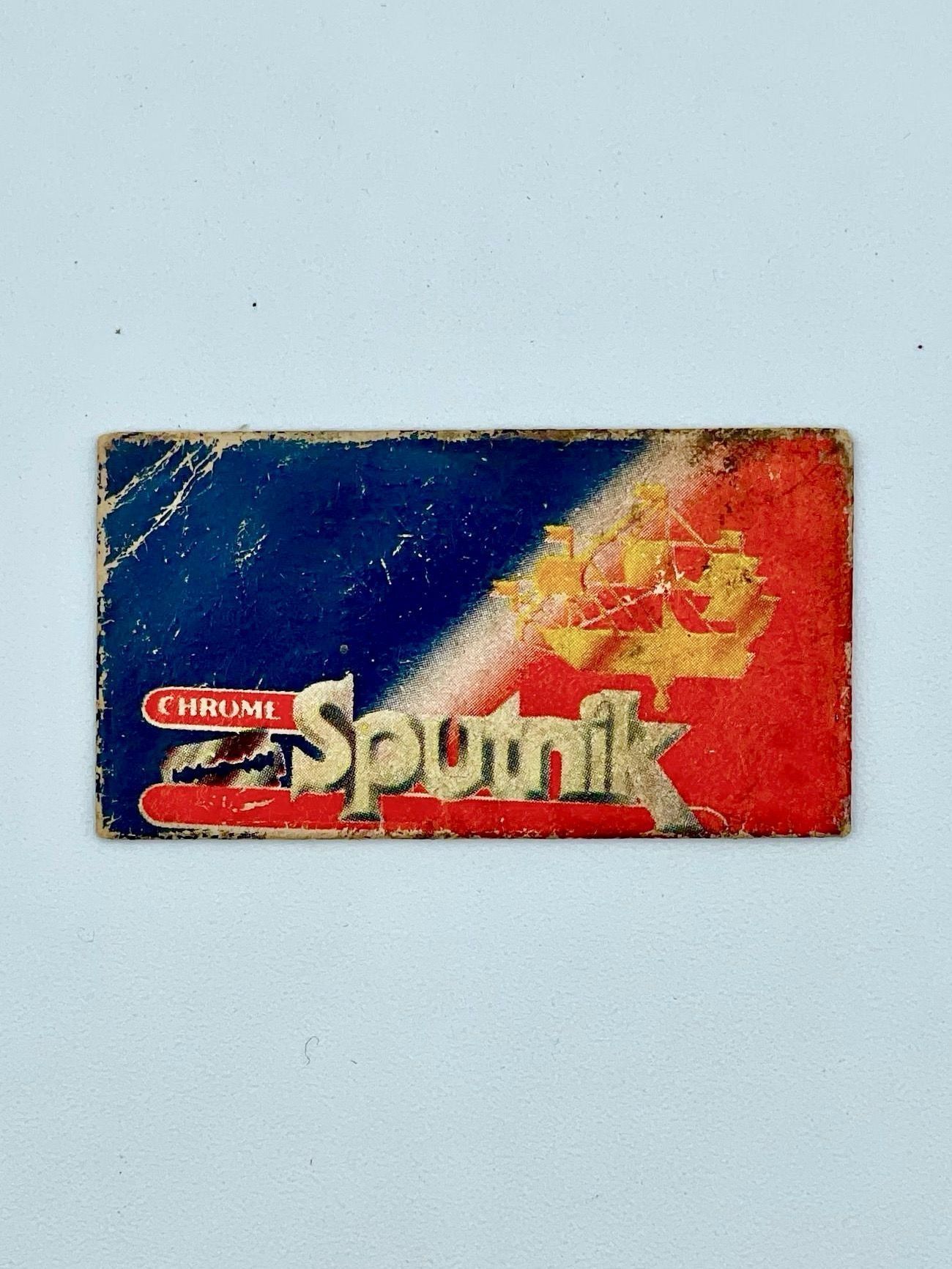
This entry catalogs an INDIVIDUAL BLADE WRAPPER, not an outer box and not a blade. The wrapper is the small paper packet that originally contained a single double-edge razor blade within a multi-blade outer box (a typical 5-blade Soviet outer box would have held five such wrappers, each containing one blade). At some point in the household's use of this product, the wrapper was separated from both its blade and its outer box, and it survived as a single paper artifact. Perhaps indicative of the symbolic weight of the Spunik.
Notes
The Sputnik brand name draws on the dual valence of the Russian word "Спутник" — meaning both "satellite/artificial companion" (the 1957 cosmic achievement) AND "fellow traveler / companion" (the older Russian word, applied to ships, traveling companions, and any "joining-presence"). The packaging visualizes the latter, older meaning, while the brand name evokes the former, newer meaning. The two readings co-exist productively — not as paradox but as polysemy.
The exact historical ship depicted on the Sputnik wrapper could be:
- The Neva — historically the name of one of the first Russian round-the-world voyage ships (the Imperial Russian Navy sloop "Neva," which along with the "Nadezhda" completed the first Russian circumnavigation, 1803-1806 under Yuri Lisyansky and Adam Johann von Krusenstern).
- A generic "Age of Sail" Russian/Petrine-era vessel — Russia's 18th-century naval modernization under Peter the Great is the foundational moment of Russian maritime identity; many Soviet consumer goods used Petrine-era sailing-ship imagery to invoke this heritage.Notes
The Sputnik name in Soviet consumer culture. Following the October 4, 1957 launch of Sputnik 1, the word "Спутник" rapidly acquired enormous symbolic value across Soviet consumer-goods branding. Sputnik became the standard Soviet brand-name signifier of "modern," "advanced," "scientifically progressive," and "Soviet cosmic achievement." Hundreds of Soviet consumer products were named Sputnik in the late 1950s through 1980s: chocolates, cigarettes, vacuum cleaners, watches, radios, hotels, restaurants, ice cream, candies, and razor blades. The Sputnik name became to Soviet consumer culture roughly what "Atomic" or "Space-Age" became to American consumer culture in the same period. The Sputnik razor blade wrapper is a small but specific example of this brand-name phenomenon.