Name/Title
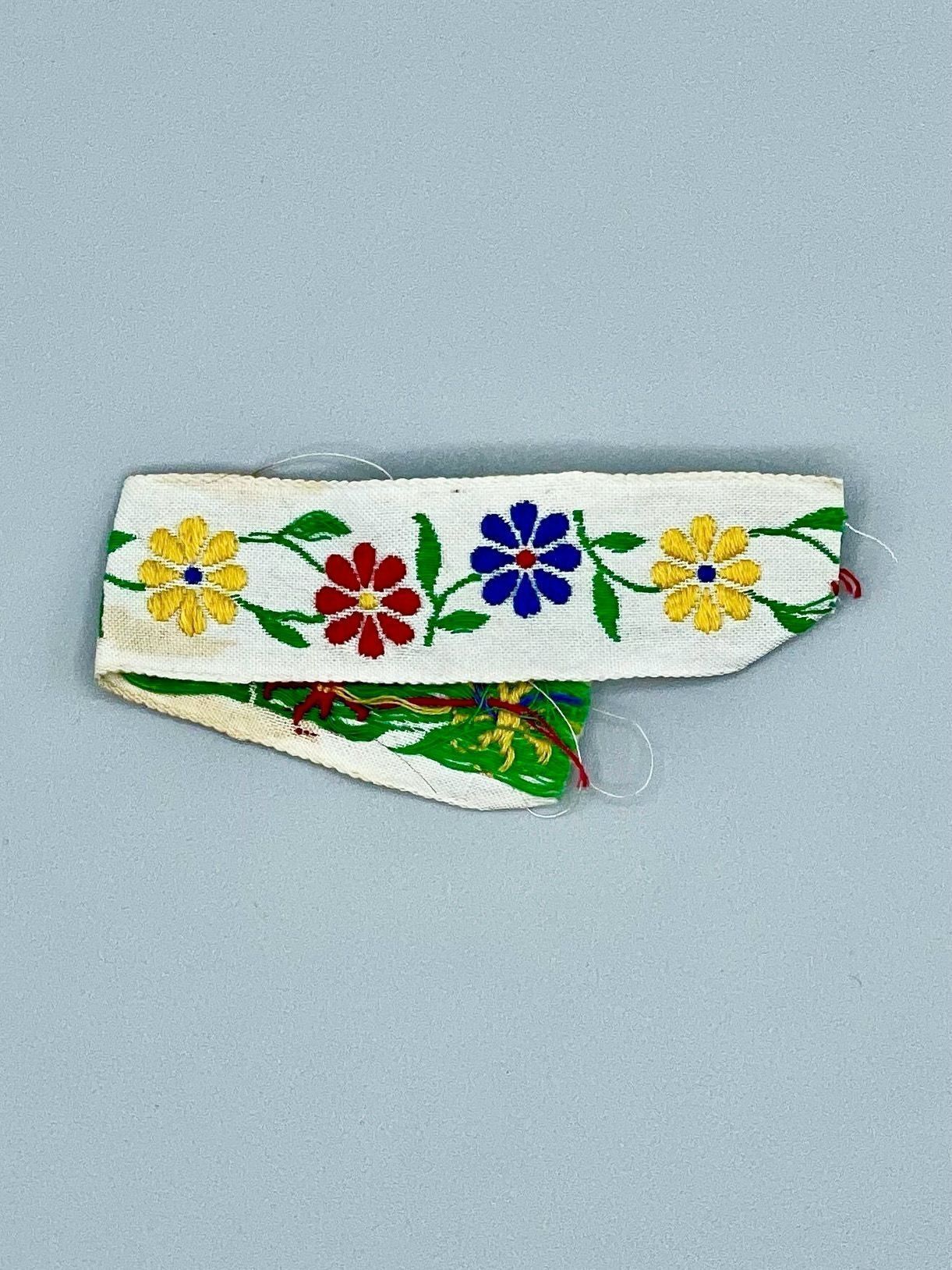
Woven floral ribbon trimEntry/Object ID
2025.1.48Description
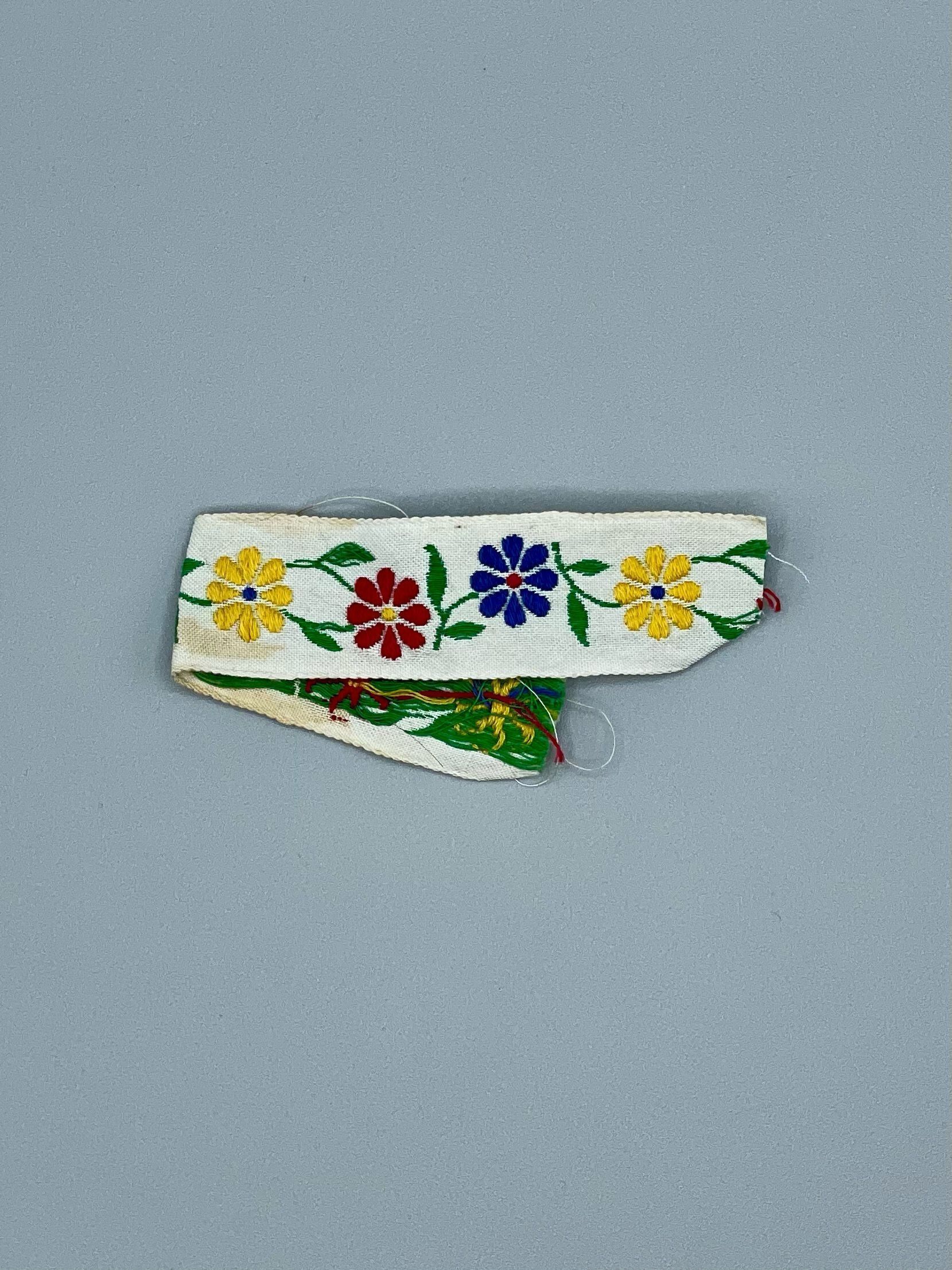
A short length of narrow decorative ribbon/trim on a cream/ivory ground, patterned with a horizontal row of stylized daisies — yellow, red, and blue — joined by green leaves and stems. The band has finished woven selvedge edges along its length and cut, slightly frayed ends; it is shown folded back on itself, and the reverse (visible at the fold) carries long floats of colored thread (red, yellow, blue, green) running across the width, the typical back of a figured/brocaded woven ribbon. A few loose threads (white, and red loops near one end) hang from the piece. It reads as a cut length or remnant of decorative trim rather than a complete made-up article.Use
Preserved with sewing materials by María A. Arús Caraballo.Context
The remnant of a trim sewn by María A. Arús Caraballo into gowns she made for her daughters c. 1980.Collection
The Cabrera Arús family collection, María A. Arús Caraballo collectionMade/Created
Date made
circa 1980Notes
ORIGIN: Undetermined; probably European, most likely within the Central/Eastern European folk-costume trim tradition. Attribution by style only, unconfirmed — no country-of-origin mark is present.Materials
Material Notes
MATERIALS: Woven textile — a cotton (or cotton-blend) ground with colored pattern wefts that appear to be rayon (viscose) or mercerized cotton, judging by the sheen; possibly with some synthetic content.
TECHNIQUES: Most likely a woven figured/brocaded ribbon, the floral motifs formed by supplementary colored wefts (brocade) that float on the reverse where they are not bound to the face — which accounts for the satin-like raised flowers on the front and the multicolor floats at the back, and for the finished selvedges.Relationships
Related Person or Organization
Person or Organization
María A. Arús CaraballoNotes
ownerRelated Places
Place
City
HavanaCountry
CubaRegion
Caribbean, Central AmericaNotes
purchase, useResearch Notes
Notes
This is a narrow figured trim of a type made and used across Europe to embellish folk and festive dress. Technically it is a jacquard/brocade-woven ribbon. The decorative ribbon weave in question is a European technology — the Jacquard loom was invented in France by Joseph-Marie Jacquard in 1804, and brocade/jacquard ribbons carry their pattern as colored floats on the reverse — which matches the colored thread floats visible at the fold. Under magnification, continuous weft floats woven into the ground would indicate a commercial jacquard ribbon.
The motif supports a European, and more specifically a Central/Eastern European, attribution. Bright primary-color daisies with a blue cornflower and green leaves on a white ground is a garden/field-flower vocabulary characteristic of European folk-costume trim, and floral-on-white woven trim is a recognized commercial category sold expressly as "European folk costume trim," traditionally used to embellish folk costumes, with a floral pattern on a white background — a category produced in several European countries (documented examples include Swedish manufacture), which is precisely why a single country cannot be assigned on appearance. The cornflower motif is a particular favorite in German and Central/Eastern European design. The leading candidates are therefore the German/Austrian "Trachtenband" tradition and the Czech/Slovak or Hungarian costume-ribbon and folk-embroidery traditions, with the established commercial ribbon-weaving centers (Saint-Étienne in France, Wuppertal/Krefeld in Germany, Basel in Switzerland, and Scandinavian producers) as the likely places of manufacture for the woven version. None can be ranked above the others without a mark or a technique determination.Created By
María A. Cabrera ArúsCreate Date
September 22, 2025Updated By
María A. Cabrera ArúsUpdate Date
June 20, 2026