Name/Title
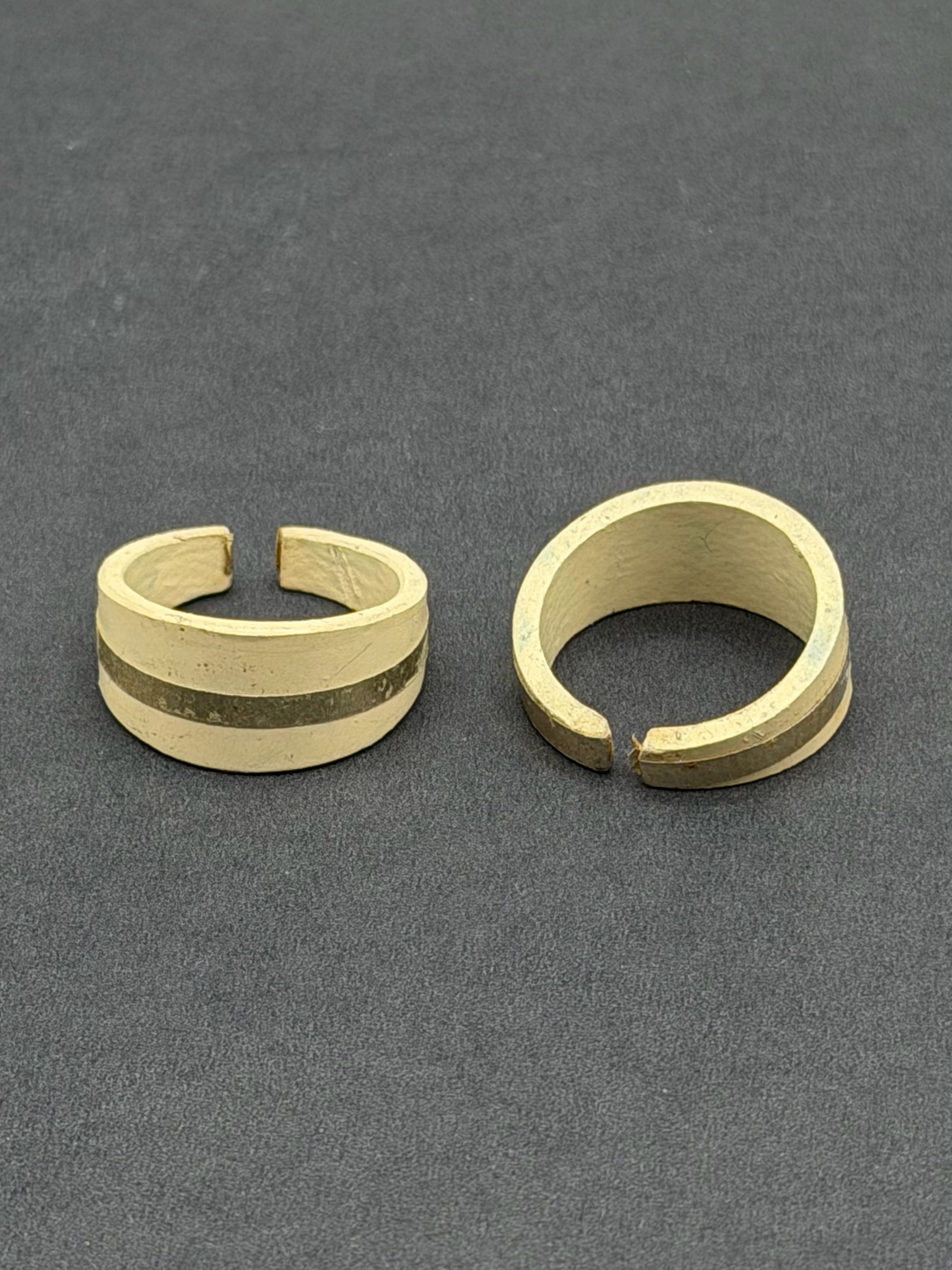
Pair of earrings, cut plastic pipe faced with gold paperEntry/Object ID
2026.11.2Description
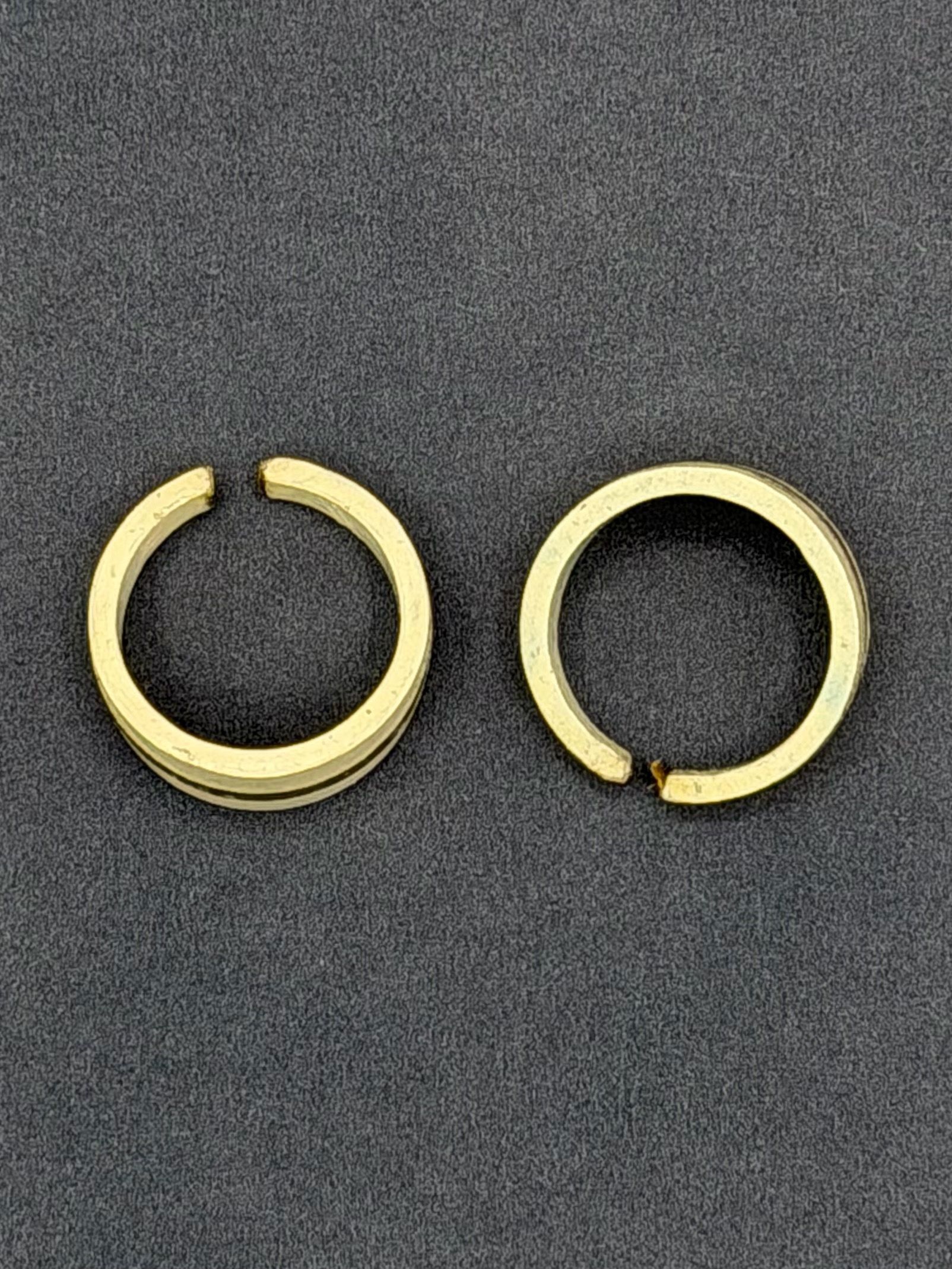
Two open hoops, each cut as a short section from a length of cylindrical plastic pipe and severed once through the wall so that the ring stands open as a C. The band is broad relative to its diameter, with flat cut ends and square-cut edges. The wall is thin and of even thickness; the interior is plain and shows the pipe's own surface, with fine longitudinal striations.
The outer face carries a band of gold paper running around the circumference, occupying the central portion of the band's width and leaving the plastic exposed as a pale stripe above and below. The paper is bright metallic.
⚠️ The two are close but not identical — the hoops differ slightly in diameter and in the width of the exposed plastic above and below the gold band. Consistent with hand cutting.
The hoops appear to have been worn by springing the open C onto the earlobe under the plastic's own tension.Item Type
Earrings - PairUse
Purchased and used by Esther María Hernández ArochaContext
This object is what scarcity looks like made into ornament, and its date places it precisely.
On 13 March 1968 Fidel Castro announced the Ofensiva Revolucionaria from the steps of the University of Havana, declaring that neither commerce nor self-employment nor anything of the kind would have a future in the country. Within sixteen days the official press reported 55,636 small businesses nationalized — among them, per Granma's own figures, 1,598 artesanías (craft workshops) and 3,345 carpentry shops, alongside bodegas, barbershops, shoe repairers and thousands of timbiriches. Lillian Guerra's figure is 58,012 businesses, including small stores, beauty salons, and makers of household goods; unlike the 1960 nationalizations, most owners were not indemnified, goods and vehicles were summarily confiscated, and bank accounts were frozen with withdrawals capped at $200 by the end of March. Higher counts circulate — one account gives around 77,000 establishments — and Mesa-Lago's breakdown has 31% food retail and 26% consumer services. The immediate result was a sharp deterioration in the availability of goods and services, leaving Cubans dependent on the state even to mend shoes.
What the object adds. These were made from a scrap of pipe and a piece of gold paper, and they are competent — the cuts are square, the band is even, the paper is applied in a deliberate stripe rather than wrapped wholesale. ⚠️ That is a design decision, not just improvisation, and it is worth recording as such.
⚠️ Cross-reference and precedent. The collection's own blog documents handmade hair barrettes by "the merolico Nando," made in an improvised garage workshop in El Vedado in the late 1970s–80s. These earrings are the same phenomenon a decade earlier.Collection
Esther María Hernández Arocha collectionMade/Created
Time Period
1960sPlace
City
HavanaCountry
CubaRegion
Caribbean, Central AmericaParts
Two earrings. ⚠️ Each comprises a plastic band and an applied paper facing.Materials
Material
Plastic, PaperMaterial Notes
Body: plastic pipe — owner-attested. ⚠️ Polymer undetermined. Cream to pale ivory, rigid but with enough spring to be worn as an open hoop. PVC is the obvious candidate for pipe of this period — ⚠️ and if so, the conservation note below applies with force.
Facing: gold paper.Relationships
Related Person or Organization
Person or Organization
Esther María Hernández ArochaRelated Places
Place
City
HavanaCountry
CubaRegion
Caribbean, Central AmericaResearch Notes
Notes
Material, method, function and date supplied by the collection owner, 2026-08-07: made from plastic pipe, faced with gold paper, worn as earrings, late 1960s. All recorded on that authority. The visible construction is consistent with the stated method.
Researched 2026-08-07 in Spanish. Ofensiva Revolucionaria: Cuba Material (the collection's own blog, citing Lillian Guerra, Visions of Power in Cuba, 2012); Cuba Encuentro; Cubanet; Havana Times; Izquierda Web; La Joven Cuba. ⚠️ Politically divided sources; they converge on the March 1968 date and on figures in the mid-50,000s from Granma, and diverge sharply on interpretation. The Guerra citation, via the collection's own blog, is the scholarly anchor.
⚠️ I did not find sources documenting homemade jewelry in late-1960s Cuba as a described phenomenon. The context above establishes the conditions; it does not document this practice. The owner's testimony is the primary evidence and should be treated as such.Created By
María A. Cabrera ArúsCreate Date
September 14, 2026Updated By
María A. Cabrera ArúsUpdate Date
September 15, 2026