Name/Title
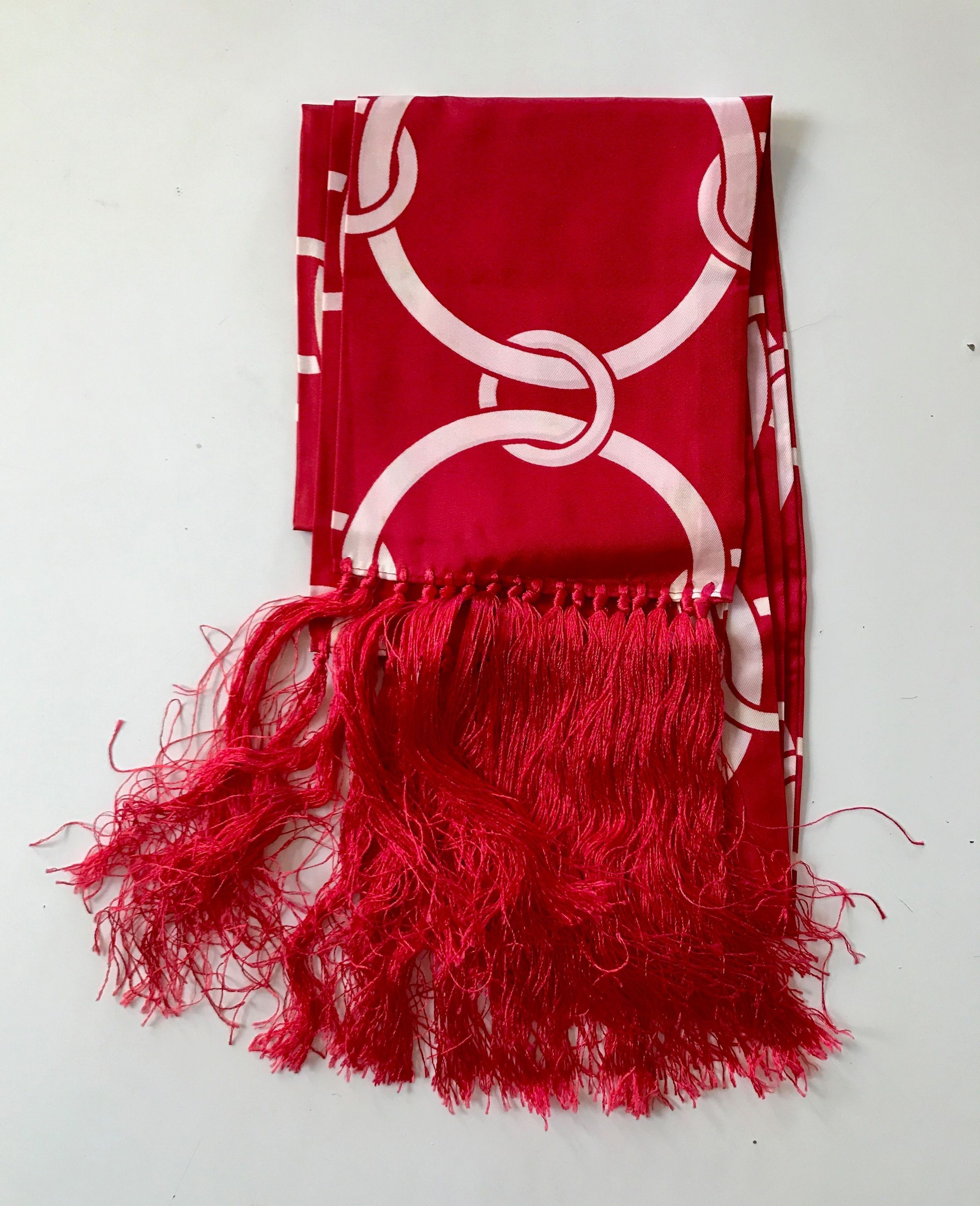
Fringed scarf, deep-red chain/link printEntry/Object ID
2025.1.243Description
A long rectangular lightweight silky scarf in deep red, printed with a large white interlocking-chain/link (or interlocking-ring) motif running along its length. The short ends have a knotted heading and a deep fringe of self-colored threads; the fringe is wavy and tangled with loose threads. This is the odd one out of the three, with a chain/link design rather than a plaid.Use
Purchased by María A Arús Caraballo and her mother, Gertrudis Caraballo Gálvez, after a neighbor's purchase.Collection
The Cabrera Arús family collection, Gertrudis Caraballo Gálvez collecitionClothing/Dress/Costume Details
Article of Clothing/Dress/Costume
ScarfClothing Sex
FemaleNotes
MATERIALS: Lightweight printed dress fabric of silky hand — silk or synthetic (the label's "no crinkle" suggests a synthetic such as polyester); fiber to be confirmed. Self-thread fringe. Sewn label.
TECHNIQUES: Screen ("hand") printing on woven fabric; knotted heading and fringe at the ends.Made/Created
Time Period
1970sPlace
Country
JapanContinent
AsiaNotes
MAKER: Per the label seen on the matching plaid scarf, a Japanese maker ("100% HAND PRINT / NO CRINKLE / MADE IN JAPAN"). No label is visible on this scarf; maker attributed by close match to its labelled sibling.
DATE / PERIOD: Not dated; mid-to-late 20th century (estimated) for a Japanese hand-printed fashion scarf of this type. Undetermined more precisely.
ORIGIN: Japan (manufacture), attributed via the matching labelled scarf ("Made in Japan"). Acquisition: 1970s Cuba per María A. Arús Caraballo.Relationships
Related Person or Organization
Person or Organization
María A. Arús CaraballoNotes
ownerPerson or Organization
Gertrudis Caraballo GálvezNotes
ownerRelated Places
Place
City
HavanaCountry
CubaRegion
Caribbean, Central AmericaNotes
purchasePlace
Country
JapanContinent
AsiaNotes
productionResearch Notes
Notes
This design is a bold white interlocking-chain/link motif on deep red, not the plaid shared by the orange and red/maroon scarves. It is therefore catalogued as a related but separate scarf, not part of the plaid set. No label is visible, so its maker and origin are not established; it may share the plaid pair's Japanese origin, but that should be confirmed rather than assumed.Created By
María A. Cabrera ArúsCreate Date
June 3, 2026Updated By
María A. Cabrera ArúsUpdate Date
June 14, 2026