Name/Title
"Krasnaya Moskva" ("Red Moscow") Cologne BottleEntry/Object ID
2025.20.21Description
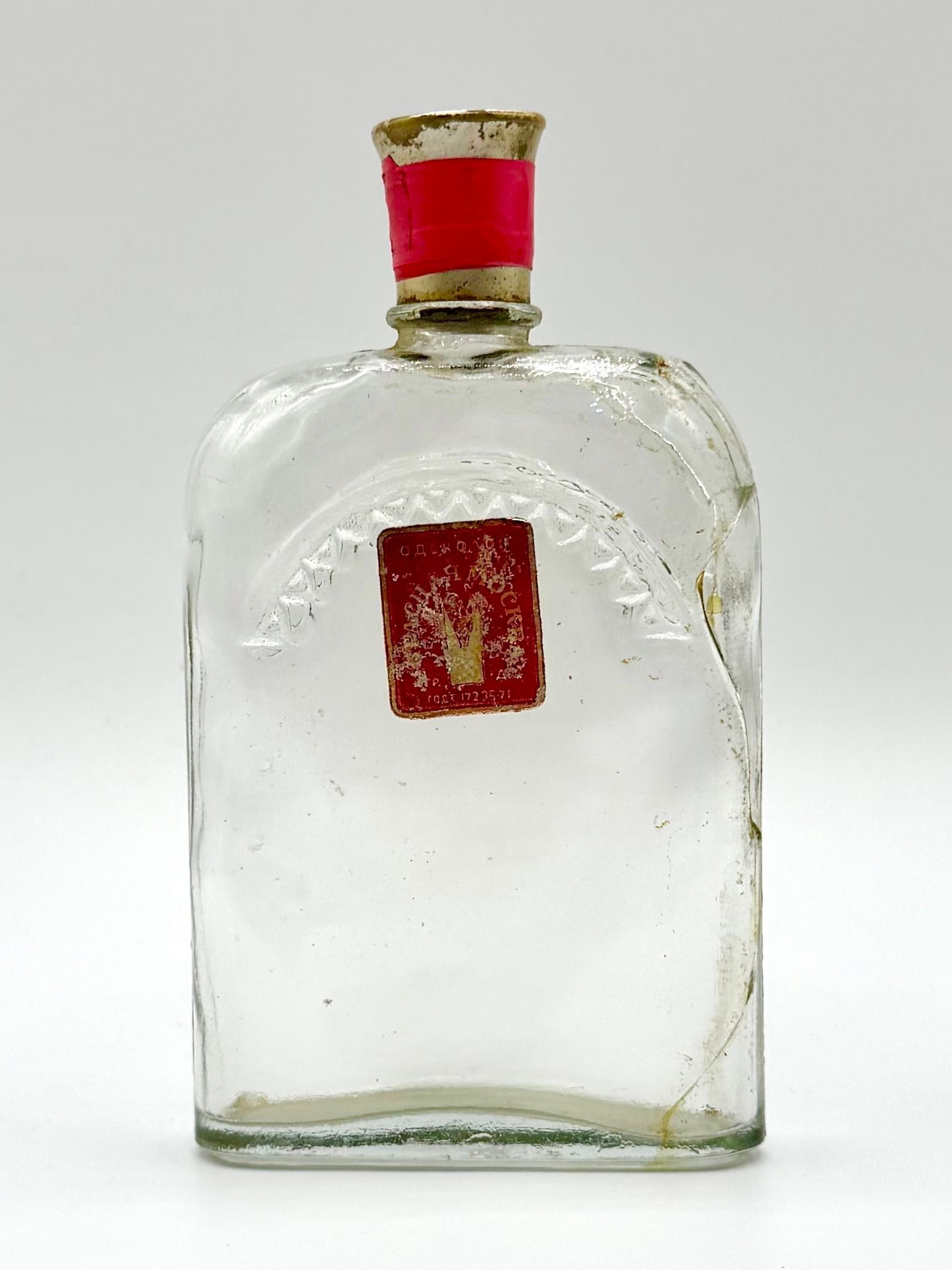
A clear colorless glass cologne (odekolon) bottle of the iconic Soviet Krasnaya Moskva ("Red Moscow") design. The flask is a flattened rectangular form with rounded shoulders and a short neck, its most distinctive feature a molded raised "jagged arch" relief across the upper body — the stylized crenellated Kremlin-wall motif that defines the Krasnaya Moskva flacon. The neck retains its closure: a metal (gold-tone) cap bound with a red band, corresponding to the line's characteristic "onion-bulb" stopper/cap assembly. The bottle is empty.
On the front, within the molded arch, is a small rectangular paper label printed in red and gold. Although worn, the label top reads "ОДЕКОЛОН" (ODEKOLON — eau de cologne); across the center, in large gold capitals, "КРАСНАЯ МОСКВА" (KRASNAYA MOSKVA — "Red Moscow"), with the trademark gold device of a Kremlin tower rising amid a spray of lily-of-the-valley blossoms; and along the bottom a small-type standards/production code including "ГОСТ" (GOST, the Soviet State Standard) and the numerals "1723 5-71," with letters "Р." and "А." flanking the central motif. The glass shows scattered soiling, internal residue staining, and a long crack running down the right side. The "5-71" element of the code plausibly indicates a 1971 standard reference, consistent with production in the early-to-mid 1970s.Context
Krasnaya Moskva was the most famous and emblematic perfume/cologne of the Soviet Union, first formulated by the French perfumer Auguste Michel (relaunched under this name in 1925 by the nationalized Novaya Zarya factory, successor to Henri Brocard's pre-revolutionary Moscow firm) and produced continuously through the Soviet era and beyond. Its scent and its instantly recognizable flacon, designed by the factory artist A. Evseev, with the crenellated "Kremlin wall" arch and Red Square iconography, were a fixture of Soviet domestic life.
Within Cuba, Krasnaya Moskva and other Soviet toiletries circulated as imported consumer goods through the close Cuba–USSR alliance of the 1960s–1980s; Soviet colognes, cosmetics, and household products reached Cuban households via state retail and as gifts brought back by those who studied, worked, or traveled in the USSR.Acquisition
Accession
2025.20Acquisition Method
GiftMade/Created
Manufacturer
Novaya ZaryaTime Period
1970sPlace
City
MoscowCountry
U.S.S.R.Region
Eastern EuropeContinent
EuropeEdition
Red MoscowNotes
Flacon design: signature "jagged arch" element credited to Novaya Zarya's in-house artist A. Evseev (design attribution; not a mark on this object). Fragrance attributed to Auguste Michel.
Date: Circa early–mid 1970s (tentative; based on label code element "5-71" read as a 1971 standard/production reference).Inscription/Signature/Marks
Notes
Paper front label (Cyrillic, red/gold): "ОДЕКОЛОН"; "КРАСНАЯ МОСКВА"; gold Kremlin-tower-and-lily-of-the-valley device; "ГОСТ … 1723 … 5-71" (standards/production code, partly worn); letters "Р." and "А." flanking the device.
Molded relief: crenellated "jagged arch" (Kremlin-wall) motif on the glass.Dimensions
Height
14 cmWidth
8 cmDepth
2.5 cmParts
Bottle (glass) with neck cap/closure (gold-tone metal with red band). Stopper assembly present at neck; contents absent.Materials
Material
Glass, PlasticMaterial Notes
Colorless pressed/molded glass; cream/ivory plastic (celluloid- or bakelite-type) screw cap; lithographed paper label; trace residue of cologne liquid.Relationships
Related Places
Place
City
MoscowCountry
U.S.S.R.Region
Eastern EuropeContinent
EuropeNotes
productionResearch Notes
Notes
Sources: Wikipedia (EN/RU) on Krasnaya Moskva and Novaya Zarya history; Novaya Zarya official shop listings for the current odekolon; Fragrantica/Parfumo brand histories; and especially collector Viktoria Vlasova's dated typology of "Krasnaya Moskva" flacons (fifi.ru, "Хронология Красной Москвы"), which establishes the no-red-caps-before-mid-1990s point and the figured-label/screw-cap dating signals — though her typology documents the standard rectangular flacon, not this flask form, which is why the date here stays tentative.Created By
María A. Cabrera ArúsCreate Date
June 26, 2026Updated By
María A. Cabrera ArúsUpdate Date
June 26, 2026