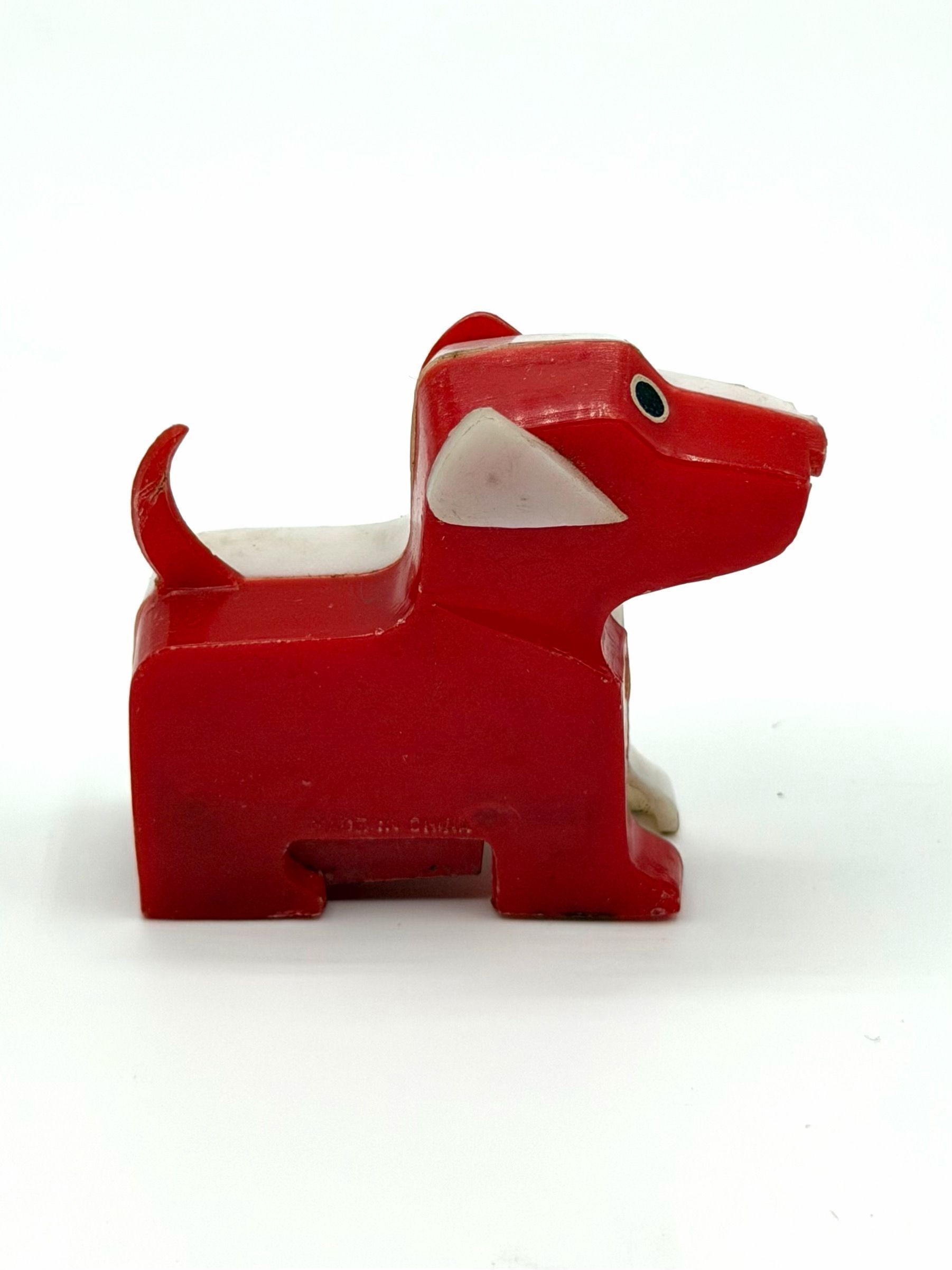
Name/Title
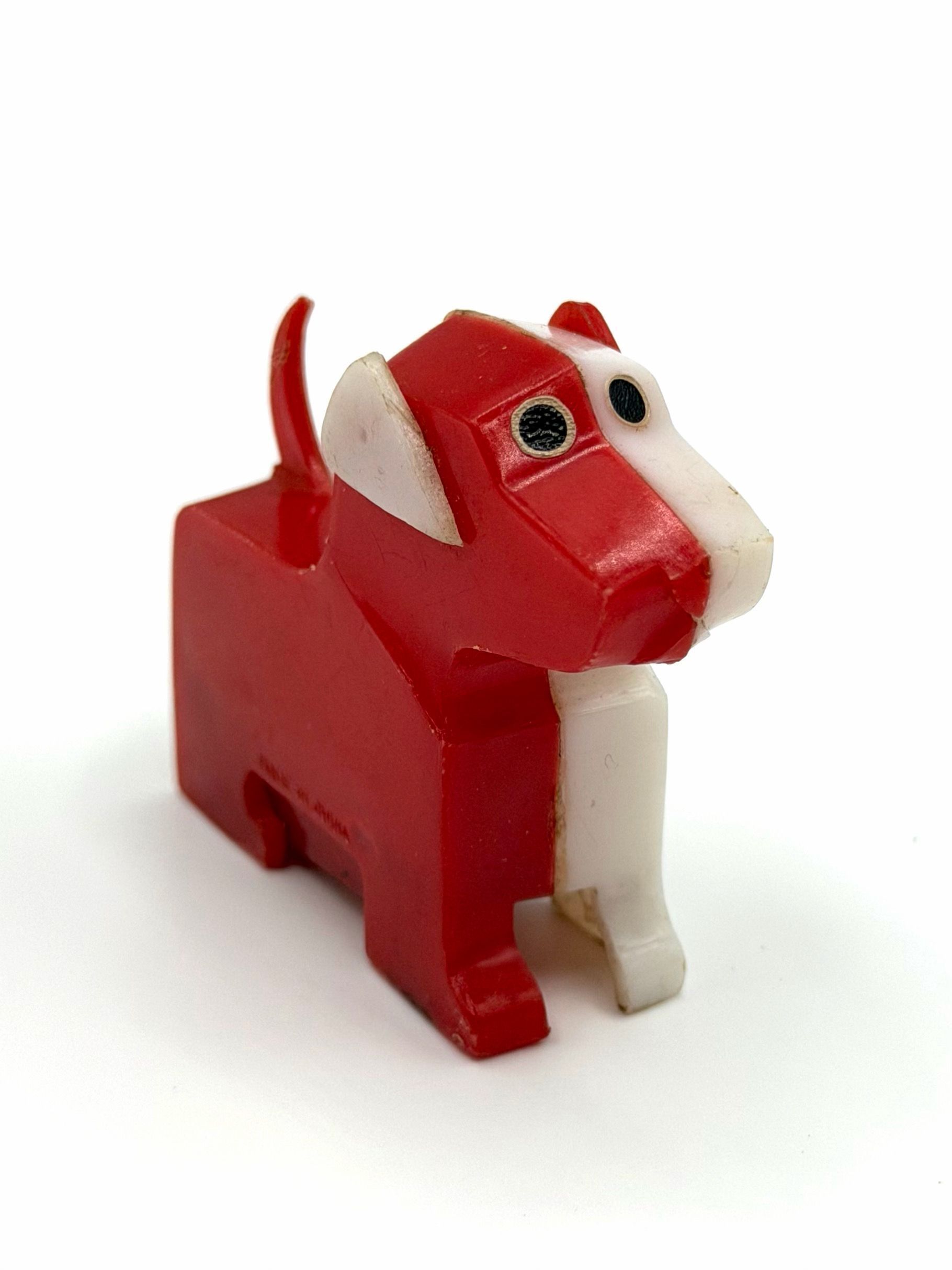
Novelty pencil sharpener in the form of a dog, red and white plasticEntry/Object ID
2025.1.418Description
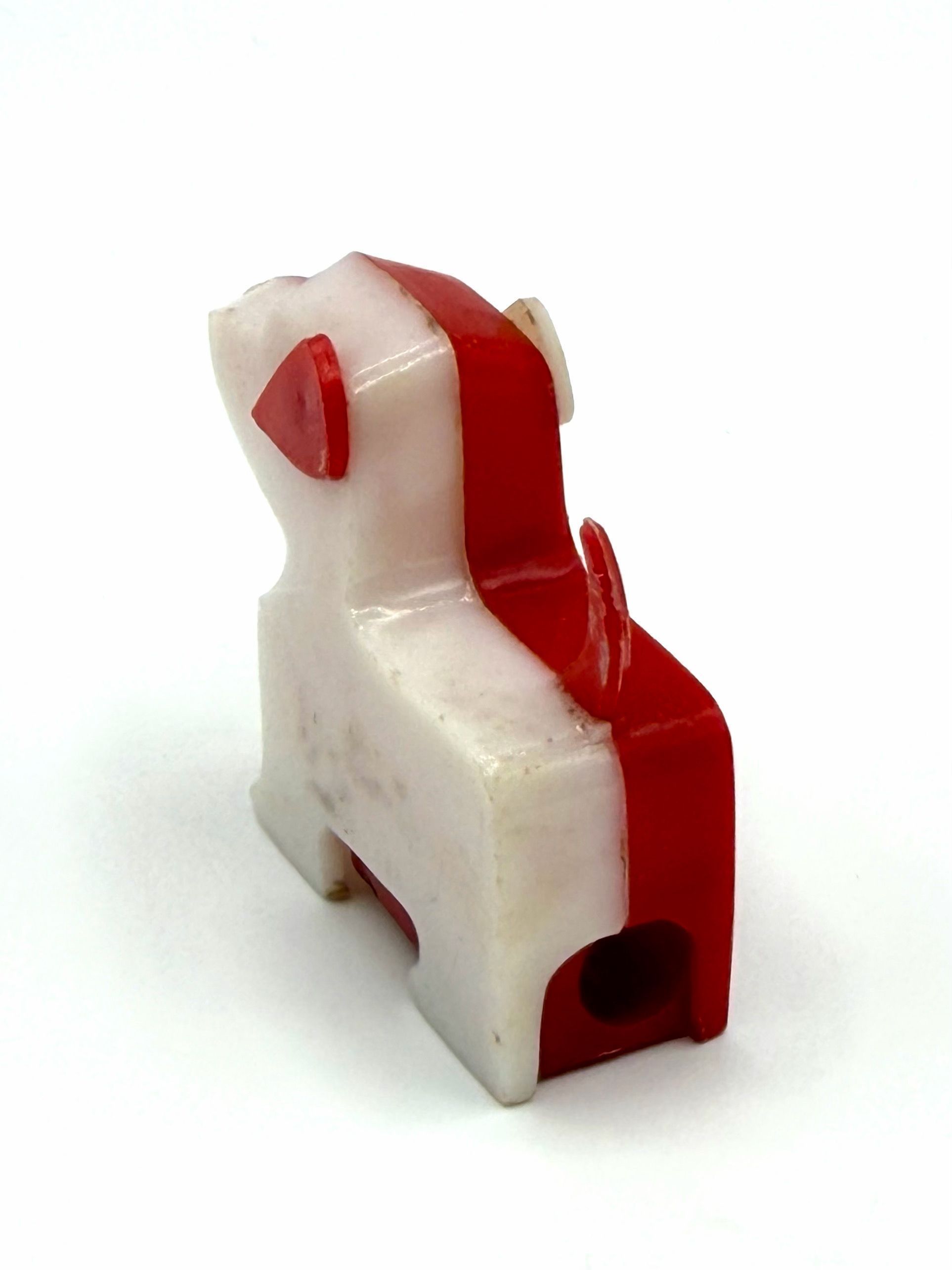
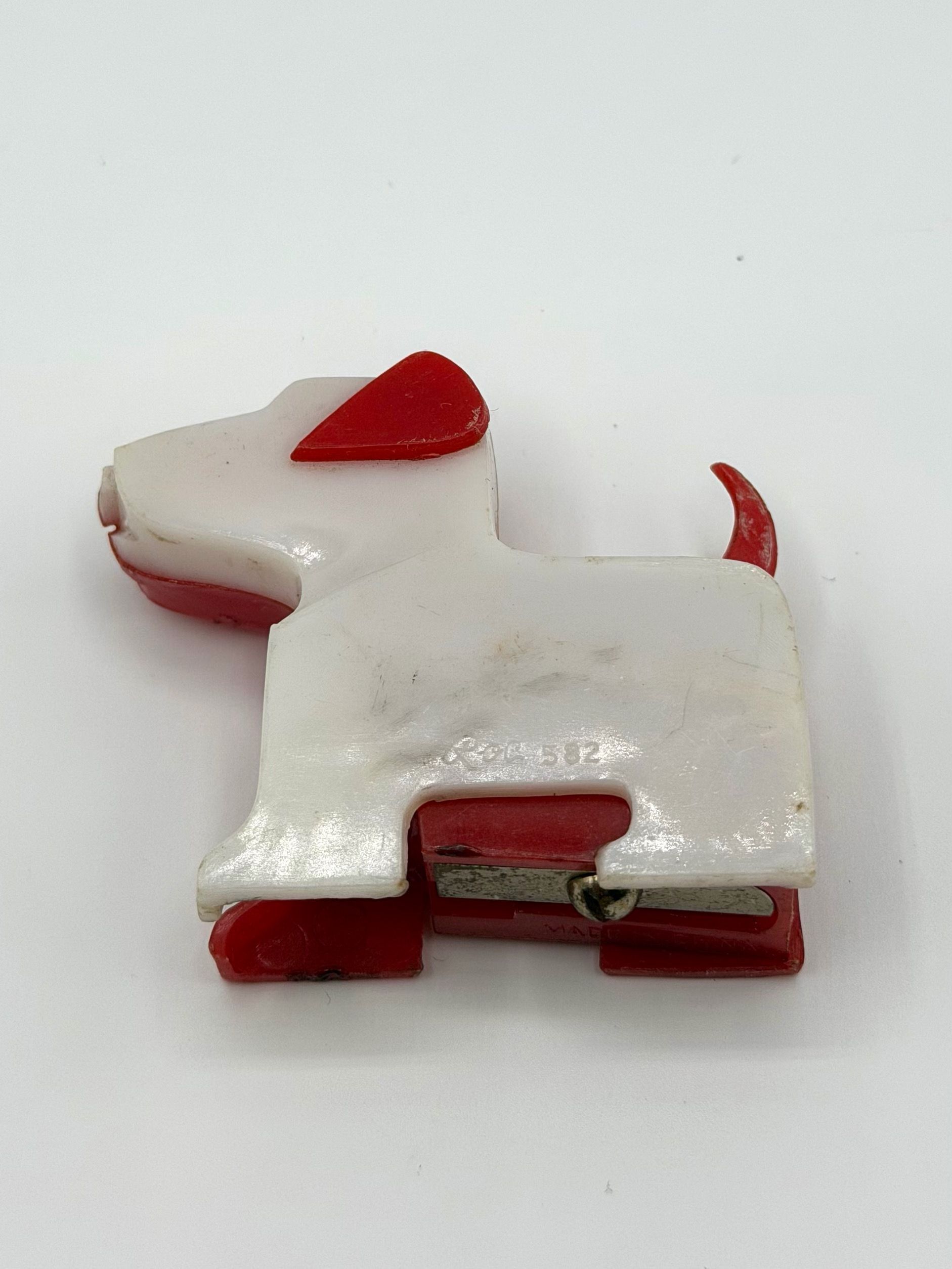
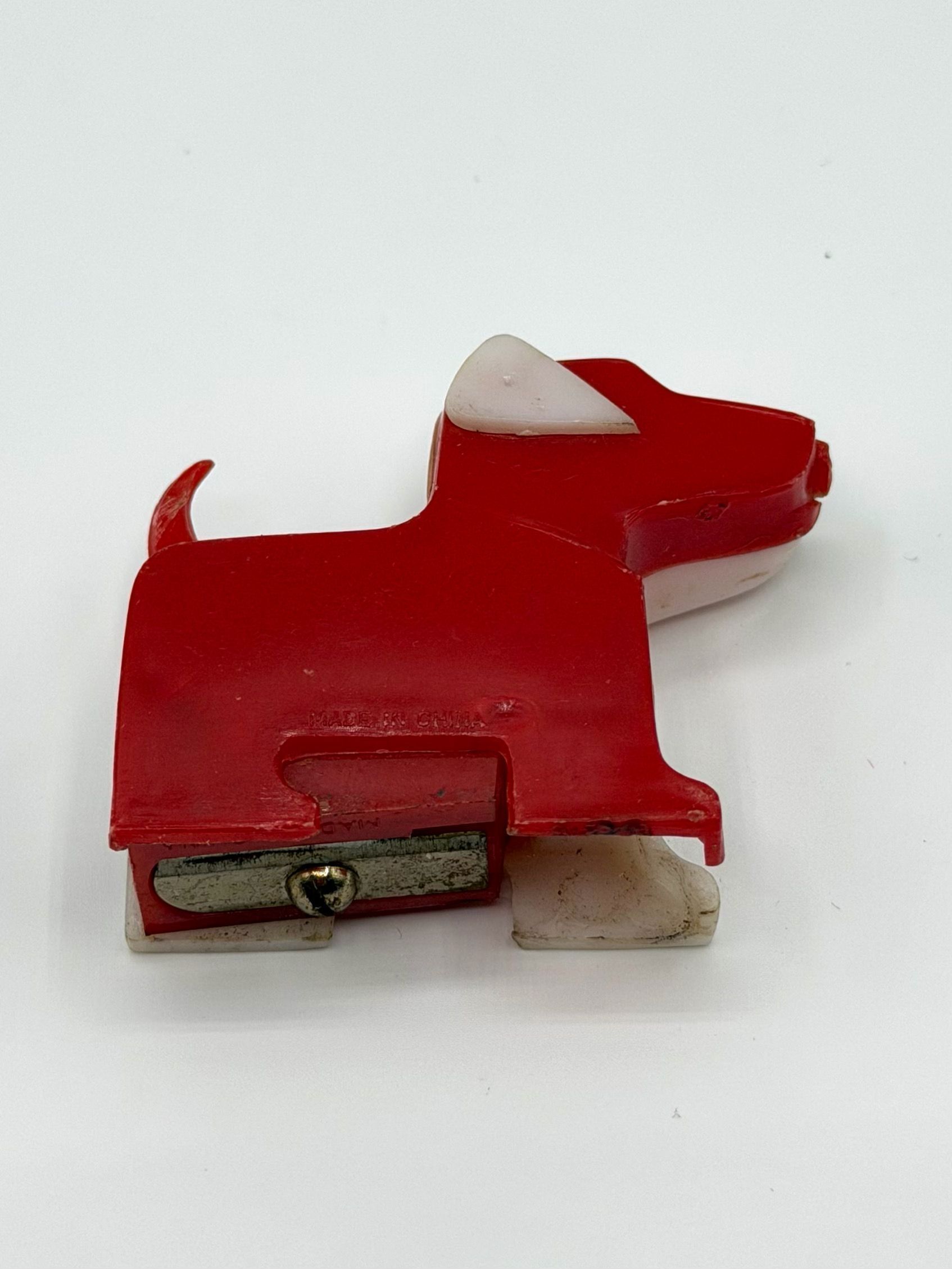
Figural pencil sharpener molded as a standing short-legged terrier-type dog, assembled from red and white plastic in an interlocking two-color arrangement: the body is split so that one flank, the ears, tail and muzzle-tip read red while the opposite flank, head, forelegs and snout read white, each color carrying the other's markings in reverse. Faceted, angular modeling throughout — flat planes and sharp arrises rather than rounded naturalism. Two applied circular eyes, black with a pale surround. The sharpening mechanism is set into the underside between the legs: a rectangular steel blade secured by a single slotted screw, over a conical bore that opens at the dog's rear as a dark circular hole visible in the three-quarter view. Molded lettering appears on both flanks.Use
Store with the office materials of Leopoldo Arús GálvezContext
Mass-produced figural stationery of a type distributed worldwide from the later twentieth century. The context depends on which country of manufacture is confirmed, and the two readings point to very different histories.
If Taiwan (R.O.C.): Taiwan dominated this exact product category during the collection's period — by the 1970s most novelty goods were produced in Taiwan or Korea, before production shifted to Hong Kong in the late 1970s and later to Malaysia, Indonesia and Mexico; the Made in Taiwan label covered textiles, plastic toys and bikes through the 1980s. But Cuba recognized the PRC on 28 September 1960, the first Latin American state to do so, and severed relations with the ROC in consequence. Official Cuban imports from Taiwan after 1960 are therefore implausible, leaving entry before 1960, transshipment through a third country, or arrival in personal luggage, a remittance parcel, or a gift from family abroad. That last route is well attested for Cuban households and is genuinely interesting evidence — objects arriving outside state trade channels, which the state import record by definition does not document.
If mainland China (PRC): the object joins the collection's existing Chinese material (Butterfly, Double Lion) as evidence of state-channel imports, which ran on quinquennial convenios from the 1960s; plastic products are among the principal categories China exports to Cuba. But bulk Chinese consumer goods in Cuba are largely a post-1990 story — the relationship's trade, credit and investment increased significantly from the nineties, and the traditional convenio-based exchange used since the 1960s was only modified in 1995 — which would push the object out of scope.Collection
The Cabrera Arús family collection, Leopoldo Arús Gálvez collectionInscription/Signature/Marks
Notes
Red flank: MADE IN CHINA
Red underside/foot area: MADE IN CHINA (second occurrence, partly obscured by the mechanism)
White flank: Roc 582Parts
Body half, red plastic (1)
Body half, white plastic (1)
Blade, steel (1)
Screw, slotted (1)
Eyes, applied discs (2)
Tail (1)Materials
Material
Plastic, MetalMaterial Notes
Injection-molded plastic — likely polystyrene, INFERRED from the hard, slightly brittle gloss and the crisp mold detail; ABS also possible. Blade: steel (INFERRED). Screw: steel or plated brass. Eye discs: plastic or printed paper laminate, undetermined.Relationships
Related Person or Organization
Person or Organization
Leopoldo Arús GálvezRelated Places
Place
City
HavanaCountry
CubaRegion
Caribbean, Central AmericaResearch Notes
Notes
Researched 2026-08-06 and 2026-08-07, Spanish and English. Sources on Cuba–China trade: Embassy of the PRC in Cuba; IGADI; Economía y Desarrollo (SciELO Cuba); Spanish Wikipedia. On origin-marking conventions: Coxsackie Antique Center and Elizabeth Appraisals country-of-origin dating guides; English Wikipedia, Made in Taiwan. On classification: Nomenclature 4.0 publisher material; Wikidata; Smithsonian NMAH and Cooper Hewitt collection records.Created By
María A. Cabrera ArúsCreate Date
August 6, 2026Updated By
María A. Cabrera ArúsUpdate Date
August 28, 2026