Type
InscriptionLocation
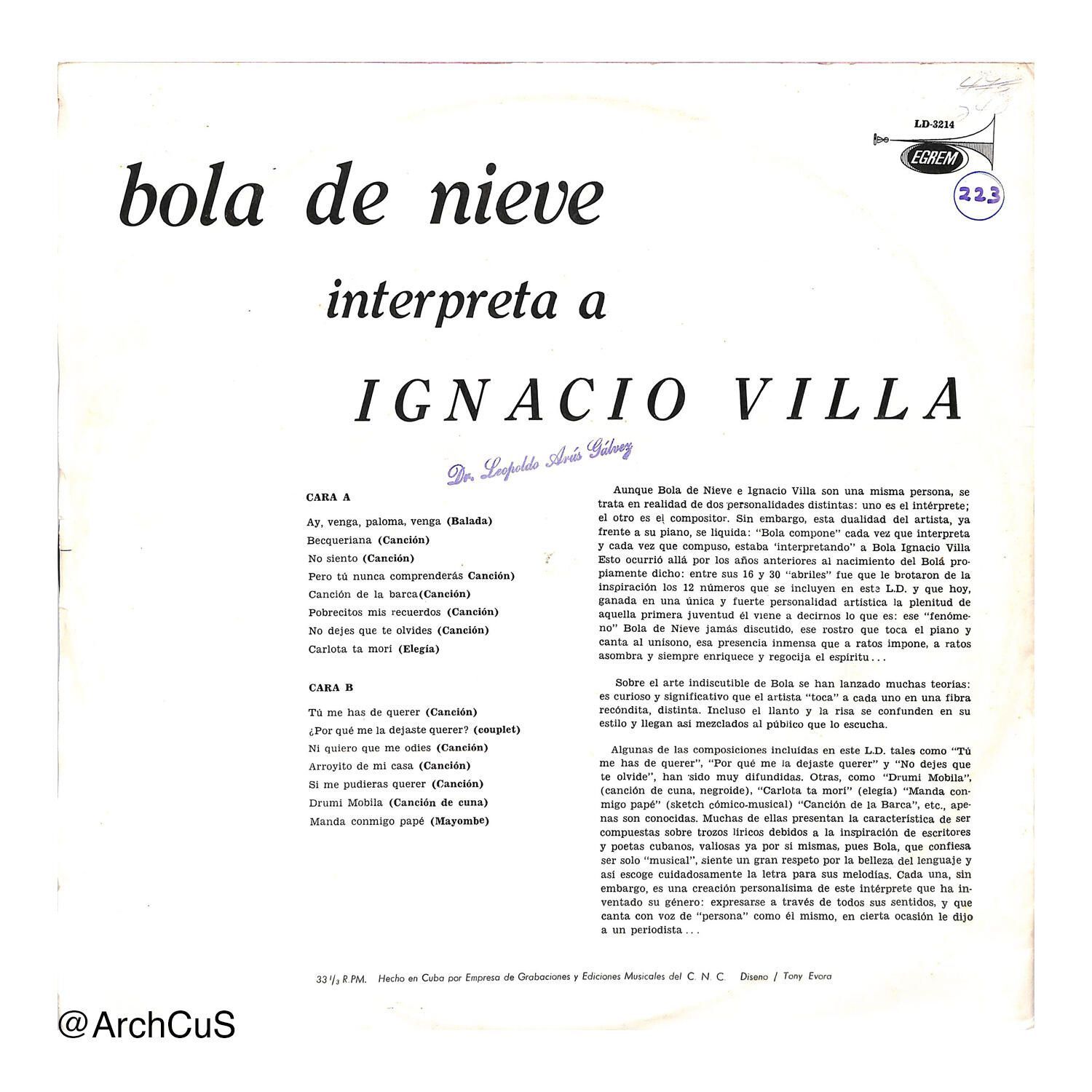
Back coverTranscription
Aunque Bola de Nieve e Ignacio Villa son una misma persona, se trata en realidad de dos personalidades distintas: uno es el intérprete; el otro es el compositor. Sin embargo, esta dualidad del artista, ya frente a su piano, se liquida: "Bola compone" cada vez que interpreta y cada vez que compuso, estaba 'interpretando" a Bola Ignacio Villa Esto ocurrió allá por los años anteriores al nacimiento del Bolá pro piamente dicho: entre sus 16 y 30 "abriles" fue que le brotaron de la inspiración los 12 números que se incluyen en este L.D. y que hoy, ganada en una única y fuerte personalidad artística la plenitud de aquella primera juventud él viene a decirnos lo que es: ese "fenóme no" Bola de Nieve jamás discutido, ese rostro que toca el piano y canta al unisono, esa presencia inmensa que a ratos impone, a ratos asombra y siempre enriquece y regocija el espíritu...
Sobre el arte indiscutible de Bola se han lanzado muchas teorías: es curioso y significativo que el artista "toca" a cada uno en una fibra recóndita, distinta. Incluso el llanto y la risa se confunden en su estilo y llegan así mezclados al público que lo escucha.
Algunas de las composiciones incluídas en este L.D. tales como "Tú me has de querer", "Por qué me la dejaste querer" y "No dejes que te olvide", han sido muy difundidas. Otras, como "Drumi Mobila", (canción de cuna, negroide), "Carlota ta mori" (elegía) "Manda con migo pape" (sketch cómico-musical) "Canción de la Barca", etc., ape nas son conocidas. Muchas de ellas presentan la característica de ser compuestas sobre trozos líricos debidos a la inspiración de escritores y poetas cubanos, valiosas ya por sí mismas, pues Bola, que confiesa ser solo "musical", siente un gran respeto por la belleza del lenguaje y así escoge cuidadosamente la letra para sus melodías. Cada una, sin embargo, es una creación personalísima de este intérprete que ha in ventado su género: expresarse a través de todos sus sentidos, y que canta con voz de "persona" como él mismo, en cierta ocasión le dijo a un periodista...Language
SpanishTranslation
Although Bola de Nieve and Ignacio Villa are the same person, they are actually two different personalities: one is the interpreter; the other is the composer. However, this duality of the artist, already in front of his piano, is liquidated: "Bola composes" every time he performs and every time he composed, he was 'performing' Bola Ignacio Villa This happened back in the years before the birth of Bolá properly said: between his 16th and 30th "Aprils" it was that the 12 issues that are included in this L.D. sprung from his inspiration and that today, gained in a single and strong artistic personality the fullness of that early youth he comes to tell us what it is: that Snowball "phenomenon" never discussed, that face that plays the piano and sings in unison, that immense presence that at times imposes, at times astonishes and always enriches and rejoices the spirit...
Many theories have been launched about Bola's indisputable art: it is curious and significant that the artist "touches" each one in a hidden, different fiber. Even crying and laughter are confused in his style and thus come mixed to the audience that listens to him.
Some of the compositions included in this L.D. such as "You have to love me", "Why did you let me love her" and "Don't let me forget you", have been widely disseminated. Others, such as "Drumi Mobila", (lullaby, Negroid), "Carlota ta mori" (elegy) "Manda con migo pape" (comic-musical sketch) "Canción de la Barca", etc., are hardly known . Many of them have the characteristic of being composed on lyrical pieces due to the inspiration of Cuban writers and poets, valuable in themselves, since Bola, who confesses to being only "musical", feels great respect for the beauty of language and thus he carefully chooses the lyrics for his melodies. Each one, however, is a very personal creation of this performer who has invented his genre: expressing himself through all his senses, and who sings with the voice of a "person" like himself, on one occasion he said to a journalist ...Notes
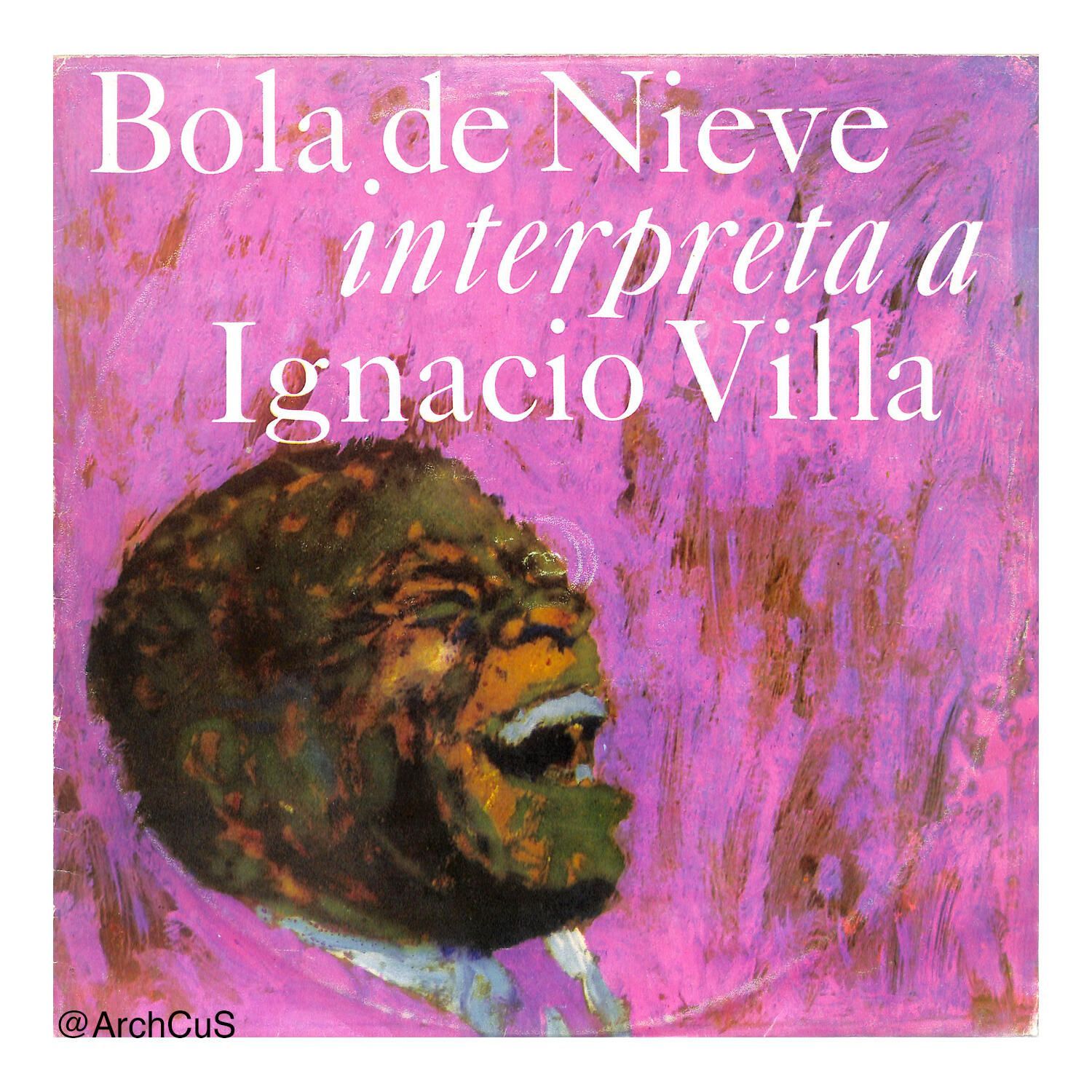
Front: "Bola de Nieve / interpreta a / Ignacio Villa."
Back: title repeated; track listing (below); Spanish liner note; "33⅓ R.P.M."; "Hecho en Cuba por Empresa de Grabaciones y Ediciones Musicales del C.N.C."; "Diseño / Tony Évora"; EGREM logo; "LD-3214"; a handwritten signature/name reading "Dr. Leopoldo Arús Gálvez" (owner's inscription); blue circular inventory stamp "223"; handwritten "44"/"33" (price/inventory) at upper right.
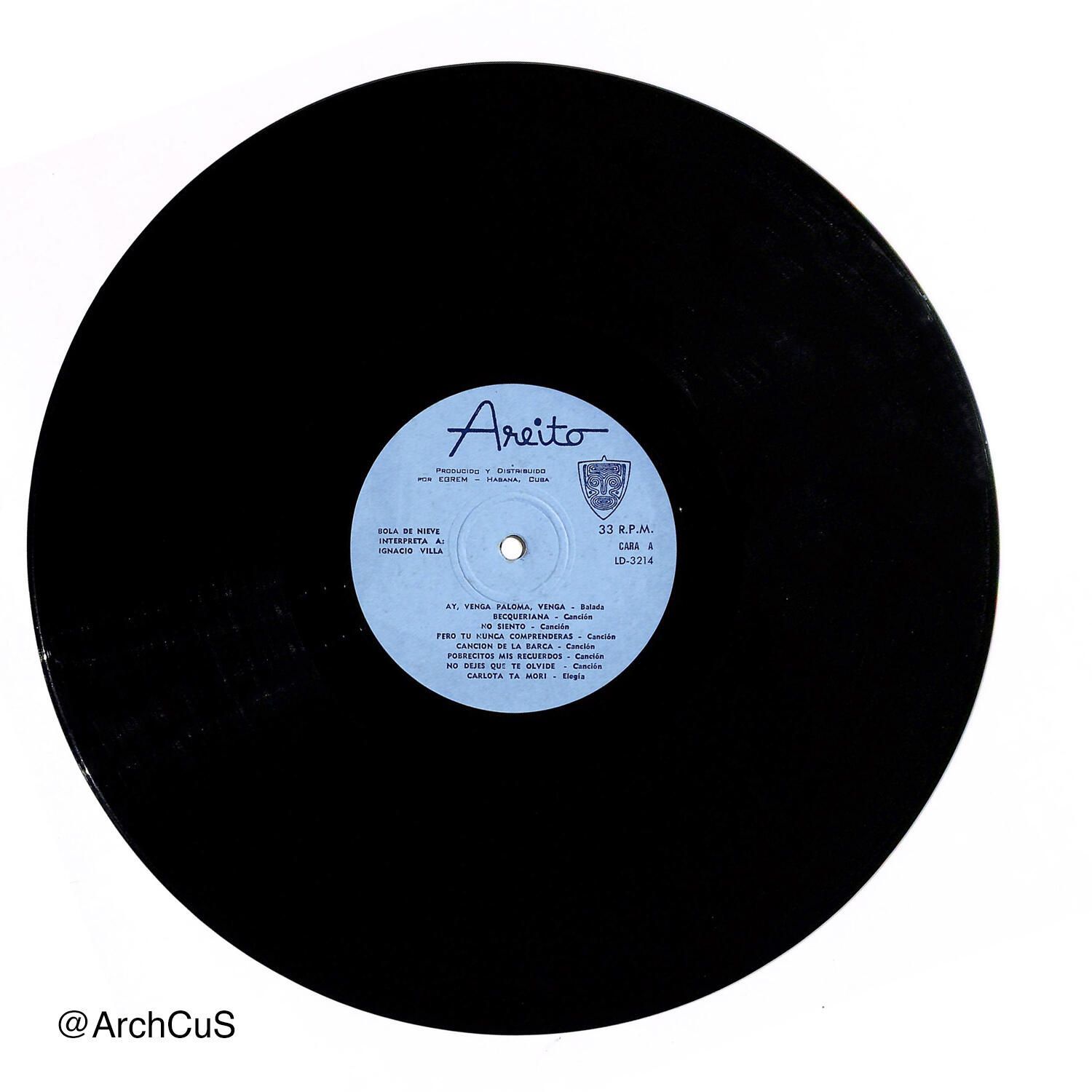
Disc label: "Areíto"; "Producido y Distribuido por EGREM – Habana, Cuba"; "BOLA DE NIEVE / INTERPRETA A: IGNACIO VILLA"; "33 R.P.M."; "CARA A"; "LD-3214"; Side A track list.
Track listing (as printed, title — genre):
Cara A: "Ay, venga paloma, venga" (balada); "Becqueriana" (canción); "No siento" (canción); "Pero tú nunca comprenderás" (canción); "Canción de la barca" (canción); "Pobrecitos mis recuerdos" (canción); "No dejes que te olvide(s)" (canción); "Carlota ta morí" (elegía).
Cara B: "Tú me has de querer" (canción); "¿Por qué me la dejaste querer?" (couplet); "Ni quiero que me odies" (canción); "Arroyito de mi casa" (canción); "Si me pudieras querer" (canción); "Drumi Mobila" (canción de cuna); "Manda conmigo papé" (mayombe).