Type
InscriptionLocation
Back cover notesTranscription
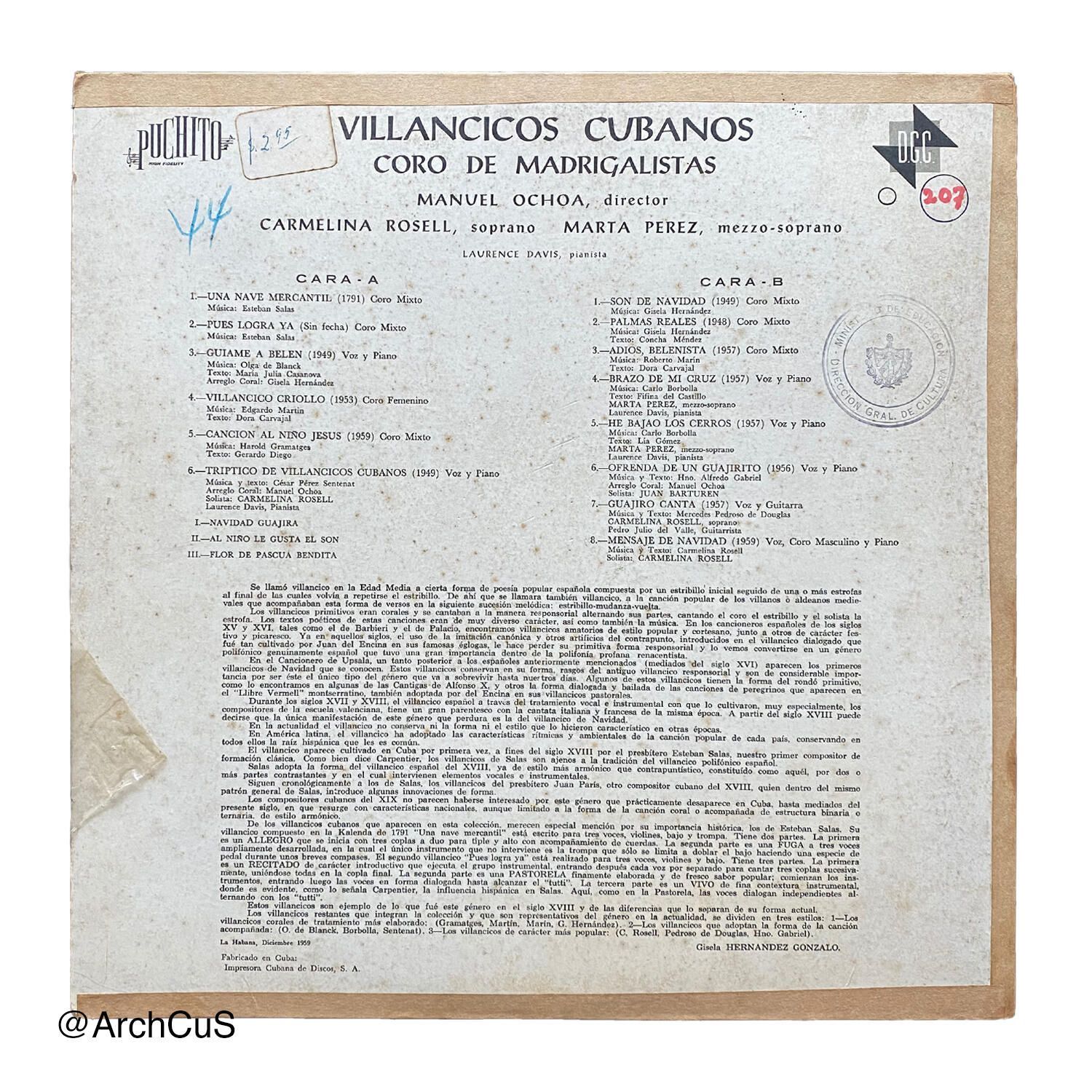
Se llamó villancico en la Edad Media a cierta forma de poesía popular española compuesta por un estribillo inicial seguido de una o más estrofas al final de las cuales volvía a repetirse el estribillo. De ahí que se llamara también villancico, a la canción popular de los villanos o aldeanos medievales que acompañaban esta forma de versos en la siguiente sucesión melódica: estribillo-mudanza-vuelta.
Los villancicos primitivos eran corales y se cantaban a la manera responsorial alternando sus partes, cantando el coro el estribillo y el solista la estrofa. Los textos poéticos de estas canciones eran de muy diverso carácter, así como también la música. En los cancioneros españoles de los siglos XV y XVI, tales como el de Barbieri y el de Palacio, encontramos villancicos amatorios de estilo popular y cortesano, junto a otros de carácter festivo y picaresco. Ya en aquellos siglos, el uso de la imitación canónica y otros artificios del contrapunto, introducidos en el villancico dialogado que fué tan cultivado por Juan del Encina en sus famosas églogas, le hace perder su primitiva forma responsorial y lo vemos convertirse en un género polifónico genuinamente español que tuvo una gran importancia dentro de la polifonía profana renacentista.
En el Cancionero de Upsala, un tanto posterior a los españoles anteriormente mencionados (mediados del siglo XVI) aparecen los primeros villancicos de Navidad que se conocen. Estos villancicos conservan en su forma, rasgos del antiguo villancico responsorial y son de considerable importancia por ser éste el único tipo del género que va a sobrevivir hasta nuestros días. Algunos de estos villancicos tienen la forma del rondó primitivo, como lo encontramos en algunas de las Cantigas de Alfonso X, y otros la forma dialogada y bailada de las canciones de peregrinos que aparecen en el "Llibre Vermell" montserratino, también adoptada por del Encina en sus villancicos pastorales.
Durante los siglos XVII y XVIII, el villancico español a través del tratamiento vocal e instrumental con que lo cultivaron, muy especialmente, los compositores de la escuela valenciana, tiene un gran parentesco con la cantata italiana y francesa de la misma época. A partir del siglo XVIII puede decirse que la única manifestación de este género que perdura es la del villancico de Navidad.
En la actualidad el villancico no conserva ni la forma ni el estilo que lo hicieron característico en otras épocas.
En América latina, el villancico ha adoptado las características rítmicas y ambientales de la canción popular de cada país, conservando en todos ellos la raíz hispánica que les es común.
El villancico aparece cultivado en Cuba por primera vez, a fines del siglo XVIII por el presbítero Esteban Salas, nuestro primer compositor de formación clasica. Como bien dice Carpentier, los villancicos de Salas son ajenos a la tradición del villancico polifónico español.
Salas adopta la forma del villancico español del XVIII, ya de estilo más armónico que contrapuntístico, constituído como aquél, por dos o más partes contrastantes y en el cual intervienen elementos vocales e instrumentales.
Siguen cronológicamente a los de Salas, los villancicos del presbítero Juan París, otro compositor cubano del XVIII, quien dentro del nismo patrón general de Salas, introduce algunas innovaciones de forma.
Los compositores cubanos del XIX no parecen haberse interesado por este género que prácticamente desaparece en Cuba, hasta mediados del presente siglo, en que resurge con características nacionales, aunque limitado a la forma de la canción coral o acompañada de estructura binaria o ternaria, de estilo armónico.
De los villancicos cubanos que aparecen en esta colección, merecen especial mención por su importancia histórica, los de Esteban Salas. Su villancico compuesto en la Kalenda de 1791 "Una nave mercantil" está escrito para tres voces, violines, bajo y trompa. Tiene dos partes. La primera es un ALLEGRO que se inicia con tres coplas a duo para tiple y alto con acompañamiento de cuerdas. La segunda parte es una FUGA a tres voces ampliamente desarrollada, en la cual el único instrumento que no interviene es la trompa que sólo se limita a doblar el bajo haciendo una especie de pedal durante unos breves compases. El segundo villancico "Pues logra ya" está realizado para tres voces, violines y bajo. Tiene tres partes. La primera es un RECITADO de carácter introductivo que ejecuta el grupo instrumental, entrando después cada voz por separado para cantar tres coplas sucesivamente, uniéndose todas en la copla final. La segunda parte es una PASTORELA finamente elaborada y de fresco sabor popular; comienzan los instrumentos, entrando luego las voces en forma dialogada hasta alcanzar el "tutti". La tercera parte es un VIVO de fina contextura instrumental, donde es evidente, como lo señala Carpentier, la influencia hispánica en Salas. Aquí, como en la Pastorela, las voces dialogan independientes alternando con los "tutti".
Estos villancicos son ejemplo de lo que fué este género en el siglo XVIII y de las diferencias que lo separan de su forma actual.
Los villancicos restantes que integran la colección y que son representativos del género en la actualidad, se dividen en tres estilos: 1-Los villancicos corales de tratamiento más elaborado: (Gramatges, Martín, Marín, G. Hernández). 2-Los villancicos que adoptan la forma de la canción acompañada: (O. de Blanck, Borbolla, Sentenat), 3 -Los villancicos de carácter más popular: (C. Rosell, Pedroso de Douglas, Hno. Gabriel).
La Habana, Diciembre 1959. Gisela HERNANDEZ GONZALO.
Fabricado en Cuba:
Impresora Cubana de Discos, S. A.Language
SpanishTranslation
In the Middle Ages, the term “villancico” referred to a specific form of Spanish folk poetry consisting of an opening refrain followed by one or more verses, at the end of which the refrain was repeated. Hence, the term “villancico” was also applied to the folk songs of medieval peasants or villagers who accompanied this verse form with the following melodic sequence: refrain-verse-refrain.
Early villancicos were choral pieces and were sung in a responsorial style, with the choir singing the refrain and the soloist singing the verse. The poetic texts of these songs were of a very diverse nature, as was the music. In the Spanish songbooks of the 15th and 16th centuries, such as those of Barbieri and Palacio, we find love villancicos in both popular and courtly styles, alongside others of a festive and picaresque nature. Already in those centuries, the use of canonical imitation and other contrapuntal devices, introduced into the dialogued villancico that was so cultivated by Juan del Encina in his famous eclogues, caused it to lose its original responsorial form, and we see it evolve into a genuinely Spanish polyphonic genre that held great importance within Renaissance secular polyphony.
The Uppsala Songbook, which dates from somewhat later than the Spanish collections mentioned above (mid-16th century), contains the earliest known Christmas carols. These carols retain, in their form, features of the ancient responsorial carol and are of considerable importance, as this is the only type of the genre to have survived to the present day. Some of these carols take the form of the primitive rondo, as found in some of the Cantigas of Alfonso X, while others adopt the dialogued and danced form of the pilgrims’ songs appearing in the Montserrat “Llibre Vermell,” a form also adopted by del Encina in his pastoral carols.
During the 17th and 18th centuries, the Spanish villancico, through the vocal and instrumental treatment with which it was cultivated, particularly by the composers of the Valencian school, bears a strong resemblance to the Italian and French cantata of the same period. From the 18th century onward, it can be said that the only surviving manifestation of this genre is the Christmas villancico.
Today, the villancico retains neither the form nor the style that made it distinctive in earlier eras.
In Latin America, the villancico has adopted the rhythmic and stylistic characteristics of each country’s folk songs, while retaining the common Hispanic roots shared by all of them.
The villancico first appeared in Cuba in the late 18th century, cultivated by the priest Esteban Salas, our first classically trained composer. As Carpentier rightly notes, Salas’s villancicos are distinct from the tradition of the Spanish polyphonic villancico.
Salas adopts the form of the 18th-century Spanish villancico, already more harmonic than contrapuntal in style, consisting, like the latter, of two or more contrasting parts and incorporating both vocal and instrumental elements.
Chronologically following Salas’s works are the villancicos of the priest Juan París, another 18th-century Cuban composer, who, within Salas’s general framework, introduces some formal innovations.
Nineteenth-century Cuban composers do not seem to have taken an interest in this genre, which practically disappeared in Cuba until the middle of the present century, when it reemerged with national characteristics, though limited to the form of the choral or accompanied song with a binary or ternary structure, in a harmonic style.
Among the Cuban Christmas carols featured in this collection, those by Esteban Salas deserve special mention for their historical significance. His carol composed during the Kalenda of 1791, “Una nave mercantil,” is written for three voices, violins, bass, and French horn. It consists of two parts. The first is an ALLEGRO that begins with three verses sung as a duet by the soprano and alto, accompanied by strings. The second part is a fully developed three-voice FUGUE, in which the only instrument that does not participate is the horn, which merely doubles the bass, acting as a sort of pedal for a few brief measures. The second Christmas carol, “Pues logra ya,” is scored for three voices, violins, and bass. It has three parts. The first is a RECITATIVO of an introductory nature performed by the instrumental ensemble, after which each voice enters separately to sing three verses in succession, all joining together in the final verse. The second part is a finely crafted PASTORELA with a fresh, folksy flavor; the instruments begin, followed by the voices entering in dialogue until reaching the “tutti.” The third part is a VIVO with a refined instrumental texture, where, as Carpentier points out, the Hispanic influence on Salas is evident. Here, as in the Pastorela, the voices engage in independent dialogue, alternating with the “tutti.”
These Christmas carols are examples of what this genre was like in the 18th century and of the differences that set it apart from its current form.
The remaining Christmas carols in the collection, which are representative of the genre today, fall into three styles: 1. Choral carols with a more elaborate arrangement: (Gramatges, Martín, Marín, G. Hernández). 2-Carols in the form of accompanied songs: (O. de Blanck, Borbolla, Sentenat), 3 -Carols of a more popular nature: (C. Rosell, Pedroso de Douglas, Hno. Gabriel).
Havana, December 1959 Gisela HERNANDEZ GONZALO.
Made in Cuba
Impresora Cubana de Discos, S.A.Material/Technique
Painted