Name/Title
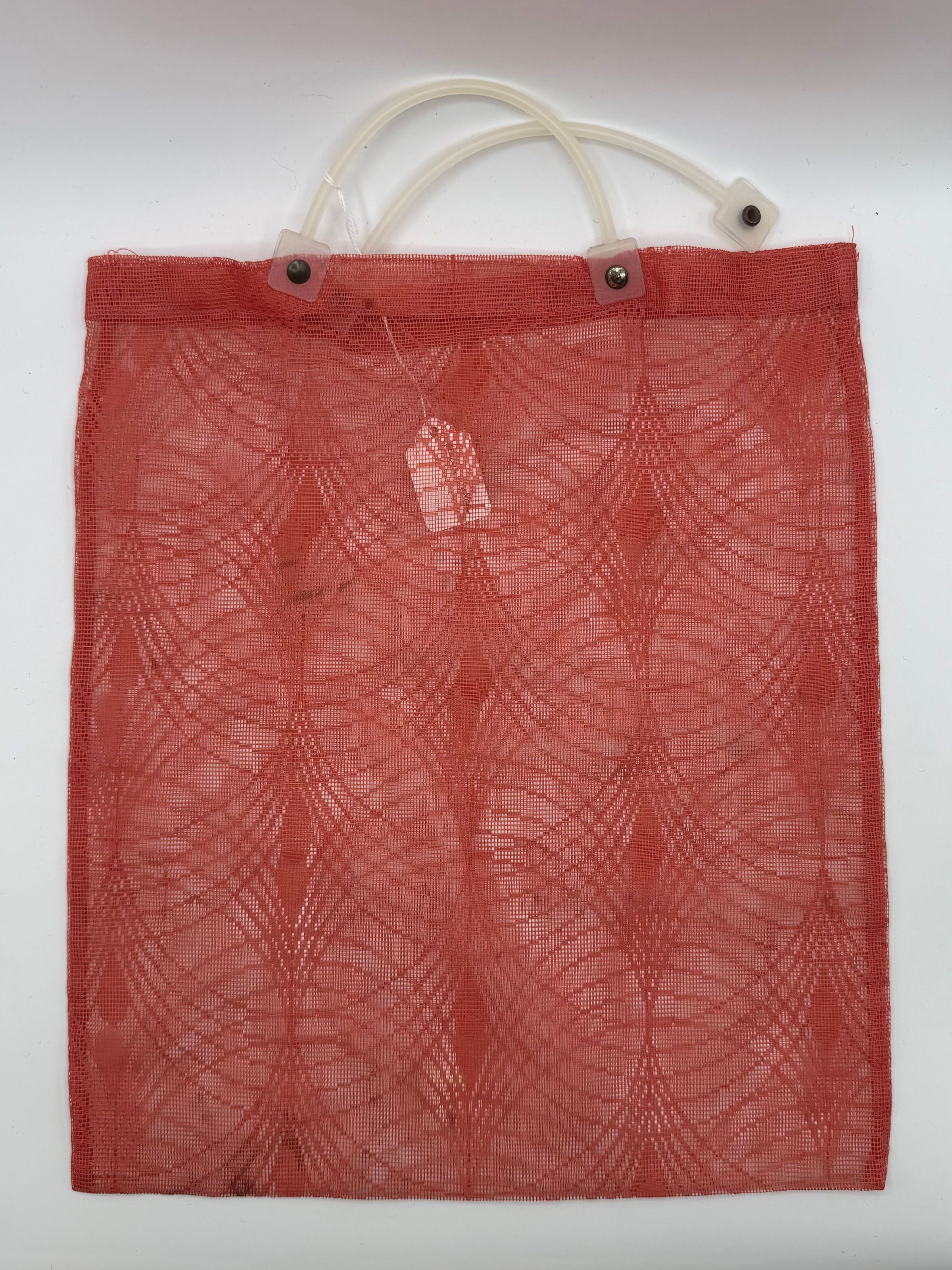
Red Lace-Net Shopping Bag with Plastic Tube HandlesEntry/Object ID
2025.6.44Description
A rectangular open-top shopping bag with a body formed from a red machine-made net in a repeating lace pattern. The net is structured: rows of radiating fan-shaped cells create a continuous geometric design across the face and back, combining a fine open ground with denser figured areas — more ornamental than the utilitarian knotted cord of a standard string bag. The upper edge is finished with a narrow woven tape header in the same red, into which two white semi-rigid plastic tube handles are inserted and secured by metal rivets or press-studs, one at each handle attachment point. The handles form two independent arched loops.
The combination of a decorative lace-pattern net body with tube handles and a riveted header is consistent with mid-century commercial production but carries no distinctively regional construction markers. It belongs to the broad and widely shared category of the reusable net shopping bag, in everyday use across socialist, post-war European, and Latin American consumer cultures from the 1950s through the 1980s. In Cuba the type was in common daily use, particularly for trips to the bodega or market.Context
The reusable net shopping bag was a fundamental object of daily life across many twentieth-century economies, and especially meaningful in conditions of material scarcity, where a compact, always-carried bag was a practical necessity — the Soviet avoska ("maybe-bag," carried "just in case" something appeared to buy) being the canonical example of the type. In Cuba, the same logic of scarcity applied from the early 1960s onward. Net bags of this kind were used for everyday errands — grocery shopping at the bodega, trips to the agromercado, or carrying personal items. The decorative lace-pattern body of this example suggests it occupied a slightly more stylish register than the plainest utilitarian nets, possibly serving also as a beach or casual handbag.Acquisition
Accession
2025.6Source or Donor
Mirta SuquetAcquisition Method
GiftMade/Created
Notes
Maker/Attribution: Unknown; no maker's mark present.
Date: Circa 1960s–1980s (tentative).Relationships
Related Person or Organization
Person or Organization
Mirta Martínez FortezaRelated Places
Place
City
Pinar del RíoState/Province
Pinar del RíoCountry
CubaRegion
Caribbean, Central AmericaResearch Notes
Notes
The lace-pattern net warrants comparison with known Spanish, Italian, and Eastern European mid-century net-bag production to narrow the likely source. Spanish and Italian manufacturers produced decorative lace-net bags for the Latin American market throughout the 1950s–70s, and Eastern-bloc producers supplied Cuba through COMECON channels — both routes remain open.Created By
María A. Cabrera ArúsCreate Date
June 22, 2026Updated By
María A. Cabrera ArúsUpdate Date
September 3, 2026