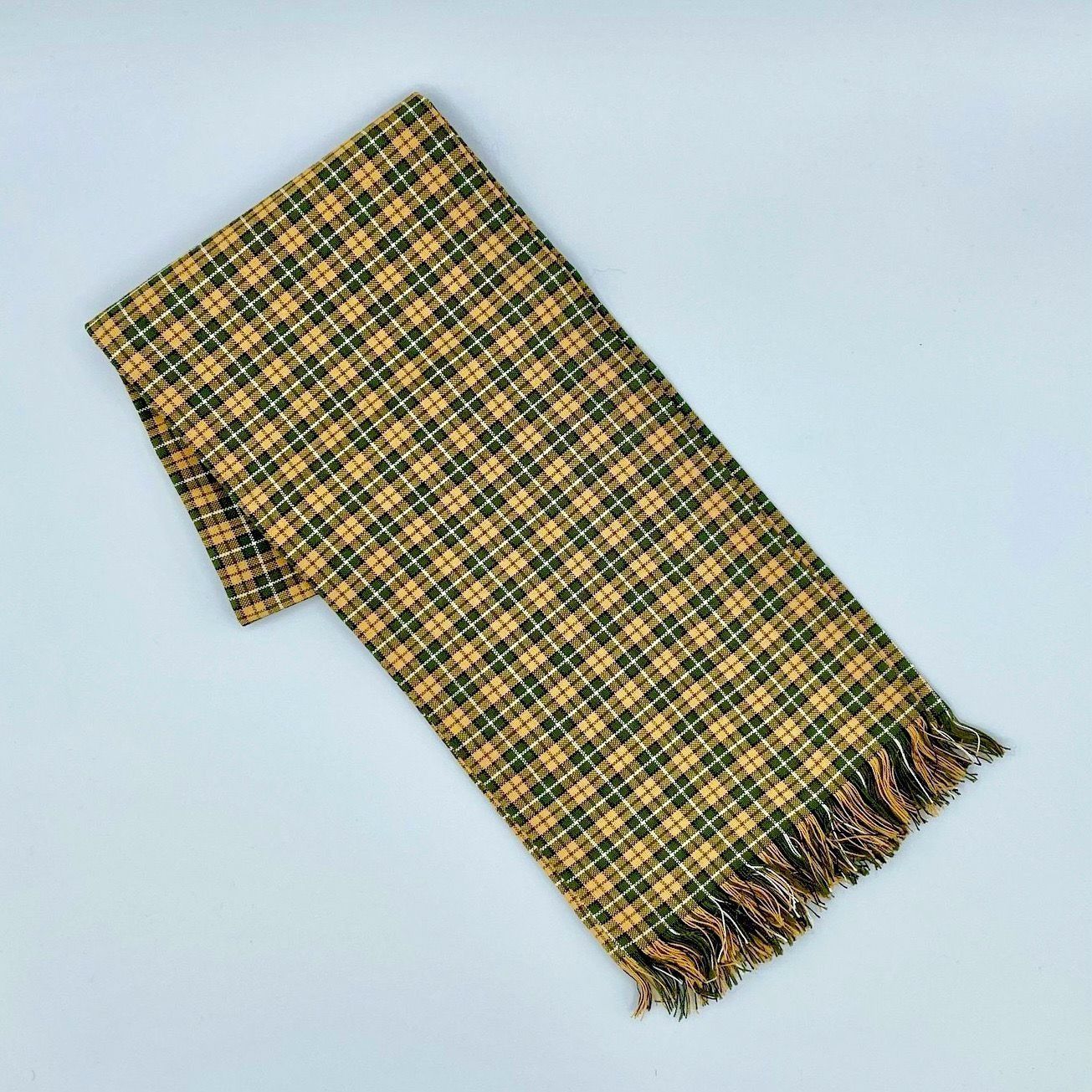
Hand-Sewn Plaid Scarf with Fringe
Name/Title
Hand-Sewn Plaid Scarf with FringeEntry/Object ID
2025.1.32Description
A rectangular plaid scarf in a small-scale yellow/mustard, green, and white check pattern, with hand-finished knotted fringe at the end(s). Hand-sewn by María A. Arús Caraballo during the 1970s. DESCRIPTION: A rectangular textile scarf. The fabric is a fine-scale yellow/mustard and green plaid (tartan-style) with thin white grid lines forming the lattice between blocks of color. The plaid is woven (not printed) — visible from the way the pattern reads consistently from front to back, with the characteristic over-and-under interlacement of dyed warp and weft threads typical of traditional plaid weaving. The dominant color is a warm mustard yellow, crossed by darker (green) horizontal and vertical bands at regular intervals, with finer white lines making the smallest grid divisions. The overall pattern reads as a "house check" or small-scale tartan. The scarf has a substantial fringed end: a row of dense fringe extending several centimeters from the cut edge of the fabric, formed by deliberately unraveling the weft threads to leave the warp threads hanging free, on both sides.Use
Made and owned by María A. Arús CaraballoCollection
The Cabrera Arús family collection, María A. Arús Caraballo collectionAcquisition
Accession
2025.1Made/Created
Manufacturer
María A. Arús CaraballoTime Period
1970sPlace
City
HavanaCountry
CubaRegion
Caribbean, Central AmericaNotes
Hand-made Machine-loomed plaid fabric (the textile itself is industrial production — most likely state-distributed textile yardage); hand-finished hems on long edges; deliberately-unraveled fringe at the cut ends; possibly knotted/twisted fringe-end bundlesCondition
Overall Condition
GoodRelationships
Related Person or Organization
Person or Organization
María A. Arús CaraballoNotes
maker, userRelated Places
Place
City
HavanaCountry
CubaRegion
Caribbean, Central AmericaNotes
manufacture, useExhibitions
Cuban Finotype and Its Materiality
Cuban Revolutionary Fashion: With objects from the Cuba Material collection
Fashioning Cuban Socialism