Notes
The matryoshka (Russian Матрёшка, a diminutive of the female name Matryona) is the most internationally recognizable Russian/Soviet craft object — a set of hand-painted wooden dolls of decreasing size, designed to nest one inside another. The first Russian nesting doll was created in 1890 at the Children's Education Workshop on the Abramtsevo estate north of Moscow, reportedly inspired by a Japanese nested doll of the Shichi-Fukujin (Seven Lucky Gods) that a Russian monk had brought from a trip abroad. The first matryoshka was a wooden eight-piece set crafted by the toy-maker V. Zvezdochkin from sketches by the artist S. V. Malyutin, who painted it as a girl in a sundress, white apron, and colorful headscarf, holding a black rooster; she was named "Matryoshka" after the popular diminutive of "Matryona". In 1900, Russia exhibited various matryoshka styles at the Paris World Exhibition, where the dolls won a medal and many admirers; by 1911 matryoshkas were being sold in 14 countries; under the Soviet regime after 1930, the emphasis shifted to mass production of standardized nested dolls.
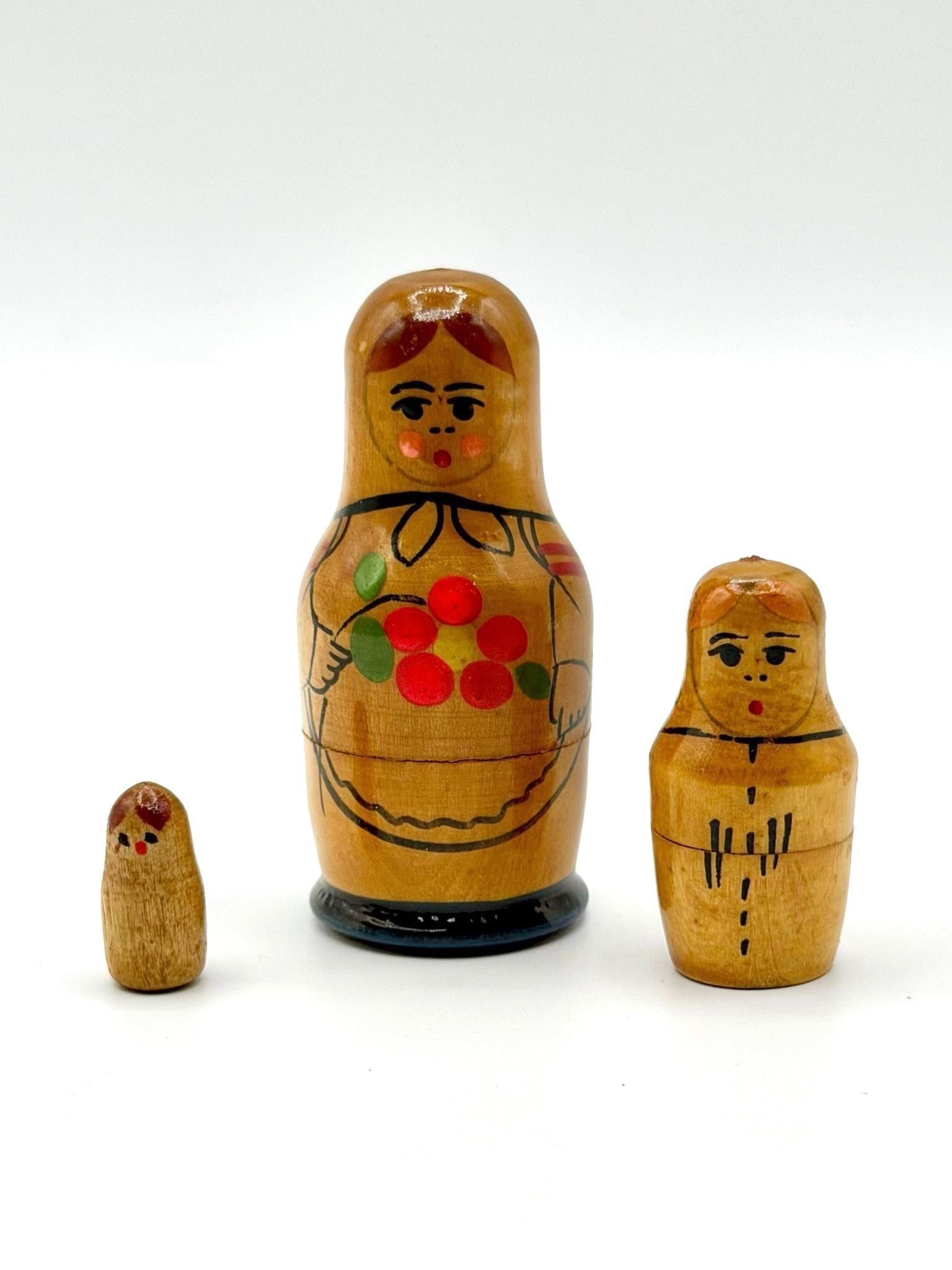
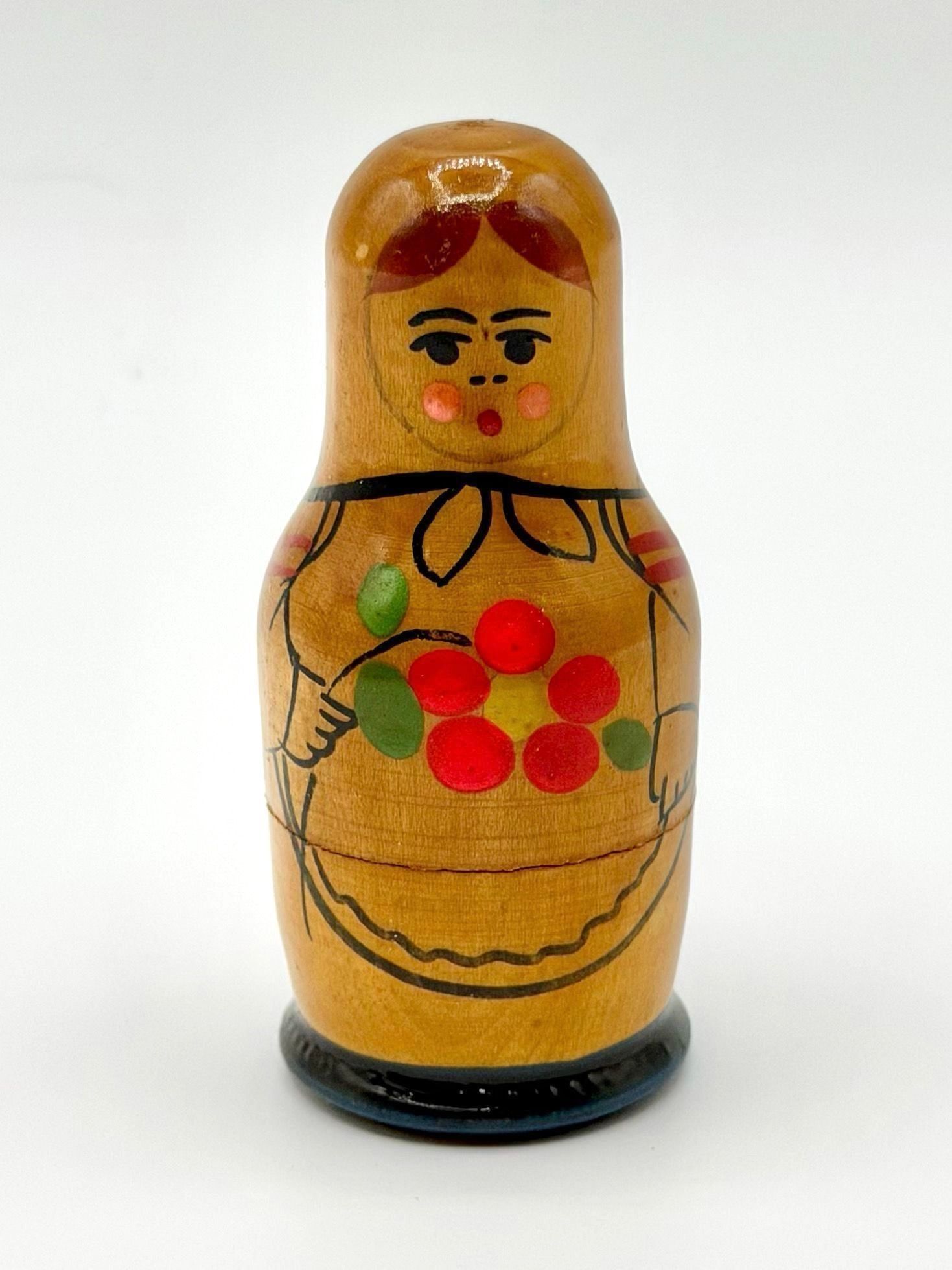
The decoration of this set points strongly to the SEMYONOV (Семёновская) regional style rather than the Sergiyev Posad / Zagorsk style — the two main Russian matryoshka traditions. The Semyonov style features a bright yellow or gold background, a more elongated face, delicate eye details, and a large, lush bouquet of roses, daisies, and poppies that fills the entire center of the figure; the Semyonov matryoshka typically has more dolls than the Zagorsk matryoshka. By contrast, the Zagorsk style is "the most canonical, with a round, rosy face, a warm yellow-red background, large flowers on its sarafan, and a white apron." This Cabrera Arús set displays the Semyonov diagnostic features clearly: the natural yellow-wood ground (no white apron), the central flower-and-berry bouquet, the more elongated head, and the blue painted base. Semyonov matryoshka painting is connected with the traditional craft of Merinovo village near the town of Semyonov, in the Nizhny Novgorod region, and was influenced by the Khokhloma-style floral decoration tradition of that area. The typical Semyonov matryoshka, sometimes called "Red Roses," is crafted from birch wood (rather than the linden used by most other matryoshka centers), and depicts a woman with a kokoshnik headdress and a flower cluster as the central decorative motif.
Most Soviet matryoshka sets contained 5, 7, or 10 nesting dolls — the canonical Russian "Matryoshka with seven dolls" being the iconic version. Most matryoshka sets contain from 3 to 12 dolls, though some can have many more. This 3-doll set is at the smallest end of the spectrum, indicating either a children's-toy version, a budget tourist-souvenir, or a "starter set" produced for the export market. The simplified painting on the inner dolls also supports the budget/export-grade interpretation.
In Cuban Spanish, matryoshkas are called "muñecas rusas" (Russian dolls). They were among the most visible Soviet decorative objects in Cuban households of the 1960s–1980s — alongside Soviet samovars (less common), Soviet glassware, Khokhloma-painted wooden spoons, and other Russian craft objects. They arrived in Cuba through multiple channels: as gifts from Soviet advisors and engineers stationed in Cuba; as souvenirs brought back by Cuban travelers from study trips, conferences, and technical-assistance visits to the USSR; as gifts between Cuban students attending Soviet universities and their host families.