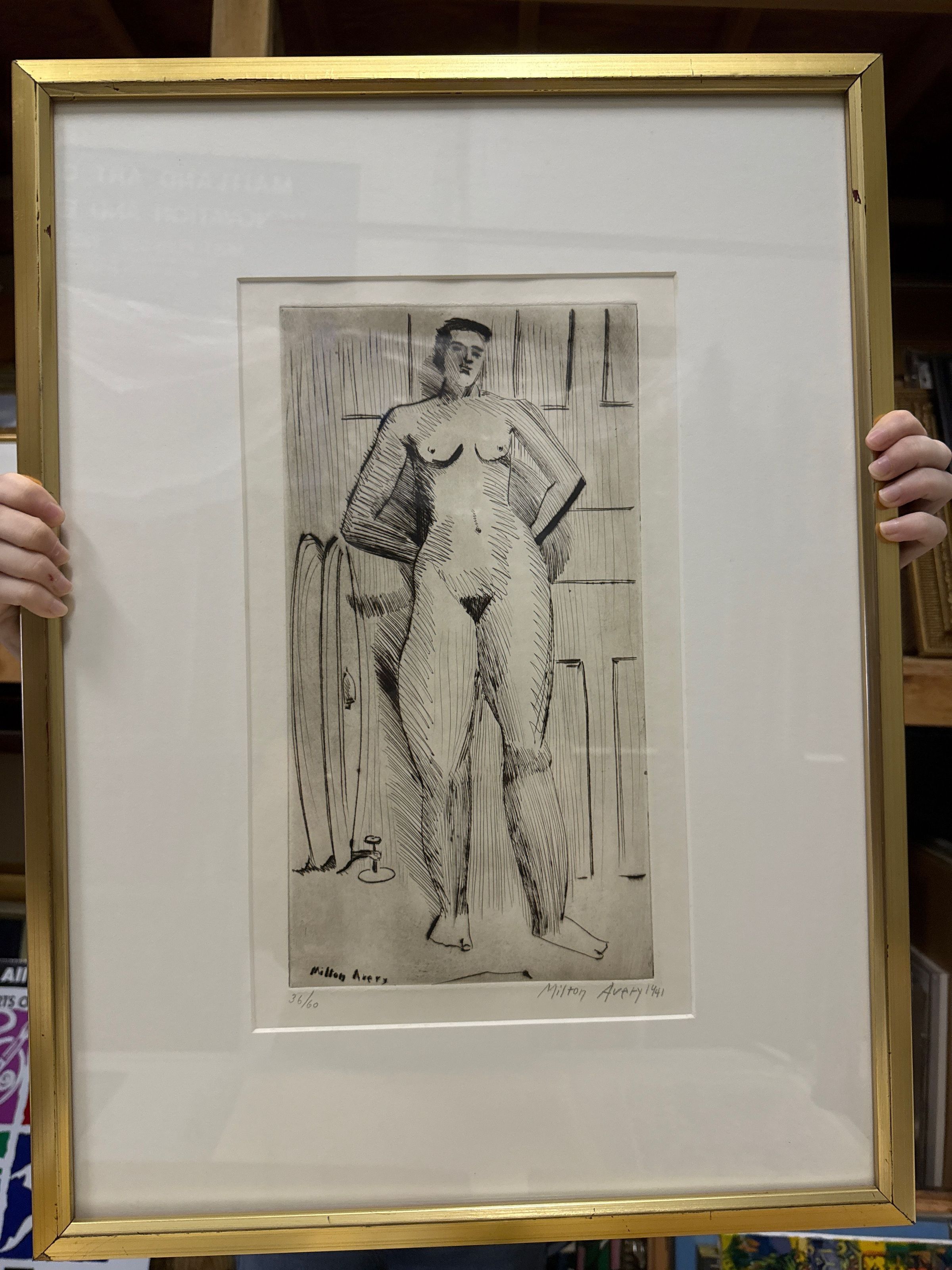
Standing Nude

black-and-white print of a standing nude figure, executed in a minimalist style with bold, expressive lines. The figure appears to be set against a simple background, possibly representing an interior space with vertical lines suggesting panels or drapes. Below the artwork, there are signatures and inscriptions, including a name and a date, adding context to the piece. T

black-and-white print of a standing nude figure, executed in a minimalist style with bold, expressive lines. The figure appears to be set against a simple background, possibly representing an interior space with vertical lines suggesting panels or drapes. Below the artwork, there are signatures and inscriptions, including a name and a date, adding context to the piece. T

Name/Title

Standing Nude

Entry/Object ID

1987.015

Description

Drypoint

Collection

Bok Fellows, MAA Collection

Acquisition

Accession

1987.015

Acquisition Method

Purchase

Credit Line

Purchased for the Permanent Collection in honor of Janet Rackley Kuhs' term as Chairman of the Board of Trustees, 1986-87.

Made/Created

Artist

Milton Avery

Date made

1941

Inscription/Signature/Marks

Type

Signature

Location

LR

Transcription

Milton Avery 1941

Material/Technique

Pencil

Dimensions

Height

25 in

Width

18-1/2 in

Exhibition

US

Interpretative Labels

Label Type

Object Label

Label

Milton Avery (1885–1965) Standing Nude, 1941 Milton Avery was a leading American modernist known for his masterful use of color and simplified forms. After establishing himself in New York and developing a distinctive style based on flattened shapes and harmonious color relationships, a major heart attack in 1949 dramatically altered his life and work. Seeking a warmer climate during his recovery, Avery and his wife, Sally Michel, spent the winters of 1949–50 and 1950–51 at the Research Studio in Maitland, Florida, as Bok Fellows. Too weak to paint outdoors or manage large canvases, Avery turned to monotype printmaking, a technique introduced to him by fellow artist Boris Margo. Margo’s experimental approach encouraged Avery to embrace the medium’s spontaneity and economy of form. During his stay, Avery produced hundreds of monotypes, simplifying compositions into essential shapes and color relationships. These experiments profoundly influenced his later paintings, contributing to the luminous color fields and distilled forms that define his celebrated late career.