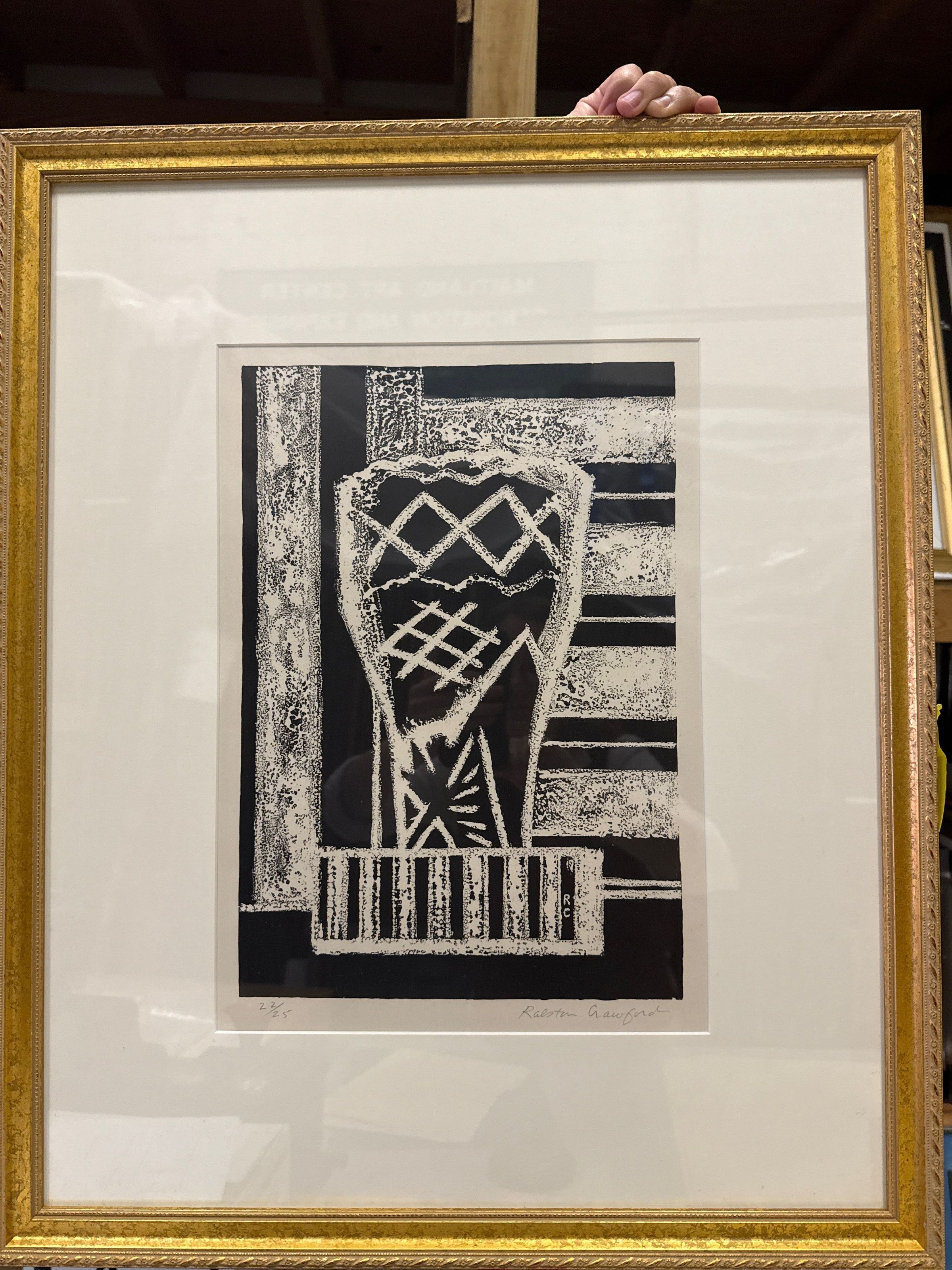
The Glass

The image depicts a framed artwork featuring a monochromatic abstract print with a central vase-like figure characterized by geometric patterns and textured surfaces, set against a contrasting background of horizontal and vertical lines, creating an intricate visual interplay between the light and dark elements. The gold-colored frame enhances the artwork, adding a touch of elegance and drawing attention to the print within. The piece is titled at the bottom of the artwork, and a partial view of a person's hands can be seen gripping the frame from the back, indicating

The image depicts a framed artwork featuring a monochromatic abstract print with a central vase-like figure characterized by geometric patterns and textured surfaces, set against a contrasting background of horizontal and vertical lines, creating an intricate visual interplay between the light and dark elements. The gold-colored frame enhances the artwork, adding a touch of elegance and drawing attention to the print within. The piece is titled at the bottom of the artwork, and a partial view of a person's hands can be seen gripping the frame from the back, indicating

Name/Title

The Glass

Entry/Object ID

2000.020.001

Type of Print

Lithograph

Artwork Details

Medium

Paper

Collection

Bok Fellows, MAA Collection

Cataloged By

Anna La Sala

Acquisition

Accession

2000.020

Source or Donor

Stone & Press Gallery

Acquisition Method

Purchase

Credit Line

Purchased for the Permanent Collection

Made/Created

Artist

Ralston Crawford

Date made

1954

Edition

Edition Size

25

Edition Number

22

Inscription/Signature/Marks

Type

Signature

Location

LR

Transcription

Ralston Crawford

Material/Technique

Pencil

Dimensions

Height

25 in

Width

20-3/4 in

Exhibition

US

Interpretative Labels

Label Type

Object Label

Label

Ralston Crawford (American, 1906-1978) The Glass, 1954 Lithograph on paper Ralston Crawford (1906–1978) was a leading American modernist and a key figure in Precisionism, a movement that celebrated the geometric forms and rhythms of modern life. In The Glass (1954), Crawford transforms an ordinary object into a carefully structured composition, emphasizing line, shape, and spatial relationships over descriptive detail. Fifteen years earlier, Crawford participated in the inaugural 1938–1939 season of the Research Studio in Maitland, Florida, as one of the first Bok Fellows. The Studio fostered experimentation and collaboration among artists, encouraging participants to explore new approaches to composition and technique. For Crawford, whose work increasingly balanced representation and abstraction, the experience reinforced his interest in reducing familiar subjects to their essential formal elements. By the time he created The Glass, Crawford had developed a mature visual language in which commonplace objects became studies in structure, rhythm, and design—qualities that remained central to his work throughout his career.