Name/Title
Plate Three: RumorEntry/Object ID
1993.002.023.5ADescription
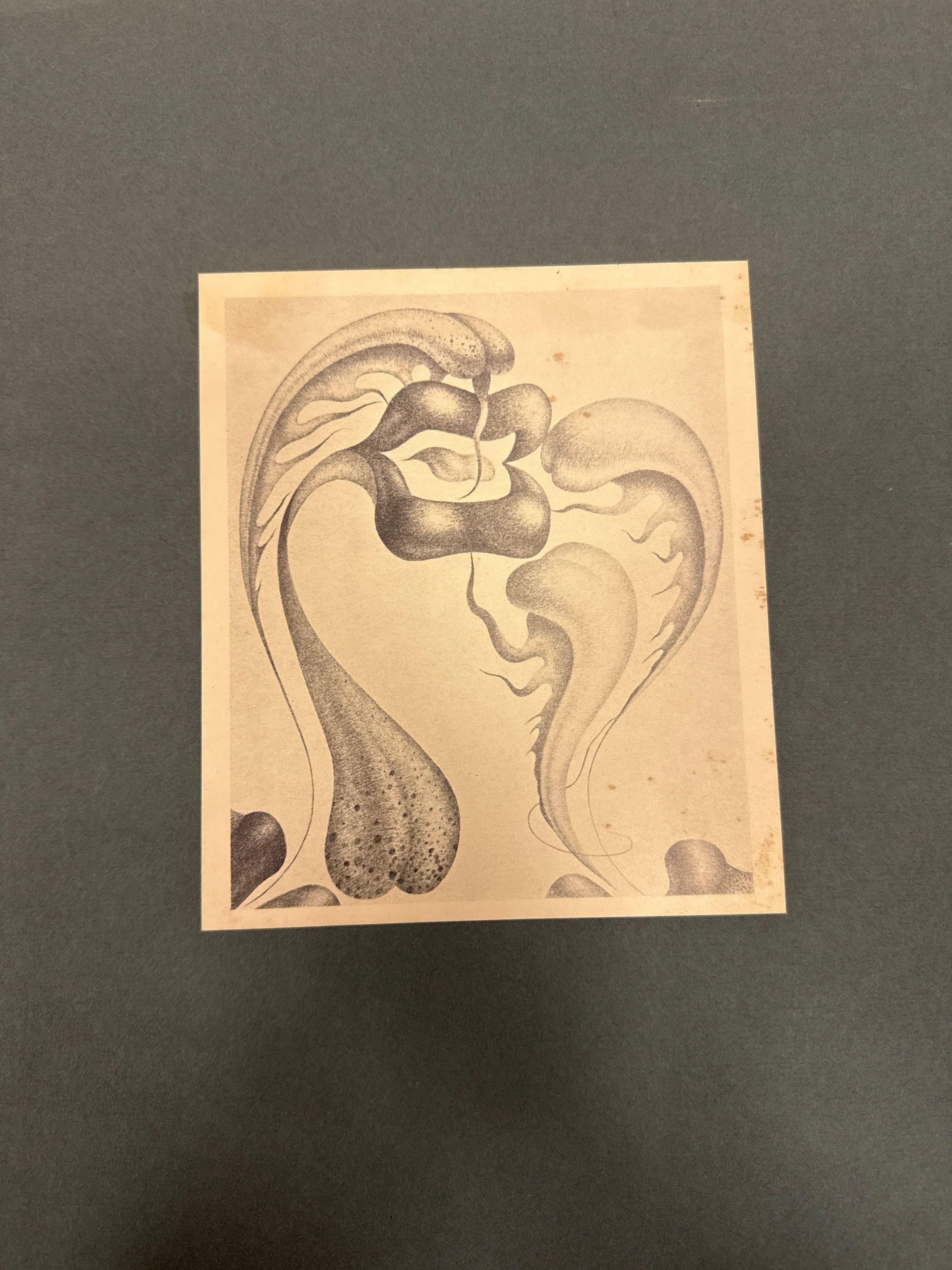
1993.002.023.5A Rumor: Voluntary mental subjugation: the wagging tongue and the willing ear . . ."I wouldn't tell anyone but --". . .the suggestion of secret sources of information. . . the desire to appear important.Artwork Details
Medium
Offset LithographSeries
The Psychoses of War (1943)Context
Studies of social derangement: Seventeen drawings by John Franklin Hawkins with an Introduction and notes by John Howard Birss.
The Psychoses of War present pictorially those doctrines which affirm that the way to the good life is secured through material and physical acquisition, regulation, and domination. Although these doctrines make their early pleas under the guise of righteousness, they lead to a denial of the humanitarian spirit. They are a fatal process, for such delusions contain the beginnings of their own dissolution. Toward an awareness of the mental domain in this war, the seventeen studies following analyse the hidden, subtle motivations and mental pathologies which bring about the deterioration and ultimate self-destruction of such delusive, false idealism. The visualization of the abstract aspects of this insidious world-malignancy provides a document for uncovering the recesses of foul savagery. This pictorializing is in multiple arrangements of basic forms, rhythmic line, and dimensional relation -- with a kind of shorthand anatomy concentrating on the focal points of nerve centers. These manifest the mental retrogression which would drag us back to primordial ways. To realize the substratal, radical derivations of these falsities will help toward an understanding of how to win -- and to secure -- the peace. - John Howard BirssCollection
Bok FellowsCataloged By
Katie BensonAcquisition
Accession
1993.002Source or Donor
Vincent A. RapettiAcquisition Method
GiftCredit Line
Gift of Mr. V Rapetti to the permanent collectionInterpretative Labels
Label Type
Cultural/Historical ContextLabel
One of seventeen drawings by John Franklin Hawkins with an Introduction and notes by John Howard Birss.
Introduction: The Psychoses of War present pictorially those doctrines which affirm that the way to the good life is secured through material and physical acquisition, regulation, and domination. Although these doctrines make their early pleas under the guise of righteousness, they lead to a denial of the humanitarian spirit. They are a fatal process, for such delusions contain the beginnings of their own dissolution. Toward an awareness of the mental domain in this war, the seventeen studies following analyse the hidden, subtle motivations and mental pathologies which bring about the deterioration and ultimate self-destruction of such delusive, false idealism. The visualization of the abstract aspects of this insidious world-malignancy provides a document for uncovering the recesses of foul savagery. This pictorializing is in multiple arrangements of basic forms, rhythmic line, and dimensional relation -- with a kind of shorthand anatomy concentrating on the focal points of nerve centers. These manifest the mental retrogression which would drag us back to primordial ways. To realize the substratal, radical derivations of these falsities will help toward an understanding of how to win -- and to secure -- the peace. - John Howard BirssLabel Type
Artist CommentaryLabel
Voluntary mental subjugation: the wagging tongue and the willing ear . . ."I wouldn't tell anyone but --". . .the suggestion of secret sources of information. . . the desire to appear important.