Name/Title
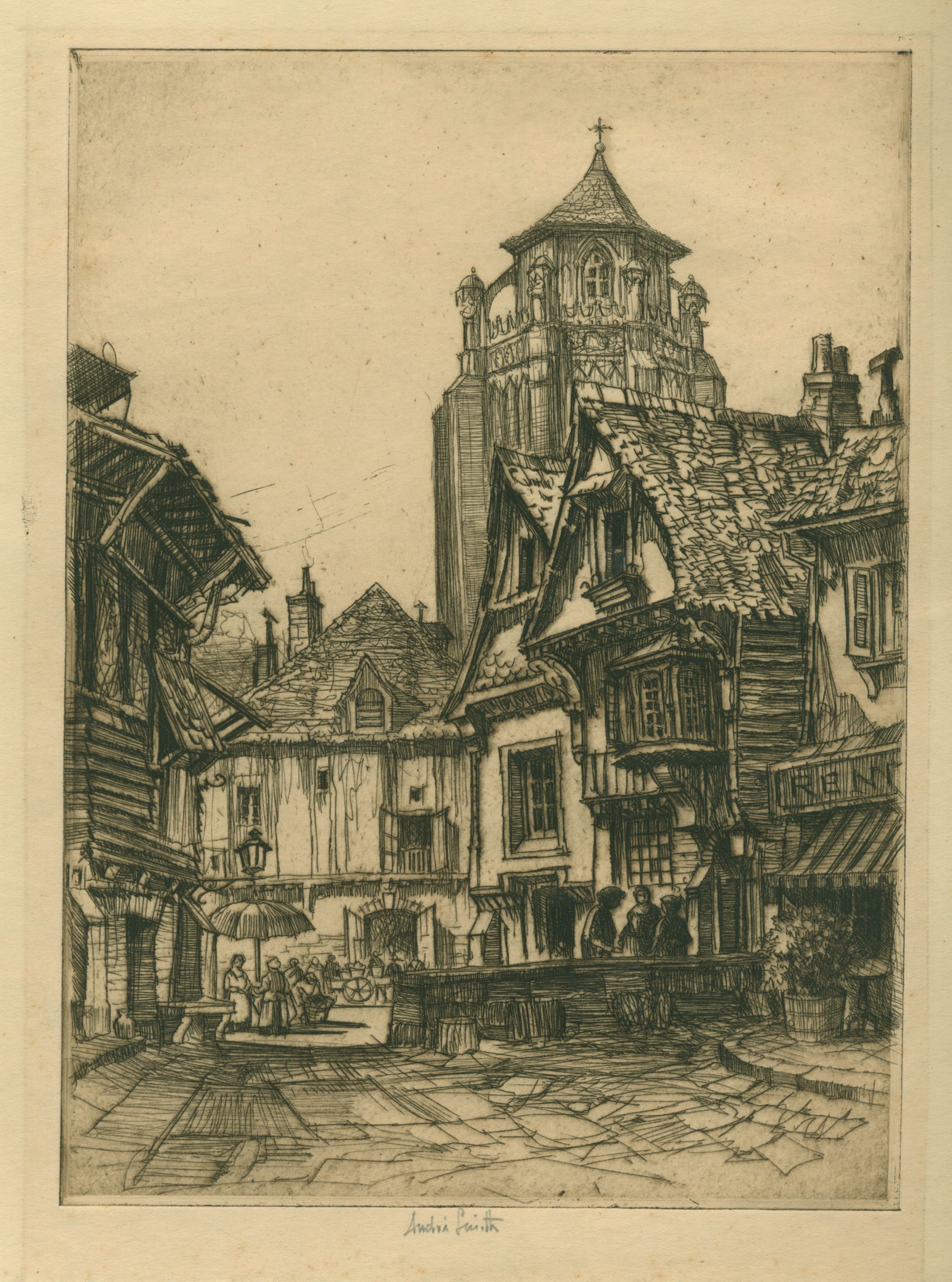
Sketch Four (From Sketches of Espero)Entry/Object ID
2008.13.19Description
"Sketch four" from Smith's article "Sketches of Espero" which was published in the Architectural Record, Vol. 59, No.331 (1926)Type of Print
EtchingContext
In 1924, Smith became bedridden with a serious illness that would profoundly alter the trajectory of his life and work. He underwent a year-long series of surgeries relating to an old injury caused by barbed wire during basic training, culminating with the amputation of his right leg. He would suffer from phantom pain for the rest of his life. His mother, who had moved in with him to care for him during his illness, died during his recovery. It was a period of intense darkness for Smith, but as he emerged from it, he created a series of works of a fantasy European town of Smith's invention called Espero, which were published alongside a short story titled "Sketches of Espero" in the "Architectural Record"(April, 1926).
"If you turn off from the Street of the Stairs, a little more than half way up, as I remember it, you will come to the Place of the Golden Rose. This drawing shows a view down the Street of the Bold Beggar, looking into the Square, and shows the tower of St. Estaine looming rather impressively above the roofs of two very ancient and lovely houses. The one with the richly carved brackets and bay window belonged to Jean Viendrez the famous goldsmith whose chalice, known as the Cup of the Three Virgins, was made for the Cathedral of Saint Teresa and is now in the Louvre where, no doubt, you have seen and admired it."
- Text from "Sketches of Espero" in regards to this print by J. Andre Smith, 1926Collection
Smith Collection (MAA)Cataloged By
Katie Benson