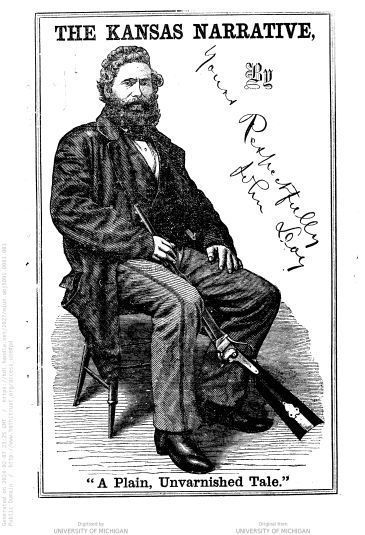
Description
"The Kansas Narrative of John Doy of Lawrence, Kansas - A Plain, Unvarnished Tale" - - (Researcher's note: Due to the numerous references to Platte County, only selected excerpts have been indexed.)
Chapter XVI The Jail at St. Joseph - Further Incidents of The Slave-Trade, p. 92-94 - - Slaves of all shades of color were constantly brought into the lock-up below, as above mentioned, but nothing particularly worthy of record took place from the time of the trial until the 26th of April, when my cell doors were opened and in walked a colored man, such as they call a light copper-colored negro.
He walked straight up to me, holding out his hand and saying: “How do you do, Dr. Doyle?” Seeing that the door of the room was filled by several persons, armed with revolvers, etc., I smelt a rat, and looking him straight in the face, answered: “Stranger, I rather think you have made a mistake.” “Oh no,” said he, “I knew you in Lawrence.”
Seeing that this was an attempt to entrap me, and to connect me in some manner with the escape of a fugitive, I called out to those at the door to come in like men, if they wanted to ask me any questions, and not to send in a poor, crushed, down-trodden slave, in hopes to catch me tripping.
At my call, there entered a tall, bloated, red-haired individual, of the name of Hutchinson, who professed to own the poor creature. He said I had done his boy a great deal of harm by endeavoring to run off a number of slaves, that he had become dissatisfied, and had learned the way into Kansas through my means. He called me a d----- d nigger-thief, as usual, etc., etc. We had some high words, in the course of which I asked him if it was not enough to kidnap, disarm, rob, and imprison me in an enemy’s country, without coming in crowds to insult a sick and helpless man. At last they left, not having attained their object, and put the colored man into the lock-up under our room.
That colored man was Charles Fisher - mentioned in the earlier part of this narrative - and a more dispirited, broken-down being I never saw. I had seen him in Lawrence, where he was a barber, working for himself and family - for he had a wife and child - and earning a good livelihood, industrious, bright, cheerful, and happy.
While I was in the iron box at Platte City, he was kidnapped in the neighborhood of Leavenworth, and taken to Weston. Once in Missouri, his captors thought they could make merry and be glad, so they had a carouse in triumph at their successful foray. While they were all more or less drunk, Charley, chained as he was, managed to get into a boat, and to paddle it over the Missouri to Leavenworth.
There he was arrested under the fugitive-slave law, and his case made some noise. By some means he escaped, and letters were written to all parts of Kansas, offering a reward for him.
He worked around Lawrence, however, until April, when, thinking himself no longer safe in that neighborhood, he started with three others - one of whom was poor Bill Riley, who broke out of Platte City jail while we were there, and whose wife had been sold down South, from the garret in Weston - on his way to Iowa through Nebraska.
In Nebraska they were betrayed by a miserable villain who professed to be willing to aid the oppressed, and were sent over the river in the night to Oregon jail, in Holt County, Missouri. That Judas answers to the name of H. R. Price, St. Stephen’s, Nebraska Territory; and I have seen two letters written by him, asking whom he was to look to for the reward offered for these four.
(Researcher's note: In January 1859 abolitionist John Doy agreed to take a group of 13 African American Kansans north to Iowa on one leg of the Underground Railroad. Dr. Doy and his group were then captured 12 miles north of Lawrence by a group of Missouri slave hunters which included Weston Mayor Benjamin Wood. Doy and his 21 year old son, Charles, were transported back to Weston, Missouri and placed in jail. He was later transferred to the Platte City jail and then to the St. Joseph, Missouri, jail. Along the way they were displayed in the streets and hounded, beaten and nearly hanged. He was charged with a federal offense of "slave stealing” and awaited a sentence of hard labor or death. In jail after a second trial that found him guilty, ten men went from Lawrence to St. Joseph in July 1859 and broke Doy out of jail. He returned to Kansas and later wrote a 137-page narrative describing in detail his experiences in Platte County, Missouri.)Date(s) of Creation
1/1/1860