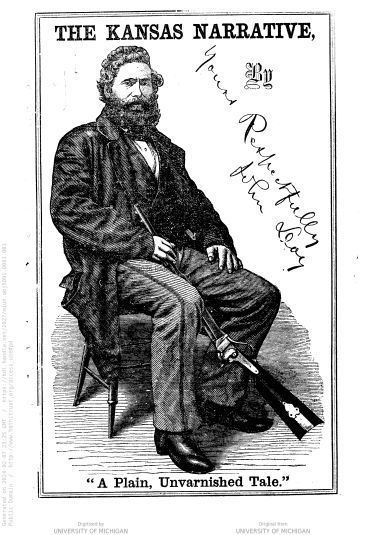
Description
"The Kansas Narrative of John Doy of Lawrence, Kansas - A Plain, Unvarnished Tale" - - (Researcher's note: Due to the numerous references to Platte County, only selected excerpts have been indexed.)
Chapter XVI The Jail at St. Joseph - Further Incidents of The Slave-Trade p. 96-98 - - One day a fine-looking, copper-colored man was brought into the lock-up, terribly mangled. He lay down on the bed and told his fellow-prisoners the following story, which I heard through the stove-pipe hole:
He and three white men were going through St. Joseph on their way to Pike’s Peak, when Mr. Morgan, sheriff of Buchanan County, stopped them, and asked him if he had free papers. He answered, “No; I am only passing from the cars to the Kansas ferry-boat, to go over.” The sheriff then told the white men that they had incurred a fine of $100 dollars each by bringing a free colored man into the State. This frightened them, and they hurried across, but the sheriff kept hold of the colored man and took him to his office.
There, in the presence of four other men, he questioned him as to who he was, who owned him, etc. The colored man replied that his name was James Lisburn; that he was a free man from Ottawa, Laselle County, in the State of Illinois, where he owned eighty acres of land, and gave him the name of the postmaster and several prominent citizens there, by writing to whom he could satisfy himself of the truth of his story.
But he was told that it was all a d--d lie; that he belonged to Frank Rowlett, of Lunenburg County, in Virginia, and had run away from him 8 years before. On persisting that his story was true, he was stripped, his arms held round a post, and he was beaten with a new raw hide, till he admitted everything they wished, rather than be butchered.
This poor man, whose real name was Berkeley, was very bright and intelligent, as well as good-looking, and had received some education. After being brought to the jail, mangled as he was, he cried with uplifted hands, “If this is the land of the free and the home of the brave, I pray that Almighty God will take me out of it!”
On his asking me as to what he had better do, I told him that the best advice I could give him was, if sold, as he probably would be, to jump overboard from the steamboat that took him down the river, even if he was chained to another man, and try to reach the shore - that he had better be drowned than go into life-long slavery.
Generally speaking, a colored person’s word is not considered worth anything, but in this case, with the aid of the whip, it proved to be worth a $1000 and more, for on the strength of this poor man’s alleged confession, he was kept in jail from 28th April to 16th July, then sold at the auction block for $1045 dollars, and sent down the river in chains.
(Researcher's note: In January 1859 abolitionist John Doy agreed to take a group of 13 African American Kansans north to Iowa on one leg of the Underground Railroad. Dr. Doy and his group were then captured 12 miles north of Lawrence by a group of Missouri slave hunters which included Weston Mayor Benjamin Wood. Doy and his 21 year old son, Charles, were transported back to Weston, Missouri and placed in jail. He was later transferred to the Platte City jail and then to the St. Joseph, Missouri, jail. Along the way they were displayed in the streets and hounded, beaten and nearly hanged. He was charged with a federal offense of "slave stealing” and awaited a sentence of hard labor or death. In jail after a second trial that found him guilty, ten men went from Lawrence to St. Joseph in July 1859 and broke Doy out of jail. He returned to Kansas and later wrote a 137-page narrative describing in detail his experiences in Platte County, Missouri.)Date(s) of Creation
1/1/1860