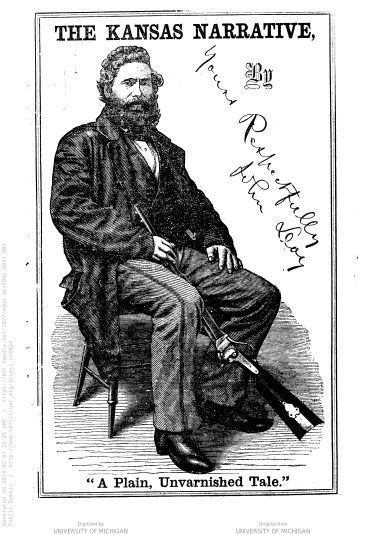
Description
"The Kansas Narrative of John Doy of Lawrence, Kansas - A Plain, Unvarnished Tale" - - (Researcher's note: Due to the numerous references to Platte County, only selected excerpts have been indexed.)
Chapter XVI The Jail at St. Joseph - Further Incidents of The Slave-Trade p. 98-99 - - One morning, as I was walking to and fro in the cell, looking out of the little grated window into the street, I saw a heap of something lying at the end of a long pile of fire-wood.
As the day dawned and it grew lighter, I saw that it was a young colored fellow, about 18 years old.
From the slave that tended our room, we learned that the poor fellow had come to the jail and wanted to be put in and sold to anybody or anywhere, as he could not live any longer with the man that owned him, who beat him unmercifully for the most trifling offense.
He was covered with scars and scabs, literally cut up, as much as a man could be and yet walk, and his neck was all skinned, where he had been hung up for a while.
When the jailer heard his story, be told him that he must go back and do the best he could, for he could not be taken into the jail without his master’s orders or consent. I saw the poor fellow walk away slowly, despondingly, and, as I thought, pondering in his mind whether it was worth while to stay in this world any longer.
I did not see him again, but heard, just before I left St. Joseph, that he had been found in the woods, completely deranged.
(Researcher's note: In January 1859 abolitionist John Doy agreed to take a group of 13 African American Kansans north to Iowa on one leg of the Underground Railroad. Dr. Doy and his group were then captured 12 miles north of Lawrence by a group of Missouri slave hunters which included Weston Mayor Benjamin Wood. Doy and his 21 year old son, Charles, were transported back to Weston, Missouri and placed in jail. He was later transferred to the Platte City jail and then to the St. Joseph, Missouri, jail. Along the way they were displayed in the streets and hounded, beaten and nearly hanged. He was charged with a federal offense of "slave stealing” and awaited a sentence of hard labor or death. In jail after a second trial that found him guilty, ten men went from Lawrence to St. Joseph in July 1859 and broke Doy out of jail. He returned to Kansas and later wrote a 137-page narrative describing in detail his experiences in Platte County, Missouri.)Date(s) of Creation
1/1/1860